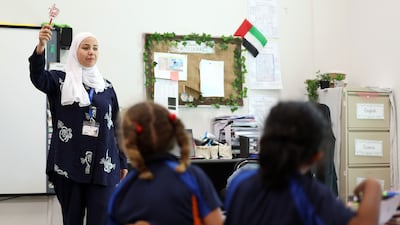
Schools in the UAE are introducing artificial intelligence into lessons while also trying to avoid increasing pupils’ screen time after an AI curriculum was approved this month.
The curriculum will apply to public and private schools with lessons set to cover data, algorithms, applications, risks and the ethical use of technology.
The government also plans to train 22,000 teachers and educators to use AI in teaching, assessment and lesson planning.

But school leaders told The National that introducing AI does not mean putting younger children in front of computers or making them use generative AI tools.
At Nord Anglia International School Abu Dhabi, early-years pupils are being introduced to AI through an “unplugged” programme without screen time.
Michael Connor, founding head of primary at the school, said the lessons instead focus more on play, critical thinking and basic ideas such as the difference between humans and machines.
“Early years of school are introduced very much to the AI literacy framework, but it's strictly as an unplugged framework,” he said.
“So there is no screen time … it looks at building the student's conceptual understanding of AI.”
AI lessons from kindergarten
Jamie Efford, elementary principal and cluster AI lead at Dubai Schools Al Khawaneej, said artificial intelligence literacy could begin as early as kindergarten without children using the tools themselves.
“For younger students, learning is through stories, play, sorting, discussion and simple ideas such as understanding that humans create AI and machines follow instructions,” Mr Efford told The National.
As pupils get older, lessons can move into areas including data, algorithms, bias, privacy and ethics.
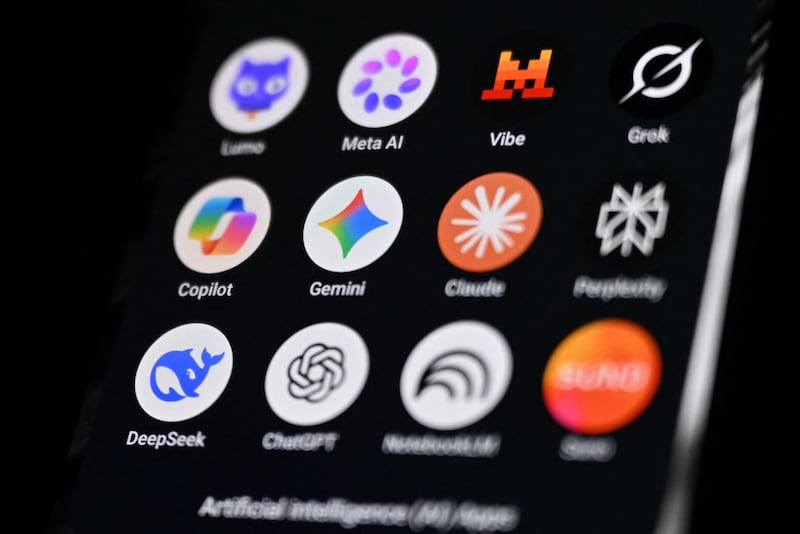
Dubai Schools had already developed its own kindergarten-to-Year-9 AI literacy programme before the cabinet announcement and has since checked it against the Ministry of Education's guidance.
Mr Efford said the aim was not to make AI another digital skill but to teach pupils how to question it.
“The biggest shift is from simply using technology to understanding, questioning and applying it responsibly,” he said.
“Students need to understand how AI works at an age-appropriate level, how data influences outputs, why AI can be wrong or biased, and when human judgment must take priority.”
Keeping younger pupils off AI platforms
Gems Education is also taking a cautious approach with younger children. Chief education officer Lisa Crausby said pupils in the earliest years would learn through stories, pattern recognition, computational thinking and teacher-led examples.
Under the group’s safeguards, pupils under 13 will focus on teacher-led awareness and analysis rather than independently creating generative AI accounts or uploading information.
From around the age of 13, pupils can begin supervised use of approved tools, subject to platform rules, school approval and UAE law.
“Our progression is simple: start with awareness, move to supervised use and progress to independent judgment,” Ms Crausby said. She said the aim was to ensure pupils learnt about AI without becoming dependent on it.
“We will teach students a simple discipline: think first, use AI with purpose and verify everything,” she said.
Teachers will continue to protect time, free from AI, for writing, calculations, discussion, creativity, and problem-solving.
Avoiding ‘cognitive debt’
School leaders said one of the main risks was that pupils could begin relying on AI to do the thinking for them.
Ms Crausby described this as “cognitive debt”, where knowledge and independent judgment could weaken if pupils repeatedly outsourced mental effort to technology.
Gems Education plans to use such tasks as comparing human-generated and AI-generated work, checking sources and asking pupils to explain their thinking.
Mr Efford said schools should not judge AI literacy by how quickly a pupil can generate an answer.
“We should judge it by how effectively they can question, evaluate, improve or reject what AI produces,” he said. “Our message is very simple: think first, use AI with purpose, and check carefully.”
He said pupils at Dubai Schools would only be able to use AI when teachers allowed it and through approved, age-appropriate platforms.
Public or personal ChatGPT accounts are not part of the school’s approved student-use model.
Teachers trained first
Schools are also focusing heavily on teacher training before AI becomes more widely used in lessons.
At Nord Anglia Abu Dhabi, all teachers have completed foundation-level AI training and the school's AI lead is receiving more advanced training.
Pupils in Years 5 to 13 will also take standardised AI growth tests twice a year to measure their progress under the new framework.
Mr Connor said the school was deliberately cautious about how AI was introduced.
“It's no longer whether AI belongs in education. It's how we ensure it enhances the education without losing the skills and the human relationships that are so important to the development of our students,” he said.
“By using AI to limit the administrative load on our teachers, then we're able to put that time back into the face-to-face [teaching],” he said.

Gems Education said its teachers would receive training in areas including bias, privacy, attribution and recognising when AI should not be used.
Mr Efford said judgment was the most important skill teachers needed.
“Teachers need to understand what AI can do, but equally where it is inaccurate, biased, inappropriate or simply unnecessary,” he said.
The Ministry of Education introduced AI as an official subject in public schools from kindergarten to grade 12 for the 2025-2026 academic year.
The latest Cabinet approval expands the national approach to preparing pupils for a future in which AI plays a growing role.
For school leaders, what AI does, rather than how often it is used, is the key measure.
“Success would not be every classroom using AI every day,” Mr Efford said. “It would be students using it purposefully and selectively and teachers confident enough to know when it improves learning and when it does not.”

