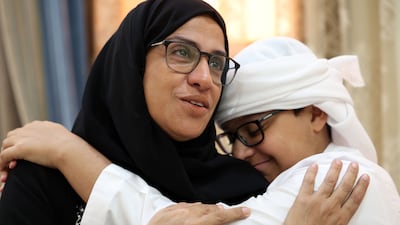
For some Emirati women, achievement is measured not in titles, awards or professional milestones, but in moments that others might barely notice.
It can be a child’s first word, a place for them in a mainstream classroom or, years later, finding a university willing to give them a chance. Sometimes it is a boy sitting at a piano, discovering that something introduced as therapy can become a talent that makes thousands stop and clap.
As the UAE extends Emirati Women’s Day into a month-long celebration, running until September 28 under the theme We Emerge Stronger and Better, The National spoke to mothers of young people with disabilities about achievements that are intensely personal and often hard-won.

They are women who have sat through diagnoses they did not fully understand, learnt the language of unfamiliar therapies and fought for their children to be educated alongside their peers.
They have also experienced their children being stared at, misunderstood and bullied.
And while the UAE has significantly expanded support for people of determination, the mothers say there are still battles to be fought – for greater understanding, genuine inclusion and opportunities that do not disappear when their children reach adulthood.
‘I know my son can give something’
For Fatema Ali Sulleiman, motherhood has meant fighting for two of her children, Mohammed, 18, and Salama, five, both people of determination.
Mohammed has an intellectual disability and struggled with speech as a young child.
His mother enrolled him in nurseries early and he later entered government schools, where an individual educational plan was prepared for him each year.
“I was constantly communicating with the school about the areas in which Mohammed needed to strengthen his skills,” she said. “We worked hand in hand, and his teachers were extremely supportive.”
At home, she was determined that his disability would not define how he was treated.
“As a mother you always try not to make those differences apparent,” she said. “Whether at school or at home, I wanted him to be treated equally.”
The outside world was not always as accommodating. Mohammed experienced significant bullying and struggled, particularly in his early years, to form friendships.
Yet he completed his schooling. Now, his mother’s fight has shifted to higher education.
“I have tried to find a university for him, but they keep rejecting him,” said Ms Sulleiman, who works at the Ministry of Higher Education and Scientific Research.
“All I want is for Mohammed to have that opportunity. I am looking for a place for him because I know my son can give something if he is given the chance.”
‘This is a gift from God’
Five and a half years ago, Mrs Sulleiman faced another challenge when she became pregnant with Salama.
The pregnancy was difficult. Doctors discovered three holes in the baby’s heart and raised the possibility that she could have a genetic disorder. Mrs Sulleiman was asked whether she wanted to terminate the pregnancy.
Her answer was clear.
“I told them: ‘I will continue the pregnancy. This is a gift from God, and I am prepared to continue and take responsibility for her.’”

Salama was born with Trisomy 9, a rare chromosomal disorder, and complex medical needs.
She spent four months in neonatal intensive care and had to be fed through a tube into her stomach because swallowing liquids was dangerous.
During one of the most difficult periods, Mrs Sulleiman and her husband were asked whether they could manage the responsibility for her extensive care needs.
“She is a blessing from God,” she recalled saying. “I will take responsibility for her and I will raise her with her sisters.”
Today, one of the holes in Salama’s heart has closed. She understands what is said to her but has difficulty using her voice, her mother said. She has also received support through Zayed Higher Organisation for People of Determination.
Mrs Sulleiman remembers noticing people staring when her daughter was younger. Eventually, Mrs Sulleiman stopped caring.
“The most important thing is how I see my child,” she said.
Her advice to other mothers is simple: “Trust yourselves. Most importantly, give your children a chance. They are one of the greatest blessings from God.”

‘I needed to know what our path was going to be’
For Mariam Kouraichi, the journey began without warning.
Her pregnancy with her son Zayed was normal, but at around 18 months, his speech development changed. He walked on his tiptoes, lined objects up and struggled to express what he needed.
His mother took him to speech and occupational therapy and started recognising similarities between Zayed and children who had been diagnosed with autism.
“I would tell myself: ‘Yes, he has it. No, he doesn’t. Yes, he has it. No, he doesn’t,’” she said.
Zayed was three when a neurologist confirmed that he was on the autism spectrum.
“Of course, part of me had hoped that he wasn’t. But when they told me, I accepted it. What I needed then was to know what our path was going to be.”
That was around 2016, Ms Kouraichi said, when public understanding of autism was significantly more limited.
So she educated herself, studying the principles of applied behaviour analysis while Zayed continued speech and occupational therapy.
“Even a slight improvement gives a mother hope,” she said. “You think: if we work harder, perhaps we can go further.”
Zayed began speaking and by four he could read. He moved towards mainstream education, although his mother said teachers did not always understand autism and she sometimes had to go to school herself to help him.
Then Covid arrived. And unexpectedly, so did the piano.
Zayed had weak fine motor skills and during the pandemic a teacher suggested buying him a small piano to strengthen his hands.
The school later asked him to play the Emirati national anthem. He enjoyed it, began watching videos and taught himself more. What started as therapy became something much bigger.

“The piano changed him,” his mother said. “It changed his confidence.” She began taking him to pianos in malls, shops and other public places.
“When people applauded, he felt confident. He started talking to people more.”
Zayed went on to enter competitions, win awards and progress through the Trinity music programme. “Of course I was so proud,” she said. “That’s the result of our work.”
As Zayed grows older, the goals continue to change, with his mother now working on his independence, problem-solving skills, and his ability to identify and express emotions.
“It is not done,” she said. “We have to work on it.”
‘I felt jealous for my country’
For Dr Sharifa Yateem, the journey into the world of people of determination did not begin with a diagnosis in her own family. The clinical psychologist does not have a person of determination among her close relatives.
Instead, it began with another mother. While volunteering, she met a woman whose son was on the autism spectrum.
“At that time, few people knew what autism was,” Dr Yateem said.
The encounter changed the direction of her career. She had planned to become an ophthalmologist but instead studied psychology and specialised in behaviour analysis.
“I was touched by the community,” she said. “They are my family, and I wanted to fill a gap that didn’t have Emirati people, or specialists, in this field.”
She spent about nine years studying abroad, including in Ireland, before returning to the UAE. At that time, she said, families were paying to bring in behavioural experts from overseas.
“The testimonials from the families were just heartbreaking, when they had to bring people from abroad at their own expense just so they could get a glimpse of that knowledge,” she said.
“I felt jealous for my country. How come we don’t have this specialisation, even though we have the best schools? We graduate from the best universities. How come we don’t have this?”
Dr Yateem went on to become the first Emirati to qualify as a board-certified behaviour analyst. She later established the Sharifa Yateem Centre for Rehabilitation in Abu Dhabi, and expanded her work to Dubai.

‘Raising a child needs a village’
Today, her centre works with children aged from two to 18, providing one-to-one and group programmes focused on life skills, independence and preparation for mainstream school.
Dr Yateem believes helping parents to understand behaviour can transform their relationship with their child.
“Now she can look at her child rather than being frustrated or hopeless,” she said.
“She can see the behaviour as an independent component from her child. So now she understands why he’s doing these things.”
But after years of working with families, she says one lesson is particularly important: responsibility cannot fall on mothers alone.
“I want to give a message to the Emirati family, not just the mother,” she said.
“I want the mothers and the fathers to first accept, be on the same page, accept that your child might need extra sessions, extra services. His way of thinking might be different than the way you see things.”
She has seen relationships break down when parents disagree about their child’s needs, while in other families one parent carries almost all of the responsibility.
“Raising a child with POD needs a village. It shouldn’t be with the mother only.”
Her greatest concern is when families cannot afford the intervention their child needs.
“What breaks my heart the most is when the parents financially cannot support their child,” she said.
She said early intervention can be crucial to help children with autism or developmental delays build independence later in life.
Her message to mothers on Emirati Women’s Day is not to give up, but also not to measure their child’s future against a conventional sequence of milestones.
“Maybe your child’s pathway is not necessarily the typical way, such as going to nursery, school, going to university, then get a job,” she said.
“Maybe that pathway is not his pathway, and that’s OK. That’s OK.”
Accepting a different path, she said, does not mean abandoning ambition. It can mean creating another route.
“Being peaceful within you will actually help your child and say: we can create other pathways,” she said.
“And if it’s not there, then that’s a barrier that we need to break as Emiratis for ourselves, and the betterment of our country.”