

Privately owned self-driving cars have hit the roads of Dubai using technology that could revolutionise road safety in the UAE.
It is the first time Tesla Cybertrucks fitted with the company’s advanced driver-assistance system – called full self-driving (supervised), or FSDS – have been used in Dubai. The vehicles are offered for daily rentals by Dubai company Connect AI.
Driver intervention
A camera mounted inside the rear-view mirror monitors the driver to ensure their eyes are trained on the road, should the manual override be required as a fail-safe.

The car’s system requires constant driver attention and intervention to ensure safety. While whoever is behind the wheel is liable for any road collisions or accidents, all controls including navigation, changing lanes and parking are taken over by FSDS.
Looking away from the road for longer than a few seconds triggers an alarm inside the vehicle. The system aims to improve road safety by helping to avoid the most common errors, such as speeding, tailgating, poor lane discipline and distracted driving.
-
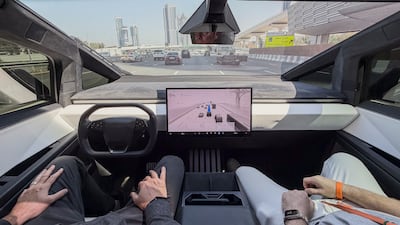
The National has taken a ride in Tesla’s self-driving Cybertruck. All photos: Ahmed Ramzan/The National -
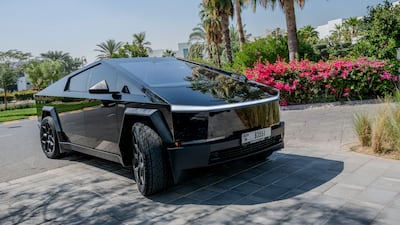
It is the first time Tesla Cybertrucks fitted with the company’s advanced driver-assistance system -
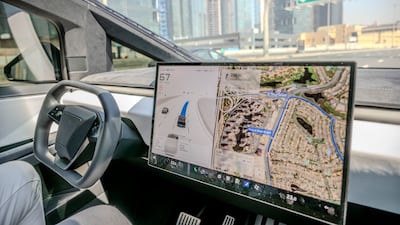
The vehicles are offered for daily rentals by Dubai company Connect AI -
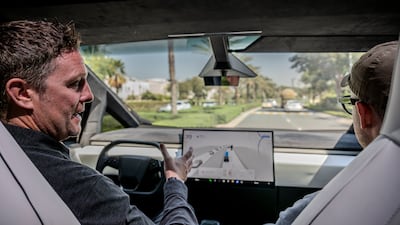
A camera mounted inside the rear-view mirror monitors the driver to ensure their eyes are trained on the road -
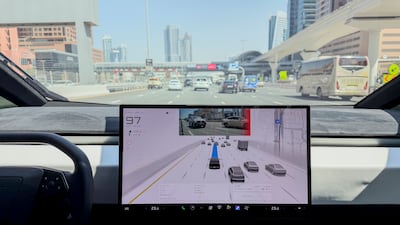
The car’s system requires constant driver attention and intervention to ensure safety -
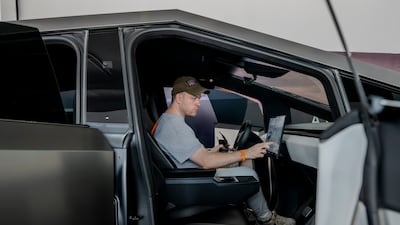
Russian entrepreneur Kirill Sosnovyi, founder of Connect AI


“This is a fully new feeling of driving,” said Kirill Sosnovyi, founder of Connect AI. He has installed the Dh30,000 ($8,168) software in two of his five Cybertrucks, with the system currently being fitted in a third.
“You no longer need to care about navigating the roads, or other traffic, it is a completely different experience on the road," he added. "When you feel it, when you try it, you understand how cool this technology is. It's very hard to describe.”
On a large touchscreen on the dashboard, a blue line stretches out in front of the vehicle to indicate it is in self-driving mode. The Cybertruck has four settings – chill, standard, hurry and Mad Max – within the FSDS. Switching between these can enable assertive driving, faster acceleration and frequent, swift lane changes to minimise travel time.
By touching the brake or accelerator pedal, or moving the steering wheel at any time, the driver resumes control of the vehicle.
Exterior cameras enable 360-degree visibility that, when paired with the FSD software, can reduce the severity of accidents or prevent them altogether, Tesla says. Cameras recognise signs and respond to the behaviour of other motorists and, crucially, pedestrians.
The Tesla software is different to similar driver assist programmes used by other manufacturers. These can be restricted to designated zones or reduced speeds and include the Ford BlueCruise, GM Super Cruise, Kia Highway Driving Assist 2 and Audi's Traffic Jam Assist.

“This is more driver assist technology than fully autonomous, where you can just sit in the back of the car and let the car take you to where you want to go,” Mr Sosnovyi said. “I think maybe within two years, we will be able to sleep in the car and not be involved in the driving process at all, allowing artificial intelligence to take over the controls completely.”
Autopilot
Tesla has been criticised in the US for calling the system “autopilot”, as it still requires human surveillance and intervention. The company, owned by Elon Musk, is suing California’s Department of Motor Vehicles after a ruling that prevented Tesla using the terms "autopilot" and "full self-driving", because of the need for human intervention when operating the FSDS.
Mr Musk is also behind the $2 billion Dubai Loop project, a tunnel network that will utilise similar FSDS software to allow Tesla cars to operate autonomously in the route. Four initial stations will be developed in the pilot stage, linking Burj Khalifa, DIFC 2, Zabeel Dubai Mall Parking and ICD Brookfield Place.

Self-driving cars – vehicles without the need for a safety driver at the wheel – will eventually form a segment of the UAE’s future mobility strategy.
At the Dubai World Governments Summit in February, Sheikh Hamdan bin Mohammed, Crown Prince of Dubai, Deputy Prime Minister and Minister of Defence, launched commercial operations of the Chinese-made Baidu Apollo Go self-driving taxis. Other self-driving zones are planned across the country, with testing areas already established in Masdar City and Dubai Science Park.
My take on the whole experience? It's quite unnerving, but it feels very safe.

