


Efforts are under way to expand the capacity of Etihad Rail’s freight network as business grows, a senior official has said.
Omar Al Sebeyi, acting chief executive of Etihad Rail's freight section, said the network is operating at full capacity when it comes to transporting aggregates, the crushed stones that are crucial for construction projects in the UAE.
The aggregates are transported from quarries in the Northern Emirates on wagons on the freight line to stations in Dubai and Abu Dhabi.

Mr Al Sebeyi said aggregates are the freight network's main load by volume and business is growing.
“We are at 100 per cent capacity on the aggregate line,” Mr Al Sebeyi told The National on Wednesday, adding that it can carry up to 60,000 tonnes of aggregates a day. “We are working on expansion.”
He was speaking on the second day of the Global Rail conference in Abu Dhabi, which organisers said was expected to draw about 20,000 attendees.
His remarks illustrate how the UAE’s freight network has been increasing in importance despite the planned passenger line grabbing much of the attention.

What does the network carry?
The freight network stretches from the border with Saudi Arabia to Fujairah. Aside from aggregates, freight trains carry loads such as petrochemicals, polymers and general cargo in shipping containers.
It has other benefits. It was previously announced that every train could take up to 300 lorries off the UAE’s roads, and the network aims to reduce CO2 emissions in the country's road transport sector by 21 per cent annually by 2050.
“There is a bigger picture,” Mr Al Sebeyi said. “There are fewer trucks on the road, reduced accidents and reduced number of C02 emissions.”
His comments came as Etihad Rail launched a “bonded rail corridor” to link Khalifa Port in Abu Dhabi with terminals in Fujairah.
The move aims to bolster the UAE’s logistics and trade infrastructure to allow “seamless movement of goods between Khalifa Port, Fujairah Terminals and their adjacent free zones”, state news agency Wam reported on Wednesday.
The corridor is expected to cut customs clearance times and allow efficient entry and exit through co-ordinated pre-inquiry procedures, with final customs formalities completed at the destination.
Goods transported via Etihad Rail trains will also “enjoy a competitive advantage with priority clearance within customs systems”, Wam added.
The corridor will be implemented across free zones, transit shipments, exports and the domestic movement of goods between Abu Dhabi and Fujairah.
Pilot operations are expected to begin in the final months of 2025.
-

Day one of the Global Rail conference at Adnec. All Photos: Victor Besa / The National -

An Omani visitor at the Etihad Rail display -

Azza Al Suwaidi, deputy chief executive of Etihad Rail Mobility -

An Etihad Rail Mobility station master -

A model of a train is displayed at Adnec -
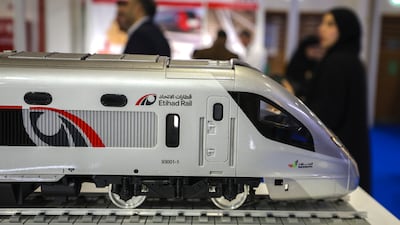
Part of the Etihad Rail display -

The IMI kiosk at Adnec -

Etihad Rail Mobility station masters take visitors on a tour -
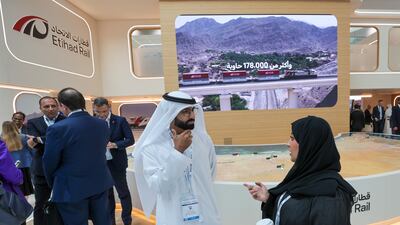
The Etihad Rail display at Adnec -

Organisers hope the event in Abu Dhabi will attract government ministers, delegations and up to 200 exhibitors


How far have we come?
Mr Al Sebeyi also underlined recent progress across the freight network.
Since 2016, Etihad Rail has been operating a route in the Al Dhafra region that transports granulated sulphur from Shah and Habshan in the Al Dhafra region to Ruwais. Sulphur is used by fertiliser plants around the world. He said this line has moved a total of 64 million tonnes.
“That is a huge number,” he said. Lorries had been used previously but the volumes were small. “Today they're able to move around millions of tonnes every year.”
The UAE-wide freight network was declared fully operational in 2023. Trains also carry polymers from Borouge to a rail freight terminal in Al Ruwais Industrial City, on to Khalifa Port in Abu Dhabi. The rail route takes only four hours each way compared to 12 hours via other modes of transport.
The rail service is more resilient to weather, such as fog, than road transport.
“This brings resilience for our customers [because] they will be able to move despite the weather,” Mr Al Sebeyi said.
Freight trains carrying cargo in shipping containers are a familiar sight for anyone passing under the marine rail bridge in Abu Dhabi that connects the main line to Khalifa Port.
He said the busiest stations are Shah and Habshan in Al Dhafra and in Ras Al Khaimah.
Etihad Rail aims to transport 60 million tonnes of cargo annually by 2030.
“Our goal is to bring the ports closer to the customer,” he said. “Rail is an enabler of trade and economy.”
During a panel discussion at Global Rail on Wednesday, several participants raised the importance of completing the planned GCC Railway to boost rail across the region.
Construction on the line to connect the UAE and Oman – a project known as Hafeet Rail – has begun.
“The plan is there,” Mr Al Sebeyi said. “Eventually we will reach the point where the whole of the GCC is connected.”

