
Dubai’s population on Thursday passed the four million mark, according to the Dubai Statistics Centre.
The DSC maintains a population clock estimating the number of citizens and residents in the emirate, which is regularly updated. The emirate's population stood at 4,000,387 as of August 28.
The city's rising population is one of the most dramatic ways of expressing the Dubai success story. Fifty years ago, it was 175,000, so the new total represents an increase of 2,185 per cent since 1975.

Dubai's population reached two million on December 24, 2011, meaning it has doubled in less than 15 years.
The emirate was then emerging from the global financial crisis of 2008 to 2010, which hit Dubai’s property sector particularly hard.
But by 2011, there was a sense of renewed optimism. The emirate was rebuilding momentum – the Dubai Metro had begun operating in late 2009, with Burj Khalifa, the world’s tallest building by far, completed the previous year.
Millionaire hotspot
Dubai's population has experienced its most noticeable growth since the pandemic, with the emirate increasingly being considered a haven for global millionaires.
Strong demand has come from the UK, India, Russia, South-East Asia and Africa.
The emirate is seeing a particular surge in people from the UK, which is set to lose 16,500 millionaires this year. This is the largest net outflow of high-net-worth individuals by any country in the past 10 years.
According to some estimates, 30,000 British people moved to Dubai in 2021, rising to 35,000 in 2022 and 40,000 in 2023. About 240,000 Britons now call the emirate home.
This is on top of a large number of Russians and Ukrainians who also set down roots in Dubai after the outbreak of Russia's invasion of Ukraine in 2022.
The number of millionaires living in Dubai has doubled in the past decade, making it one of the world’s fastest-growing wealth hubs, a report by New World Wealth for Henley & Partners found in April.
In 2024, Dubai had an estimated 81,200 millionaires, 237 centimillionaires – whose wealth is in the hundreds of millions – and 20 billionaires, according to the report. That compares to 72,500 millionaires, 212 centimillionaires and 15 billionaires in 2023.
How is population growth changing Dubai?
One of the key changes is that people are staying in the emirate longer than before. Hitesh Vachhani, team lead of commercial at Santa Fe Relocation in Dubai, told The National there was a time when people moved with their families, stayed for a set period and then went home. But this is now less common, making life in Dubai less transient, he added.
“People don't want to leave,” he said. “Because going back is the last resort.”
Road safety experts also point out that the surging population has had an effect on traffic. “More people means more vehicles, which means more traffic, which means more congestion,” said Thomas Edelmann, founder and managing director of RoadSafetyUAE.
Changing with the times
That said, the Dubai of 2011 looks positively sleepy when compared with today. One measure is the number of public transport trips, which had reached 289 million by 2010 but last year exceeded 747 million. The Metro is also expanding, with construction of the new Blue Line beginning in 2023 and expected to be completed within four years.
One of the biggest changes of the past 15 years is the Dubai Canal, opened in 2018 and completing a loop which begins in Dubai Creek and emerges more than 3km away at Jumeirah’s Safa Park.
An astonishing feat of civil engineering, the canal was built under the 16 lanes of the E11 motorway through the middle of the city without disrupting traffic flow.
Other landmarks include the Museum of the Future, opened in 2022, and the Dubai Frame, completed in 2018. The opportunities for shopping, surely Dubai’s favourite leisure activity, have also vastly expanded in the past 15 years.
Dubai Mall, which opened in the teeth of the recession, now attracts more than 84 million visitors a year – more than New York – with plans to expand ever further, Mall of the Emirates has also been extended, while new outlets include Nakheel Mall, opened on Palm Jumeirah in 2020, and City Walk, a high-fashion outlet completed in 2016.
Looking up
To understand just how much Dubai has grown since 2011, you need to look to the skies. Dubai International Airport became the world’s busiest for international traffic in 2016. But also, by looking at the city from the bird's eye view provided by Google Earth, you can visualise just how much the city has mushroomed, pushing ever deeper into what was once desert, with new suburbs and housing developments, particularly to the north and east, where many of the two million new inhabitants have made their homes.
What of the future, though? One indication is the Dubai 2040 Urban Master Plan, created in 2020 with the goal of making Dubai “the world's best city to work and live”. The year 2040 is when the population is projected to hit almost six million – on a par with the likes of Dallas, Singapore and Madrid.
As outlined by Sheikh Mohammed bin Rashid, Vice President and Ruler of Dubai, the emphasis on the future Dubai will be on sustainability and ensuring people will find virtually everything they need for daily life within a short distance – a 20-minute city.
In that sense, even as Dubai grows ever larger, it will also become smaller.
Burj Khalifa through the years
-
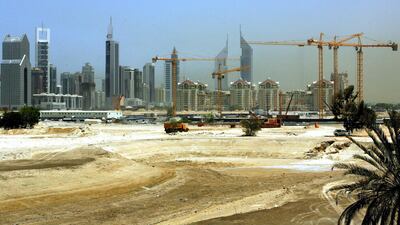
The Burj Khalifa construction site on April 29, 2005, in Dubai. Rabih Moghrabi / AFP -
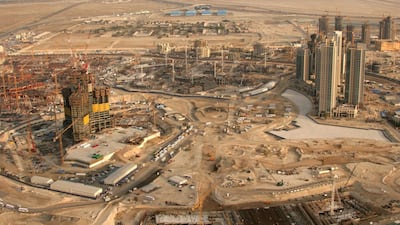
Construction under way on Downtown Dubai and Business Bay on January, 29, 2006. Nasser Younes / AFP -
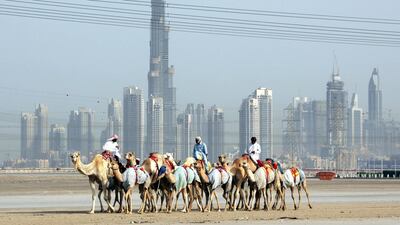
A camel handler exercises his animals along Nad Al Sheba track, in front of the Burj Khalifa Downtown Dubai construction site on April 2, 2007. Karim Sahib / AFP -

Construction is under way on Burj Khalifa in 2007. Pawan Singh / The National -

Construction under way on the very top of Burj Khalifa on December 17, 2008. Paulo Vecina / The National -
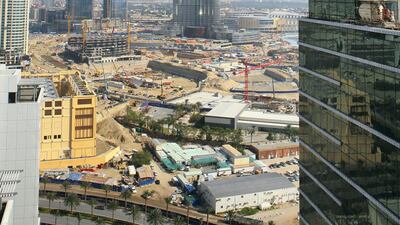
Burj Khalifa and the surrounding Downtown Dubai area still under construction during a media tour of the area on January 26, 2009. Jeffrey E Biteng / The National -
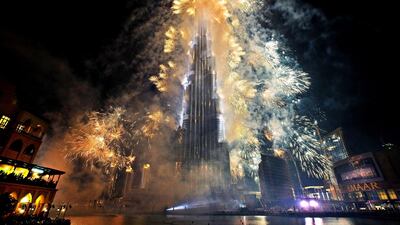
Fireworks are set off during the inauguration of Burj Khalifa on January 4, 2010. Jeff Topping / The National -
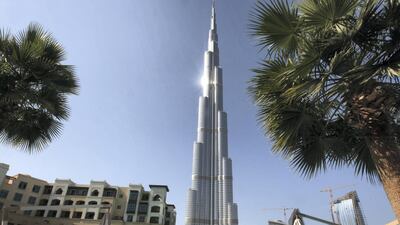
Burj Khalifa pictured on January 26, 2010, days after it opened to the public. Randi Sokoloff / The National -
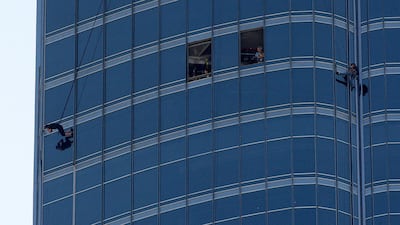
Tom Cruise is filmed running along the outside of Burj Khalifa for Mission Impossible: Ghost Protocol on November 5, 2010. Pawan Singh / The National -
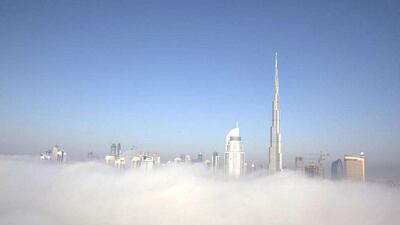
The Downtown Dubai skyline protrudes from early morning fog on September 6, 2011. Pawel Dwulit / The National -
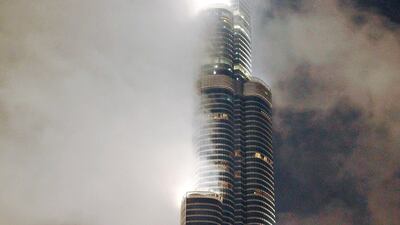
Burj Khalifa surrounded by fog on February 11, 2012. Jeff Topping / The National -
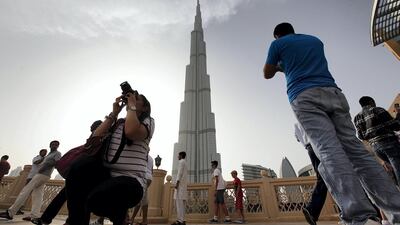
Visitors take photos of Burj Khalifa during the Eid holidays in Dubai on August 10, 2013. Satish Kumar / The National -

Burj Khalifa pictured from the metro on September 3, 2014. Pawan Singh / The National -
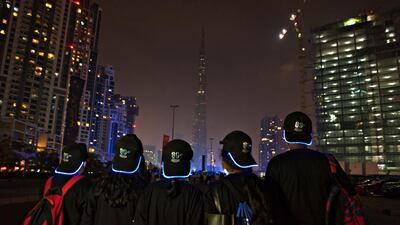
Children look at Burj Khalifa, while the lights are switched off during Earth Hour on March 28, 2015. Jeff Topping / The National -
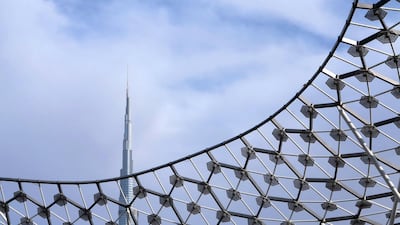
Burj Khalifa pictured from City Walk on April 2, 2016. Jeffrey E Biteng / The National -
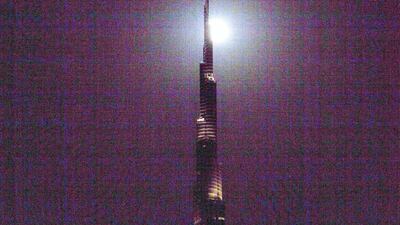
A full moon rises above the Burj Khalifa on August 7, 2017. Christopher Pike / The National -
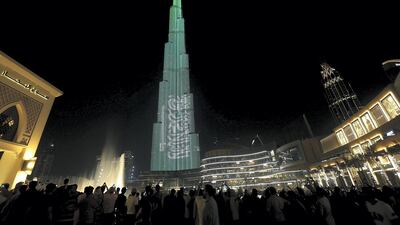
Burj Khalifa lights up in the colours of Saudi Flag to celebrate the kingdom's 88th National Day on September 21, 2018. Satish Kumar for The National -
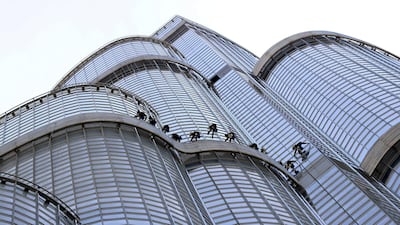
Between the 111th and 73rd floor, 11 window cleaners wash Burj Khalifa's facade on September 17, 2019. Chris Whiteoak / The National -

Fireworks go off on December 31, 2020, to celebrate the New Year. Antonie Robertson / The National -
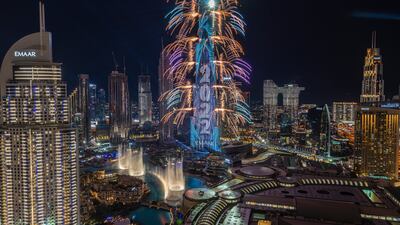
Dubai rings in 2022 with fireworks at Burj Khalifa. Photo: Dubai Media Office -
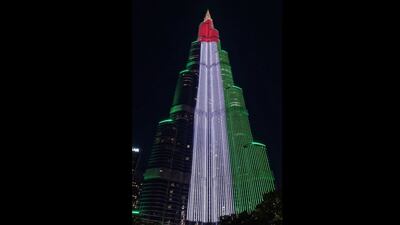
Burj Khalifa Eid Al Etihad Union Day National Day 2024. Photo: Emaar -

Fireworks light up the sky at midnight on January 1, 2024. Photo: AFP



