

Live updates: Follow the latest on Israel-Gaza
Palestinians in the UAE have widely rejected US President Donald Trump's recent proposal to “take over” the Gaza Strip, saying that it disregards the sacrifices they have made and the hardships they have endured to remain in their homeland despite conflict, death, destruction and displacement.
Mr Trump’s comments, made during a White House news conference, suggested the US could assume control of Gaza as he said he wanted to transform it into the “Riviera of the Middle East”. He also raised the possibility of relocating Gazans to neighbouring countries such as Egypt and Jordan.
The proposal has faced widespread opposition across the Middle East but shows no sign of losing momentum, with Israel’s defence minister on Thursday telling the army to prepare for the “voluntary departure” of Palestinians.
But for Rabab Abu Taha, 47, a UAE resident of 45 years and a postgraduate researcher in journalism, Mr Trump’s statements are not only impractical but also unfair. “How can someone from a country thousands of miles away decide the fate of another nation?” Ms Abu Taha said. “People have the right to determine their own future.”
Ms Abu Taha also pointed to what she sees as a contradiction in Mr Trump’s approach. “He advocates for reducing immigration to the US so America remains for its people, yet he suggests that the indigenous people of another country be removed from their homeland, the place they belong to. Even Arab governments that have taken strong positions on the Palestinian cause have rejected this.”
Determination is key
With most of her family still in Gaza, including her siblings, uncles, and aunts, Ms Abu Taha emphasised that Gazans have already demonstrated their determination to stay and she believes the international community will stand with the Palestinian cause. “People have returned to their homes despite the destruction. Neither war nor death has driven them away, and nothing will force them out,” she said. “I believe in the strength of humanity, and I trust that the world will stand against injustice.”
Fathi Abu Seedo, 62, a Palestinian who has lived in the UAE for more than four decades, said Mr Trump’s proposal brings back fears he felt after the outbreak of the Israel-Gaza war in October 2023. These fears had momentarily subsided when a ceasefire was announced in January, but they have resurfaced after the American firebrand's intervention.
“For the first time in months, I felt like I had my life back because my family in Gaza was safe, even if just temporarily,” Mr Abu Seedo said. “Now this statement brings back a sense of fear and uncertainty. Has anyone even asked the Palestinian people in Gaza what they want? Like all people they have the right to decide their own destiny, rebuild their lives, and live with dignity in their homeland.
“They have endured immense challenges but they must hold on to the belief that their destiny is in God’s hands,” Mr Abu Seedo said. “The world must recognise that peace is not achieved through control, but through justice and the right of people to govern themselves.”
Bravery earns international respect
The resilience of the Gazan people, despite unimaginable suffering, is something that continues to astonish many. “Imagine the extent of the destruction and the lives lost, and still they are happy to go back to ruined homes and stay in a destroyed city,” said Palestinian Sahar, 39, who works in the medical field in the UAE and has lived in the country since 2002.
She emphasised that the deep-rooted connection to the land is what keeps people steadfast despite adversity. “We have to think what the mindset of the people of Gaza is. They are resilient and have strong roots with the land. They will never leave. They will live in tents on the ruins of their homes.”
Born in Lebanon after her family were displaced from Palestine, Sahar was astonished about Mr Trump’s comments. “I’m really surprised at this confidence he has that he can control the Middle East,” she said. “I ask who are you and Elon Musk to think you have control over the whole world. Please leave people in this region alone.
“Our land and our home country is part of us,” she added. “Wherever in the world you live it makes up your mindset, your opinions, it is your life.”
The war in Gaza has resulted in the loss of more than 47,000 Palestinian lives and wounded more than 111,000, with much of the enclave in ruins.
Palestinians return to northern Gaza – in pictures
-
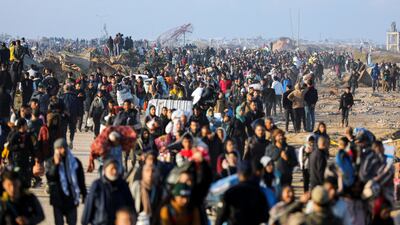
Displaced Palestinians make their way back to their homes in northern Gaza after Israel allowed them to return. Reuters -
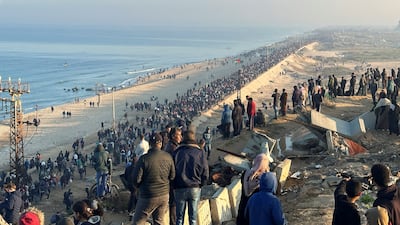
Their return had been held up by a dispute over the release of Israeli hostages held in the enclave. Reuters -
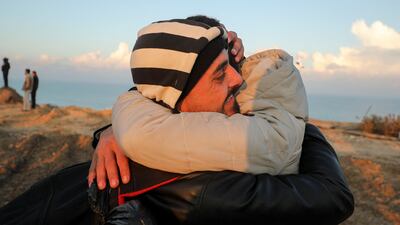
Palestinians are reunited as displaced people return to northern Gaza. Reuters -
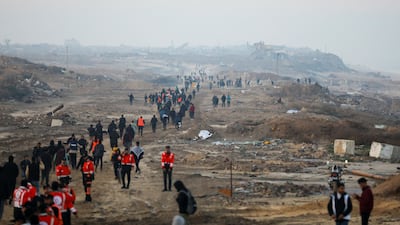
Palestinians in northern Gaza wait to welcome returnees from the south. Reuters -
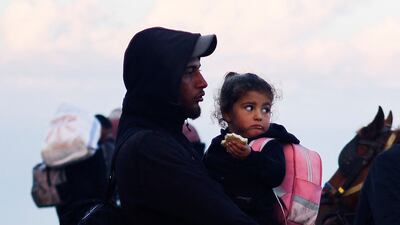
A man and child make their way home, in northern Gaza. Reuters -

Palestinians on Salah Al Din Road wait to be allowed to return to their homes in northern Gaza. Reuters



