

Countries in all corners of the globe have wiped out diseases ranging from malaria to leprosy in the past year, representing significant victories in the quest to build a healthier future for all.
Their achievements are cause for cautious optimism as World Neglected Tropical Diseases Day is observed on Thursday, part of an international campaign to eradicate historically neglected diseases.
The annual occasion seeks to raise awareness of the battle against a diverse group of communicable diseases that affects more than 1.7 billion people − including one billion children − worldwide. The World Health Organisation has set a target to eliminate at least one NTD in 100 countries by 2030.
This week saw Guinea, in West Africa, announce it had eliminated the NTD human African trypanosomiasis, also known as sleeping sickness, a disease caused by a parasitic worm that causes terrible swelling of the body
The news was “a testament to the global progress against neglected tropical diseases and a beacon of hope for nations still battling human African trypanosomiasis”, said WHO Director General Dr Tedros Adhanom Ghebreyesus.
But experts say there is still much work to be done if more nations − especially those with limited resources − are to eliminate diseases blighting their communities.
Bridging the health care divide
Prof Ian Jones, a professor of virology at the University of Reading in the UK, said that it was “pretty well accepted” that research into diseases that primarily affect tropical regions was lacking.
He said that in less developed countries there was typically less money available to treat diseases, which in turn meant that pharmaceutical companies were less focused on creating drugs for conditions common in these parts of the world.
A similar issue applies to developing vaccines, particularly if they are for conditions that affect relatively modest numbers of people.
If there are large numbers of people affected, Prof Jones said that charities or philanthropic organisations often become involved in supporting research efforts. For other conditions, though, efforts could be lacking.
“There are a lot of tropical diseases where the numbers are not huge. There it's a persistent problem,” he said.
As an example he cited melioidosis, a bacterial disease often picked up from contaminated soil or surface water, typically in South-east Asia.
“It's often in paddy fields when people are in bare feet,” he said. “It's a real problem, but numbers are low, so [efforts to develop] a vaccine for that particular bacterial infection have been very slow.”

Prof Jones said that the development of vaccines against malaria, a condition that kills more than half a million people a year, showed that progress could be made against conditions that are particularly prevalent in the tropics.
The WHO recommended the first malaria vaccine, RTS,S, in 2021, and last year the use of a second malaria vaccine, R21, began.
In December, the health body reported that 17 African countries, which account for 70 per cent of global malaria cases, now offer malaria vaccines as part of childhood immunisation programmes.
Milestone successes
There was more success this month, with Georgia, in Eastern Europe and West Asia, certified as malaria-free, after the disease caused by infected mosquitoes, remerged in 2002. There are now 45 malaria-free countries in the world, including the UAE.
The roll-call of global health success in 2024 includes Jordan, which in September became the first country to receive WHO verification for having eliminated leprosy.
Also in the Arab world, Egypt was certified malaria-free in October, as was Cape Verde, off the coast of West Africa. In Central Africa, Chad eliminated a form of trypanosomiasis, while India, Pakistan and Vietnam were declared free of trachoma, which causes blindness.
Both Brazil and Timor Leste, near Indonesia, were declared free from lymphatic filariasis − a parasite better known as causing the disfiguring condition elephantiasis, and one of the WHO’s 21 neglected tropical diseases.
The WHO has identified 54 countries which have eliminated at least one NTD and calculates that around 690 million people in the developing world have been spared medical intervention since 2010.
Battles won, but war goes on
At the same, the scale of the problem remains huge. Polio stubbornly remains, despite global infections down by 99 per cent since 1988. In Pakistan, among the last countries where the disease can still be found, the number of cases rose from six in 2023 to 39 last year.
In Afghanistan, the only other country where polio remains endemic, there were 18 cases in 2024 compared with six in the previous year. This increase was partly caused by the Taliban government’s refusal to allow women to administer vaccines, according to the WHO.
-
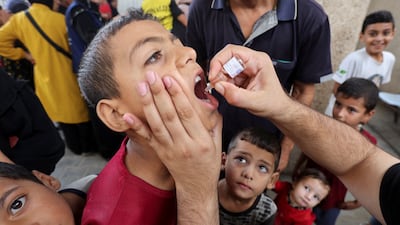
The UN-led polio vaccination campaign kicked off in central Gaza and is due to head south. Here, a child is inoculated in Deir Al Balah. Reuters -
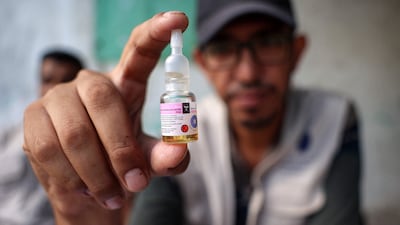
A vial of the vaccine being administered after the Palestinian territory recorded its first case of polio in a quarter of a century. AFP -
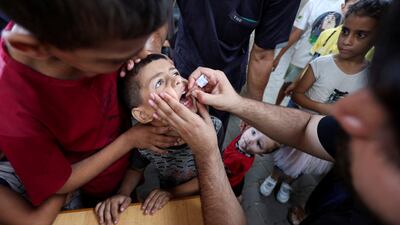
Three UN agencies and Gaza's Ministry of Health are working together to inoculate 640,000 children under 10. Reuters -
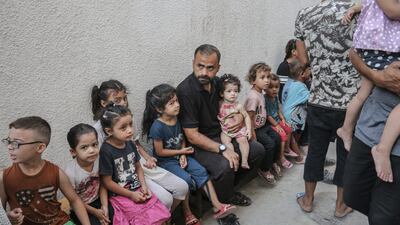
Palestinians wait for their children to receive a polio vaccination during a break in fighting in the Nuseirat refugee camp, central Gaza. Bloomberg -

At least 160,000 children were vaccinated in central Gaza during the first three days of the campaign, surpassing the goal of 156,000. Reuters -
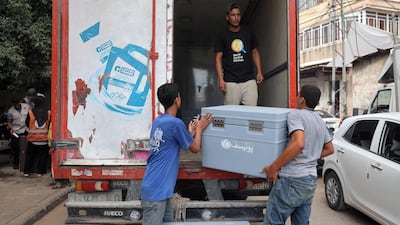
Crates of polio vaccines provided by Unicef are unloaded in Deir Al Balah. AFP -
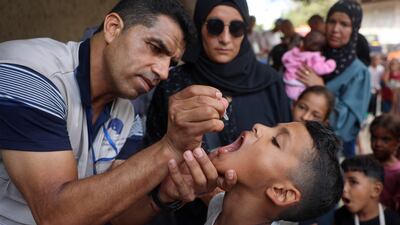
The World Health Organisation said Israel and Hamas had agreed to at least three days of 'humanitarian pauses' in parts of Gaza, starting on August 31, to facilitate the vaccination drive. AFP -
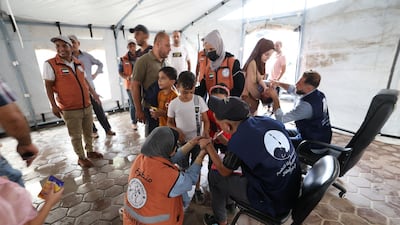
Medical staff during the vaccination drive for children in Gaza. Photo: Operation Gallant Knight 3 -
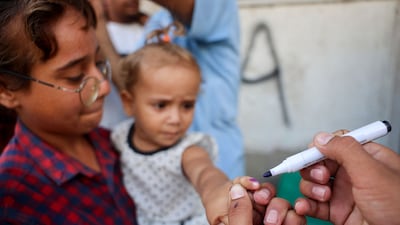
A health worker marks the finger of a Palestinian child, indicating that they have been vaccinated, in Zawaida, central Gaza. AFP -
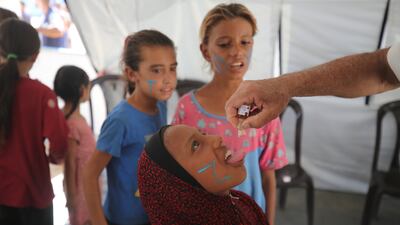
At this health centre in Zawaida, 1,500 children under 10 have been vaccinated. PA


Conflict also threatens to see a resurgence of the disease, which can cause paralysis in children and babies. Last August saw a 10-month old baby infected in Gaza, the result of immunisation campaigns being disrupted by the war, according to the UN.
The UAE is at forefront of disease elimination with the creation of Reaching the Last Mile Fund, a 10-year $500 million project backed by President Sheikh Mohamed and launched in 2017 with the support of the Bill and Melinda Gates Foundation.
Reaching Last Mile focuses on NTDs and polio and malaria, with the Recognising Excellence Around Champions of Health Awards recognising front line health workers.
More funds needed but progress made
Prof Paul Hunter, a professor in medicine at the University of East Anglia in the UK, said that research into diseases primarily affecting poorer parts of the world “has been underfunded”, but that there have been signs of progress.
“For some diseases there've been significant developments in recent years in part as a result of the WHO driving interest in neglected tropical diseases,” he said.

“Although there might be quite a lot of research going on, although not as much as there is in the rich countries, the underlying drivers, socioeconomic drivers of these infections − poverty, environmental degradation − I don't think we've seen much in the way of improvements in that.”
One condition that he said the world had hoped to have eliminated by now was dracunculiasis − or Guinea worm disease − a crippling parasitic infection. WHO figures indicate there were 13 cases in 2022 and 14 in 2023.
“It's still hanging in there, in part because of conflict in affected areas interfering with public health campaigns,” said Prof Hunter.
While Guinea worm disease persists, the number of cases has fallen significantly, with the WHO reporting that during the mid-1980s there were 3.5 million in 20 countries, most in Africa. Now it is endemic in just five countries, all in Africa.

