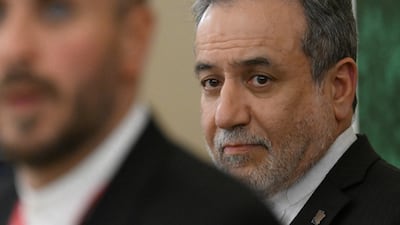

Iranian Foreign Minister Abbas Araghchi said Saturday that he had held talks with 12 foreign ministers over the past 48 hours to discuss regional developments, stressing the need to respect national sovereignty and prevent the spread of insecurity.
Mr Araghchi said in a post on Instagram that he outlined Iran's "fundamental positions" during the calls, emphasising the importance of "respecting national sovereignty, ending aggression and threats, avoiding harmful foreign interference" and preventing the expansion of instability across the region.
He also called for the establishment of "regional security arrangements without the involvement of powers from outside the region".
The calls were held separately with the foreign ministers of the UAE, Turkey, Pakistan, Qatar, Oman, Egypt, Jordan, Saudi Arabia, Kuwait, Tunisia and Iraq, as well as with the foreign minister of Cyprus.
The diplomatic outreach comes amid heightened regional tensions, with Tehran seeking to promote dialogue and a regional approach to security issues.
Qatar has been attempting to mediate between Iran and the US to defuse tensions and a potential renewal of war.
The US administration remained willing to find a solution even after the midterm elections, signalling that Washington's interest in reaching an agreement had not changed, Qatar's Prime Minister Sheikh Mohammed bin Abdulrahman said.
Significant progress had been made and Mr Al Thani expressed confidence that a settlement could be reached.
"We cannot wait to reach a perfect agreement; we hope to reach a good agreement," he said.
Iranian state media reported two missile strikes in the Suza area of Qeshm Island in the Strait of Hormuz, a crucial route for oil shipments.
It comes as US President Donald Trump acknowledged early on Saturday that American forces had carried out minor strikes against Iranian military equipment.
When asked by reporters about reports of strikes on Iran's Qeshm Island, Mr Trump said, "I don't want to talk about it. We do minor strikes, but they built a little bit of an anti-aircraft device and we knocked it out in about 15 minutes, maybe five." He did not specify when or where this attack took place.
Mr Trump also said Washington had made "a lot of progress" with Iran and that Tehran wants an agreement.
The US Department of State Consular Affairs called on Americans in the Middle East to exercise "heightened vigilance" due to threats by Iran and Houthi rebels to target government officials.
"Americans currently in the Middle East should exercise heightened vigilance due to the increased threat of armed attacks by Iran-backed Houthis and Iranian efforts to target US government officials in the region," it said in a renewed warning posted today.
"Be aware of potential flight cancellations, airspace closures, and travel disruptions," the advisory added.
Regional states had been anticipating that Mr Trump, who has held off on strikes on Iran during the weeks leading up to Tuesday's midterm elections, could restart attacks once the voting is over.
Iran has repeatedly said it would respond to new attacks by striking at US and Israeli targets in the region.
Tehran has been proposing its own seven-day plan since September, so far rejected by Mr Trump. It calls for Washington to lift a blockade of Iranian ports, unfreeze assets and approve an Iranian-backed route through the Strait of Hormuz, after which the contested waterway would be reopened.

