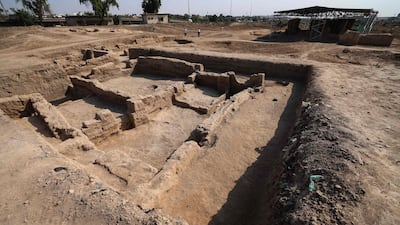

Archaeologists have found new remains near Baghdad that will shed new light on life in Mesopotamia some 4,000 years ago, Iraqi authorities have said.
Iraq's State Board of Antiquities and Heritage announced the discoveries as part of a joint project with Italy’s University of Catania. The findings include walls and gates, facilities that may have been used for food production, and traces of metalworking and ancient funeral practices.
Dating back to the period of Hammurabi, a king of Babylon around 1750 BC, the finds resulted from excavations begun in 2022 and were led by by Catania professor Nicola Aneri.
"We excavated areas related to the fortification walls, where we found two gates, one small postern [gate] for probably the military forces. After that, we decided to create an archaeological park," he told local media.
Officials plan to open the archaeological park to the public. They also unveiled a protective cover for the site.

The site in Tell Muhammad was inhabited during the Old Babylonian and Kassite periods, when Babylon was expanding its political and economic influence. The site’s remains shed light on early urban development in central Mesopotamia long before Baghdad became the Abbasid capital.
It is known to be one of the settlements of the Kingdom of Eshnunna, which flourished between 2000 and 1761 BC.
Iraq is home to ruins and artifacts from some of the world's earliest civilisations, but decades of war and instability throughout the Middle East has devastated efforts to uncovering its rich history. Also, the sites had for years faced threats from the wars and climate change.
Ali Obaid Shalgham, head of the State Board of Antiquities and Heritage, announced the findings on Monday. He said the newly uncovered artefacts from Tell Muhammad will be transferred to the Iraq Museum in Baghdad. He did not specify how many items were found or their nature.
Iraq's Tourism and Antiquities Minister Ali Al Dakhili had instructed the board to bring in archaeologists from abroad to work alongside Iraqi specialists, Mr Shalgham said. He said the aim was to combine expertise to uncover “the treasures, architectural details and secrets of civilisation” preserved at sites across the country.
Mr Shalgham said "there is determination and tireless effort by the minister to work with all international bodies to revive tourism in Baghdad and in the governorates."
Last year, Mr Shalgham said there were at least 50 foreign missions working across Iraq to excavate and restore sites and prepare them for tourism.

