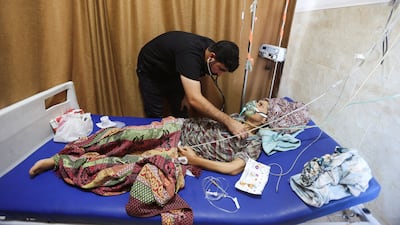

Only 19 of Gaza’s 38 hospitals are functioning after damage inflicted by Israel during two years of war, but even these have begun suspending services because of a lack of fuel and spare parts needed to keep their generators running, doctors and officials say.
“Electrical generators are the lifeline of hospitals,” said Mohammed Abu Salmiya, director of Al Shifa Medical Complex in Gaza city. “Every department depends on them, and any interruption poses a serious threat to patients' lives.”
Gaza‘s electricity infrastructure was severely damaged during the war, leaving hospitals dependent on generators to power intensive care units, operating theatres, emergency departments, laboratories, blood banks and medical equipment.
Local authorities say Israel is failing to meet its obligations under the ceasefire agreement that went into effect in October last year, which stipulates the entry of agreed quantities of supplies and fuel needed for vital sectors.
“Gaza’s operating hospitals require 94,000 litres of diesel each month to maintain even the minimum level of service for residents. Since the war began, hospitals have not received the full quantity needed to operate their generators in any single month,” Dr Mohammed Zaqout, director general of hospitals at Gaza's Health Ministry, told The National.
“Hospitals also require about 2,500 litres of engine oil each month to keep generators operating efficiently around the clock. Over recent months, however, they have received only a few hundred litres,” he said.
At the same time, Israeli restrictions on goods entering Gaza have severely limited the supply of generators and spare parts. Some machinery and parts are classified by Israel as “dual-use” items – capable of both civilian and military applications – and require special approval.
Health officials say many hospital generators have already broken down for lack of parts and oil, forcing those that still work to run around the clock under conditions they were not designed for.
Dr Zaqout said about 70 per cent of hospital generators were no longer operational, threatening the entire healthcare system.
Hospitals have tried to cope by reducing non-urgent services and directing their limited electricity supply to critical departments, but even these measures may not be enough if more generators fail.
The generators at Al Shifa Hospital were already old before the war and have since been subjected to heavy use. “They need to be replaced, as they could break down at any moment,” Dr Abu Salmiya told The National.
“We have repeatedly applied for the hospital to be supplied with fuel and for the necessary spare parts and engine oil to be allowed into Gaza,” he said.
“If a generator breaks down, it can’t be repaired and must be taken out of service,” said Mohammed Salha, co-ordinator of the Palestinian NGOs Network in Gaza.
He said generators had stopped working at several facilities, including Nasser Hospital in Khan Younis, Al Aqsa Martyrs Hospital and Jaffa Hospital in Deir Al Balah, and Al Ahli Arab Hospital in Gaza city.
At Al Ahli Hospital, the main generator unit failed, forcing imaging and diagnostic departments to stop operating, according to hospital officials. The breakdown also affected the only functioning CAT scanner serving patients in northern Gaza, Dr Abu Salmiya said
Dr Zaqout said the World Health Organisation had informed health authorities that it would stop providing support for fuel and oil for generators from this week.
“Thirteen hospitals and seven health centres are currently affected by the fuel and generator crisis after the World Health Organisation stopped funding their diesel and engine oil supplies because of Israeli restrictions,” he said.
“No hospital has completely ceased operating or closed its doors as a result of this particular crisis. However, many departments at some hospitals have stopped functioning, leaving the facilities able to provide only minimal services and emergency care.”
In April, the UN Office for the Co-ordination of Humanitarian Affairs reported that only 19 hospitals were still operating in Gaza and that only about 270 of the 630 health centres in the territory before the war began in October 2023 were still functional.
Dr Zaqout explained that 26 hospitals were taken out of service at various stages during the war, but some were later reopened through local efforts.
“Entire departments at other facilities, including Al Shifa Hospital, have also stopped operating because of shortages of medical equipment, hospital beds and treatment supplies. The loss of qualified medical personnel – through evacuation, death or detention – has further affected services,” he said.
The hospitals that are still working are under pressure from the need to treat not only illnesses and chronic conditions but also people wounded during the war who require continued treatment.
According to Gaza's Health Ministry, nearly 175,000 people have been injured since the war began, including more than 4,800 wounded in Israeli attacks during the ceasefire.
“The remaining hospitals are unable to meet the need,” Dr Zaqout said.

