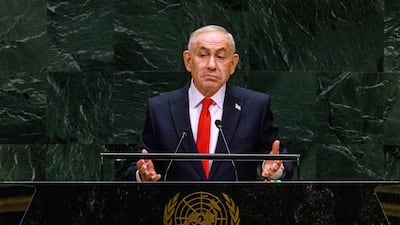

Faced with a tight election race, plummeting global support for Israel and conflicts across the Middle East, Prime Minister Benjamin Netanyahu might well have viewed his speech to the UN General Assembly as one of the most important addresses he has made in the chamber.
He certainly came with strong messages, accusing close allies Britain and France of hypocrisy and warning of global campaigns to “brainwash young minds to hate Israel”. But his messages do not appear to have convinced many, and have generated a wide range of critics, from normally pro-Israel social media personalities to foreign diplomats.
Mr Netanyahu did not come to make friends. As many foreign dignitaries walked out of the hall in protest, he said: “If there are any other moral cowards who haven’t yet left this hall, please do so now.” He said western countries that recently issued sanctions against illegal Israeli settlements were not standing up to “barbarians who threaten our common civilisation”.
On New York Mayor Zohran Mamdani, who has said he supports Mr Netanyahu's arrest for war crimes, Israel’s leader said: “Here’s the simple truth. Israel didn’t commit genocide. Israel prevented genocide. And that’s exactly what Mr Mamdani’s Hamas buddies would have done to us had we not stopped them. He also said Turkey is “the latest country to become a super-spreader of anti-Semitic lies”.

Brandishing a Starlink terminal, he said: “The Iranian regime is especially afraid when their people have this. This is a communications device, Starlink, that allows people to access truth, to exercise choice and to exercise freedom of thought and freedom of speech.”
Ultra-nationalist coalition members praised the 40-minute speech. National Security Minister Itamar Ben-Gvir called it “important” and said that “the entire state of Israel stands behind you against the lies of the world”. Finance Minister Bezalel Smotrich said the same, adding: “We trust you to represent the righteousness of the state of Israel's path with pride and head held high.”
But negative reactions were more numerous. Dozens of delegates walked out as Mr Netanyahu took to the podium, leaving much of the hall empty. The hall was much fuller for Palestinian President Mahmoud Abbas, who said Israel was pursuing “a malicious colonial plan” to drive Palestinians from their land.
Israeli opposition politicians widely criticised the speech. Former prime minister Naftali Bennett, who is running in the upcoming elections, criticised him for missing “a historic opportunity to declare Qatar an enemy state”.
Palestinian-Israeli politician Ahmad Tibi mocked Mr Netanyahu, posting a video of delegates leaving the room at the start of his speech. “‘Voluntary migration' from the hall: yet another international achievement for Netanyahu,” he posted on X, mocking a euphemism for expelling Palestinians from their land that is backed by many right-wing Israeli politicians.
Majed Al Ansari, an adviser to Qatar's Prime Minister, said the Gulf state “categorically rejects” the accusation that it is influencing public opinion against Israel. “This continuing rhetoric against Qatar is nothing more than an attempt to divert attention from the atrocities committed by his government”, he said.
Hamad Al Muftah, deputy chief of mission at Qatar’s embassy in Washington, posted a photo allegedly showing Mr Netanyahu apologising to the country’s Emir for bombing Doha last year, after Mr Netanyahu spent much of his General Assembly speech criticising Qatar again.

Pro-Israel social media personality Eylon Levy posted on X: “Netanyahu’s speech was decidedly mediocre. It was also a missed opportunity to lay out forensically how the Iranian Axis has been subverting the basics of the international order – and how the UN has been complicit.”
Another pro-Israel commentator, Hen Mazzig, also criticised the speech: “He wanted to show Israel’s strength. What came out sounded more like a rebuttal of his enemies’ talking points. Israel's accusers ended up setting the agenda for Netanyahu's biggest moment on the world stage this year.”
Mr Netanyahu’s bombast came amid broader worries in Israel about declining US support for the country. In an editorial on Friday, the left-wing Israeli outlet Haaretz addressed the crisis: “No bombastic speech by Netanyahu at the UN General Assembly can paper over this bleak reality ... every Israeli needs to understand the extent to which Israel's image has deteriorated in the eyes of the American public and the implications for the future of relations between the two countries.”

