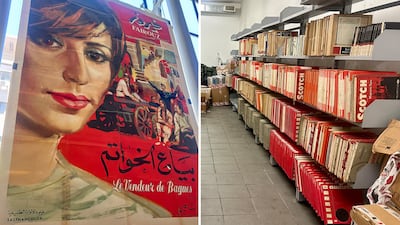

Film reels from Lebanese cinema icon Studio Baalbeck, original posters from 1960s Arabic films and a forgotten documentary on Tyre's heritage are among the gems uncovered in the archives of Lebanon's Ministry of Culture.
Since 2025, the ministry has been working on sorting, digitising and eventually screening its long-neglected audiovisual archives, which date back to the 1950s. The project aims to preserve and showcase Lebanon's rich cultural legacy while documenting its modern history, too often recounted through the prism of fractured sectarian narratives.
“Audiovisual archives, whether music, films or photographs, are incredibly important because they provide tangible testimony to periods of history that were never recorded in our history books,” Vanessa Helou, who oversees the archive project, told The National.
In Lebanon, history textbooks end in 1943, when the country gained independence. The country's subsequent history, including a bloody civil war, is completely ignored, a historical erasure meant to avoid reviving past hostilities.
The archives, now housed at the National Library in Beirut, where the Ministry of Culture is located, offer a rare glimpse into the country's untold past.
“They're individual memories that together build a collective memory,” Ms Helou said.
As Israel continues razing parts of south Lebanon and threatening its memory by wiping out occupied border villages, their cultural landmarks, homes, mosques and churches, Ms Helou said she noted a renewed interest in Lebanon’s heritage among the general public.
“These archives are witnesses,” Ms Helou said. “They preserve images of buildings that have now been destroyed.”
Mammoth task
Among the discoveries is a vast collection from Studio Baalbeck, one of the Arab world's most important film and recording studios during Lebanon's cinematic prime in the 1960s and 1970s. It includes reels featuring performances by iconic Lebanese singers such as Wadi Al Safi, Fairuz, Sabah and Samira Toufic.
“We'll soon have a much clearer picture of what's in our cinematheque's collection as we work through the inventory and receive the digitised materials. But we already know that it includes, among other things, numerous news reports from the 1960s,” Ms Helou said.

The collection is eclectic: it reflects Lebanon's most glorious days, but also its darkest ones. Wandering through the archive's cluttered shelves, The National found bleak resemblances to present-day Lebanon.
A documentary on the 1996 Qana massacre in southern Lebanon, when an Israeli shelling of a UN compound in the village killed 106 civilians, stands as a prescient warning of Israel's most recent massacres in the south.
The ultimate goal, once the archives have been organised, digitised and made easily searchable for historians, journalists and architects, is to screen the collection to the public.
But sorting it out has been a mammoth task. The archives are an image of Lebanon’s own convoluted history.
“The building where the archives were stored was literally falling apart. Between the economic crisis, the port explosion, everything had been left there,” Ms Helou said.

During the 2024 war between Israel and Hezbollah, the building housed displaced people and the archives were further mixed up.
“Some of what I found was in really terrible condition,” she said. Many paper archives had deteriorated due to heat and humidity.
The next step is digitisation, in collaboration with an association called Maraya, which is set to provide equipment for technicians to establish a small film restoration laboratory.
It will mainly serve the ministry's collection but also individuals who want to digitise or restore their own films, Ms Helou said.
'History repeating'
Beyond the archives, Ms Helou's project also involves collaborating with private collections that have already restored older Lebanese films to organise public screenings.
These will include little-known films made during the civil war that were not screened in Lebanon at the time.
Ms Helou said cinema is one of the most effective ways of engaging with Lebanon's contested past, as it subtly approaches political issues through personal experiences.
“Many of the films made during the civil war don't have the war itself as their main subject. The war is simply the backdrop. The films tell intimate, personal stories,” she said.
Faced with a lack of a unified national record, younger generations generally learnt about their country’s recent history from their family and community. What they know – and especially what they don't know – is often a reflection of their own sectarian background.
“I think one of the reasons history repeats itself so often in Lebanon is precisely because we tend to forget what happened. When people forget, they end up repeating the same patterns,” Ms Helou said.