
Syria’s Al Omar oilfields offer apocalyptic scenes straight out of Mad Max: rusty cylinders, burnt-out oil tanks and bullet-riddled buildings rising from the deserted landscape.
In the distance, dark silhouettes of fast-moving motorbikes cut across the grey sky, as they gathered around an oil-spitting well, siphoning off the precious black gold hidden beneath the parched ground.
A few days ago, the Syrian central government regained full control over Al Omar, the country’s most important oilfield, in Deir Ezzor governorate after it had been run for years by the Kurdish-led Syrian Democratic Forces.
But retaking control is only the first step.
The grounds of the much-coveted Al Omar site are scattered with debris: metal scraps and rubble mixed with decade-old documents and technical manuals, rusty food cans and bullets. The site, which was bombed by the international coalition when ISIS controlled it, has been left in ruins after years of war, sanctions and underinvestment.
Waleed Youssef, director of the Syrian Petroleum Company, told The National that rehabilitating energy infrastructure would cost “billions".
“This is a massive task. We would need a huge amount of money to restore things to how they were before," Mr Youssef said. "It will also require investors and major international companies to come in, study the situation and decide how to fix it, rehabilitate it and bring it back to what it was."
The government regaining the field follows a rapid eastward offensive launched last week against SDF-held territory, which until now covered about a quarter of Syria. The push led to the army reclaiming two resource-heavy regions: oil-rich Deir Ezzor and Raqqa, home to major hydroelectric dams.

Mr Youssef said Damascus retook several other oil and gas sites in Deir Ezzor during the offensive, including the Tanak and Isbah fields in the eastern countryside, the Jafra oilfield near the outskirts, and the Conoco gas plant in the north of the province.
“These are the major fields we rely on for oil and gas in Syria, and I think this covers all of Syria’s needs for oil and gas,” he added.
Syria has relatively significant oil and gas resources, which for years have been at the heart of a battle for influence.
The Syrian government has won the latest round against the SDF, a Kurdish-led force that was once a powerful US-backed group that gained large areas of territory as it drove out ISIS with the support of allies, but is now facing collapse and isolation.
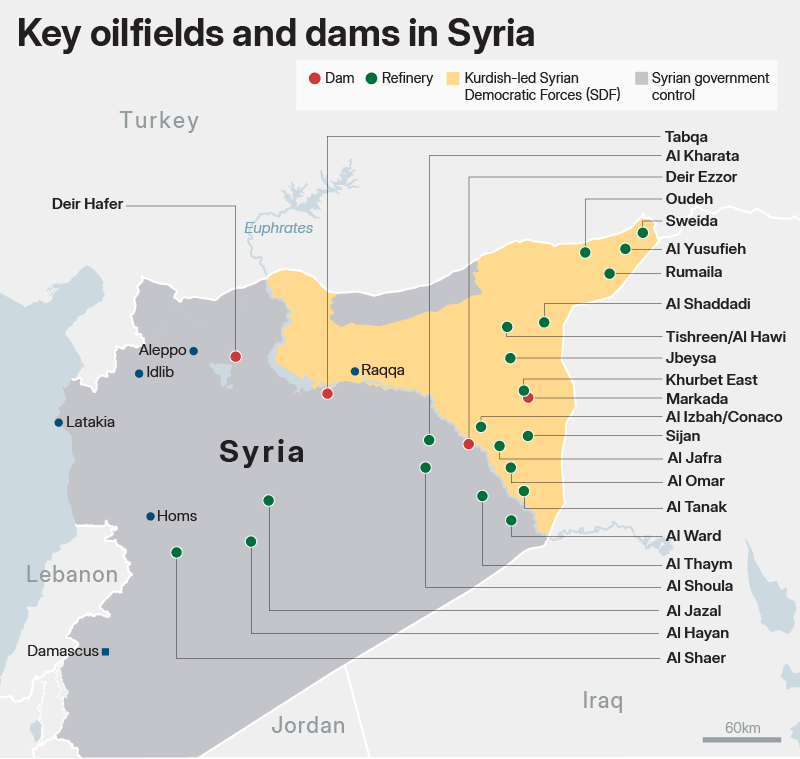
Kurdish-led authorities have resisted integration into the central government since the fall of former president Bashar Al Assad's regime in December 2024. Oil and gas have been central to the standoff, as Damascus has argued that energy revenues, which the SDF used to fund its semi-autonomous administration in the north-east, should be centralised.
Production before the SDF’s fall stood at about 25,000 barrels per day and 8 million cubic metres of gas in government-held areas, compared with 110,000 barrels per day and 1 million cubic metres of gas in SDF-held areas, according to data shared with The National. This means that before the takeover, about 81.5 per cent of oil production was in the hands of the SDF, while the government controlled most of gas production.
Decaying facility
Foreign companies have looked at Syria’s energy sector since the fall of the Assad regime. Preliminary agreements have been signed between the SPC and international companies. They include US companies ConocoPhillips and Novaterra, four Saudi energy companies – Taqa, Ades Holding, Arabian Drilling Company and Arabian Geophysical and Surveying Company – and Dana Gas, a UAE-based regional gas producer.

As the West removed far-reaching sanctions imposed on Syria, the dispute between the SDF and Damascus over contested resource-rich areas was a major obstacle to investments, sources in the sector said.
Mr Youssef expects “major development” in the coming months. “There is continuous communication with international oil companies,” he said, adding that representatives of ConocoPhillips were in Syria on Wednesday. “We’ve been in touch with Chevron and Total,” he said, referring to the US and French energy giants.
According to figures reviewed by the think tank Karam Shaar Advisory, the central government could expect revenue to reach about $1.1 billion if it retook all SDF-held territories, making oil the country’s largest single source of income.
Output is about a third of pre-conflict levels, the think tank said.
Mr Youssef said this would translate into significant changes for ordinary Syrians. “If electricity comes, all the factories will be working and agriculture will develop. Life will change. Electricity is life.”
He said that exports would only be considered in the very long term.

But the path ahead is long. “Despite the takeover, the short-term outlook for Syria’s oil sector is still underwhelming,” said Benjamin Feve, senior research analyst at Karam Shaar advisory, based in Istanbul, Turkey.
“Even under optimistic assumptions, near-term output gains will be marginal and largely limited to stabilising existing production rather than meaningfully increasing volumes,” Mr Feve wrote in a post on X.
SPC chief executive Youssef Qablawi said the decaying site produces only 5,000 barrels per day, down from 50,000 in the past.
Alexander McKeever, an analyst based in Syria who focuses on northern Syria, said the site was bombed by the anti-ISIS International Coalition between November 2016 and May 2017, when it was under the control of the extremists. “The SDF was still pumping oil, but at a fraction of capacity,” Mr McKeever said.
Rapid takeover
Al Omar oilfield also hosted a US base and airstrips, and served as headquarters for the SDF and its internal security force, the Asayish, Mr McKeever said. The US base later moved to the oilfield housing complex before withdrawing in mid-2025, he added.

During the visit to Al Omar field, The National passed through the former Asayish centre, where Syrian forces are now stationed.
The oilfield housing, which was taken over by the SDF after the US withdrawal, has been burnt and looted. Inside the building, a copy of jailed Kurdish leader Abdullah Ocalan’s defining book, Manifesto for a Democratic Civilisation, lay on top of an SDF uniform on the ground, next to leftover food – signs that the SDF members left in a hurry, and a broader reflection of the group’s sudden collapse.
Damascus moved quickly to regain territory contested by the SDF. Syria’s President, Ahmad Al Shara, on Tuesday signed a fragile, four-day truce with its leader, Mazloum Abdi, under which energy revenues should be shared.
But for Mr Feve, “full rehabilitation requires time, capital, skilled contractor, and functioning midstream infrastructure, none of which are immediately available".
Even if the military gains were swift, rehabilitation remains a long way off.

