


Across the border from the Empty Quarter is Yemen's northern governorate of Al Jawf. Food and water are scarce in this region with a population of 590,000 people, nearly all of whom are reliant on aid.
It is also one of Yemen's largest transit hubs for a growing drug trade, local and security officials say.
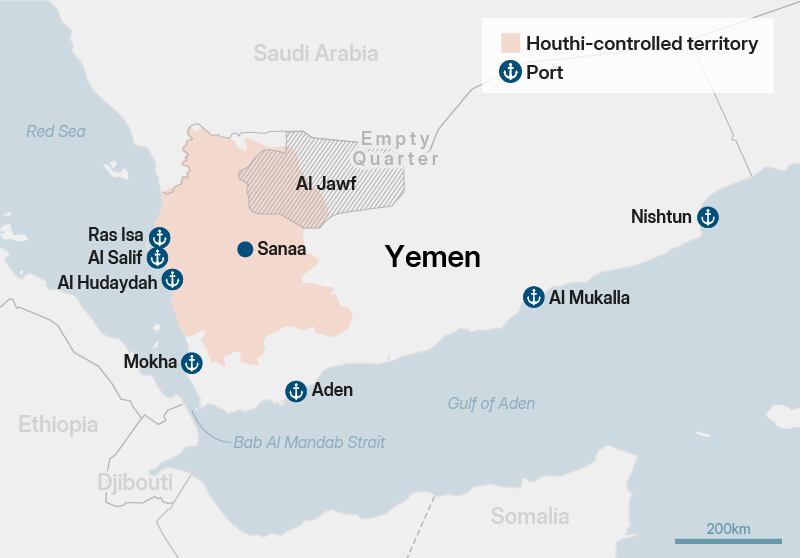
Yemen, now in its 11th year of civil war, is divided into governorates that are controlled by different armed factions, from the Iran-backed Houthis in the north to the internationally recognised government in the south.

The exact quantities of drugs, including Captagon pills, moving through the country, remain unknown. But with its strategic location on the Red Sea and Bab Al Mandeb strait, which links to the Indian Ocean, as well as deep security fractures, rampant lawlessness and grinding poverty, Yemen has become a major route for smuggling to lucrative markets in the Gulf and beyond.
Local officials, security figures and experts told The National that the narcotics trade in Yemen has "exploded", especially for Captagon, an amphetamine over which Syria held a monopoly of about 80 per cent under Bashar Al Assad.
This can be measured through seizures in Yemen, which totalled 1.7 million pills in 2025, up from 358,000 pills the year before, according to data collated by the US-based New Lines Institute, which tracks narcotics in Yemen.
Fighting between groups that control different areas of the country, as well as divisions within the government, have increased the lawlessness that enables traffickers.
Syria effect
"It is not a direct result of the fall of the Assad regime, but a spillover effect that was seen in 2024 when the regime was in power," Caroline Rose, an expert on military and national security at the New Lines centre, told The National.
Countries around the Middle East are eager to shut down trade of the highly addictive amphetamine, which was produced on a mass scale during Syria's civil war and often smuggled across Lebanon's border.
"They encouraged traffickers to diversify routes beyond Lebanon and Syria, and Yemen was one of them," Ms Rose said. British and American experts estimated the global illegal Captagon drug trade to have been worth about $57 billion as of 2023.
This week, Lebanon said it had seized 6.5 million Captagon pills – and 700kg of cannabis – that were being prepared for trafficking to Saudi Arabia. Riyadh suspended imports of Lebanese fruits and vegetables in April 2021, citing drug-smuggling concerns and accusing Beirut of failing to take action.
Originally made by a German company in the 1960s, Fenethylline, a stimulant that became known as Captagon, was first used to treat symptoms of attention deficit hyperactivity disorder (ADHD) and narcolepsy.
Beyond frontlines
The fall of Syria's Assad regime exacerbated the already surging trade in Yemen. On boats, big and small, the drugs come in, sometimes from remote areas of Oman across the border into Yemen's Al Mahra, according to security officials working to tackle the trade.

They are moved in the country in known, protected routes that are also used to ferry weapons and other illegal drugs, making their way along a porous 1,300km shared border on "donkeys and drones", to Saudi Arabia, where the purchasing power of users is higher, according to a dealer and a security source in the governorate of Al Jawf.
Partially controlled by the Houthis and the government, Al Jawf in Yemen's north shares a border of nearly 300km with Saudi Arabia. "All transit lines pass through this territory," the security source said.
The pills can be sold for as much as $20 each, Ms Rose said, making it lucrative to sell abroad rather than inside Yemen, where more than 82 per cent of the country's population of 41 million is living in poverty.
It is all now "taking place in plain sight", a senior official in Al Jawf told The National. "Cars carrying vast amounts of drugs pass publicly through neighbourhoods, and it has become common knowledge that the people involved are protected, not only by armed individuals but by powerful gangs and their networks."
The security source claimed he had frequently interrogated smugglers by the coast, who, he says, will work for the highest bidder. "They have no affiliation, no agenda. They just want to get paid."
Signs of trafficking have been found both in Houthi and government-controlled areas, showing "no evidence" of a monopolising force, Ms Rose said.
The government routinely points fingers at the rebels, accusing them of bringing in experts to run labs from Iran-backed Hezbollah, and corruption is rampant across the board.
A Hezbollah stronghold, Lebanon's Bekaa Valley, is known for Captagon manufacturing as a means to finance the group. Hezbollah has also had strong ties to the Houthis who received training from its members that were smuggled into the country.

Earlier this week, the World Anti-Doping Agency (Wada) announced a major Yemeni raid that seized 447kg of narcotics and performance-enhancing drugs, marking a “landmark moment” in the global fight against doping.
According to Wada, the operation showed authorities are now tracking cross-border trafficking of amphetamines and other banned substances, which Wada and Yemeni officials believe has shifted to Yemen as Syrian and Iranian producers exploit the country’s war and economic collapse.
Yemeni and Interpol officials said the raid dismantled what would have been Yemen’s first modern drugs production facility, allegedly staffed by Syrian and Iranian experts and linked to the Houthi rebels as a revenue source – claims Iran denies.
Tribes in Yemen are the de facto authority. They work closely with the smugglers to ensure that they are carrying out their job uninterrupted, acting as a go-between between the criminals and those who are supposed to catch them.
Sometimes, the very same people tasked with stopping crime are the ones enabling it and seemingly warring factions end up colluding with one another. "Interests transcend front lines," another senior official in Al Jawf told The National.
The drug trafficker in Al Jawf named Houthi members who he said are involved in the trade, but added that senior officials in Yemen's own government are also known enablers, if not traffickers themselves.
When asked how everybody gets away with it, he simply said: "They're all friends."

