

Three Arab journalists have been recognised for their reporting on Syria and Gaza at the 20th edition of an EU-sponsored awards ceremony in honour of assassinated Lebanese journalist Samir Kassir.
The Samir Kassir Award for Freedom of the Press was held on Tuesday at Sursock Palace in Beirut. The annual event is organised by the Samir Kassir Foundation with EU financing.
Mr Kassir was killed on June 2, 2005 in the Lebanese capital. He was a vocal critic of Syria’s occupation of Lebanon which started in 1976 and ended in the year he died.
Gaza, devastated by almost 20 months of Israeli bombardment, was central to this year's event, along with Syria as the country emerges from decades of authoritarian rule after the fall of Bashar Al Assad.
Tuesday's ceremony carried extra poignancy, 20 years on from Mr Kassir’s assassination.
“It has very much to do with Samir’s own multiple identities – Lebanese, Syrian, Palestinian – and what is happening in these three countries defies all imagination and expectations,” said Ayman Mhanna, executive director of the Beirut-based foundation.
“Whether on the positive side or even on the tragic side”, the changes taking place in Lebanon and Gaza are “beyond anything we thought possible”, he told The National.
Raised in Beirut by a Lebanese-Palestinian father and Lebanese-Syrian mother, Mr Kassir went on to become a prominent intellectual and journalist. As well as criticising the Syrian occupation, he was a vocal opponent of Hezbollah, the powerful Lebanese armed group and political party.
-
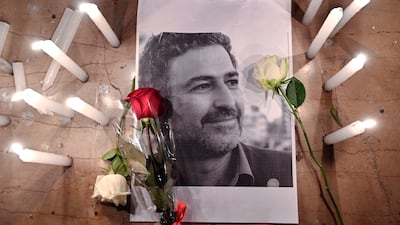
epa11781349 Lit candles sit near a picture of slain Lebanese journalist Samir Kassir during a march under the slogan 'From Beirut, freedom, we declare the fall of the Baath regime and criminality' to celebrate the ouster of Syrian President Bashar al-Assad, at Samir Kassir Square in Beirut, Lebanon, 16 December 2024. The march, organized by 'Mada Network and Secular Clubs', was held more than a week after Syrian rebels entered Damascus and announced the overthrow of Bashar al-Assad, and the release of all the prisoners on 08 December 2024. EPA-EFE/WAEL HAMZEH -

FBI agents inspect the wreck of Kassir's car in Beirut on June 3, 2005. The US asked the UN Security Council to expand an investigation into the assassination of Lebanese prime minister Rafic Hariri on February 14 that year to include the killing of the journalist. Reuters -

FBI agents inspect and collect evidence from the scene of Samir Kassir's assassination in Beirut. Reuters -

Colleagues of Lebanese journalist Samir Kassir carry his coffin past the offices of An Nahar newspaper in central Beirut on June 4, 2005. Hundreds of mourners, including senior opposition leaders, attended Kassir's funeral as international calls for an inquiry into his assassination grew. Reuters -

Lebanese deputy Gebran Tueni, left, and colleague Akram Shehayeb carry Samir Kassir's coffin past the An Nahar newspaper building in Beirut on June 4, 2005. Reuters -

Lebanese journalists hold posters and brandish pens bearing name of anti-Syria journalist Samir Kassir in Beirut on June 3, 2005, the day after his assassination. Reuters


His assassination was one of a series of killings that targeted critics of the Assad regime and its influence abroad. The perpetrators have never been held accountable.
Mr Kassir's death has been widely blamed on Hezbollah, which was a key ally of the Assad regime before the president was toppled last December.
For a second year, the awards ceremony was held without Gisele Khoury, the Lebanese journalist and widow of Mr Kassir, who died of cancer in October 2023. Ms Khoury founded the Samir Kassir Foundation.
A panel of seven judges from the Middle East and Europe selected the winners.
The prize for best opinion article was awarded to Palestinian journalist Badar Salem for her piece headlined The Normalisation of Resilience in Gaza. The best investigative story was Egyptian journalist Marina Milad's investigation into Syrian women imprisoned under the Assad regime.
The award for best video went to Syrian journalist Khalil Al Ashawi for his portrayal of a childhood lived “in an endless war” in Syria.
“It’s very important to receive a prize named after someone who was killed because of the Syrian regime, the same regime that forced us to flee,” Mr Al Ashawi told The National. “It shows that we’re back. I returned to my country for the first time in 14 years, and I did this report after the fall of the regime. I would never have dreamt of doing so before.”
The judges were The National’s Editor-in-Chief Mina Al-Oraibi, French writer Jean-Pierre Perrin, BBC Middle East correspondent Lina Sinjab, Antoine Haddad – vice-president of Saint George University of Beirut and the Samir Kassir Foundation’s representative, Paul Radu, co-founder of the Organised Crime and Corruption Reporting Project, Spanish journalist and communications expert Natalia Sancha and Ali Amar, Editor-in-Chief of Moroccan news outlet Le Desk.
The jury paid tribute to Ms Khoury, and Lebanese journalists and intellectuals who had been killed, including Hezbollah critic Lokman Slim and Gebran Tueni, former editor of An-Nahar, a leading newspaper in Lebanon. The judges also paid tribute to the people of Gaza and Syria.
“We cannot talk about the Arab world today without pausing to acknowledge the brutal war on Gaza and the unjust occupation of Palestine,” Ms Al-Oraibi said in a speech. “And yet, amid all the challenges, we are witnessing a glimmer of hope, after a long and dark period. Hope shines through in beautiful Lebanon, in Syria and, God willing, in my beloved homeland, Iraq.”
Mr Mhanna said the ceremony was a message of defiance to anyone attempting to stifle freedom of expression in Lebanon.
“They are pathetic if they believe that a country capable of producing journalism of this calibre, like Samir Kassir did, and embracing the kind of work represented by this year’s nominees, actually cares about them,” he said. “Where else other than Lebanon can journalists banned from their own countries come to be recognised?”

