US envoy Hochstein says UN resolution is basis for ceasefire in Lebanon


Jamie Prentis
  • English
  • Arabic

Live updates: Follow the latest on Israel-Gaza

US special envoy to Lebanon Amos Hochstein, who arrived to Beirut yesterday in the latest effort towards achieving a ceasefire, said that UN Resolution 1701 which ended the 2006 Israel and Hezbollah war was the basis to end the conflict between the two sides, but that “simply committing” was not enough.

The conflict between the two started more than a year ago, a day after Hamas waged its surprise October 7 attack on Israel, killing 1,200 people and kidnapping 240. It escalated into a full-blown war following the assassination of Hezbollah's leader Hasan Nasrallah last month and Israel's invasion of the country and constant bombings.

The UN Security Council's resolution was agreed to end the last war, but it has never been fully implemented. It states that only the Lebanese army and UN peacekeepers should be stationed in southern Lebanon, while demanding the withdrawal of Israeli forces from Lebanese territory.

Senior Lebanese officials have said they want to put it into effect, but Israel, whose warplanes have entered Lebanese airspace thousands of times without permission, has signalled that even if UNSC 1701 was fully implemented, the terms were no longer tenable.

“The commitment that we have is to resolve this conflict based on [UN Resolution] 1701 – that is what the solution is going to have to look like,” Mr Hochstein said.

“Resolution 1701 was successful at ending the war in 2006 but we must be honest that no one did anything to implement it,” he added, saying: “Both sides simply committing to 1701 is just not enough.”

Mr Hochstein said the aim was ensuring lasting peace and that conflict would not flare up again. “We have to put things in place that would allow for confidence that it will be implemented for everyone.

“We have to know this is not just going to another round of conflict in a month or a year or two years,” he said.

Lebanese caretaker Prime Minister Najib Mikati said there was no alternative to 1701, but that “new understandings” could be reached to put it into effect.

Washington said yesterday that Secretary of State Antony Blinken will make his 11th trip to the Middle East this week, visiting Israel and several Arab nations in a week-long tour.

Israel has reportedly demanded that its forces be allowed to engage in “active enforcement” to ensure Hezbollah does not rearm and rebuild its military infrastructure close to the border. Israel also demanded its air force have freedom of operation in Lebanese air space, according to reports.

Israel, armed and supported by the US, has said it wants to ensure that Iran-backed Hezbollah can never be a threat to its citizens in the north of the country again. Israel continued its aerial bombardment of Lebanon, hitting numerous Hezbollah-linked financial institutions across the country on Sunday.

Mr Hochstein met Mr Mikati, army commander Gen Joseph Aoun and Speaker of Parliament Nabih Berri yesterday. Mr Berri is a key figure and has close ties with Hezbollah.

Both Mr Mikati and Mr Berri have called for the implementation of UNSC 1701.

Iranian Parliament Speaker Mohammad Bagher Ghalibaf was reported as saying last week that his government was ready to negotiate the implementation of the resolution, prompting Mr Mikati to accuse Tehran of interfering in Lebanon's internal affairs.

An Iranian Foreign Ministry spokesman said on Monday that there had been a “misunderstanding”.

“Iran has never had any intention or action that could be suspected of interfering in the internal affairs of Lebanon,” Esmaeil Baghaei said during a weekly news conference.

Last month, Hezbollah was under the impression it had agreed to a ceasefire with Israel to end the fighting. However, that was torn up by Israel the day after when it assassinated Hezbollah leader Hassan Nasrallah in a bombardment of Beirut.

Mr Hochstein, who has served in the Israeli military, is a regular visitor to Israel and Lebanon as the US seeks to find a ceasefire. He helped mediate the landmark maritime border deal between Lebanon and Israel in 2022. The two countries are technically in a state of war and do not have diplomatic relations.

Israel's bombardment of Lebanon has killed about 2,500 people and displaced more than 1.2 million.

On Sunday, an Israeli attack on a Lebanese army vehicle in south Lebanon killed three soldiers. Israel claimed that it thought the vehicle belonged to Hezbollah. The Lebanese army has not been involved in the clashes with Israel.

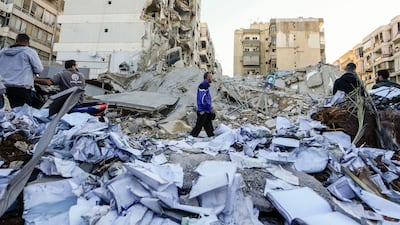
  • Documents of Hezbollah-run Al Qard Al Hassan are scattered at the site of an Israeli air strike on Sunday night in the southern suburbs of Beirut, Lebanon. AP
    Documents of Hezbollah-run Al Qard Al Hassan are scattered at the site of an Israeli air strike on Sunday night in the southern suburbs of Beirut, Lebanon. AP
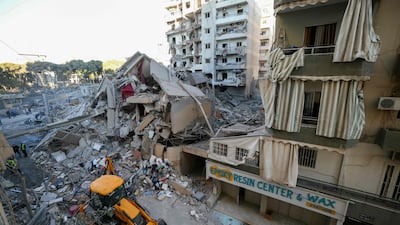
  • An excavator clears the rubble at the site of the Israeli air strike that targeted the branch. AFP
    An excavator clears the rubble at the site of the Israeli air strike that targeted the branch. AFP
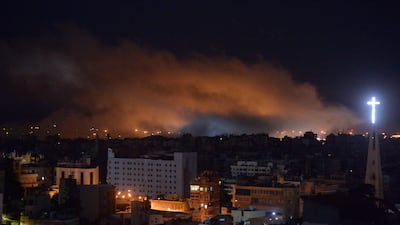
  • Smoke rises after an Israeli air strike on Dahieh in southern Beirut. EPA
    Smoke rises after an Israeli air strike on Dahieh in southern Beirut. EPA
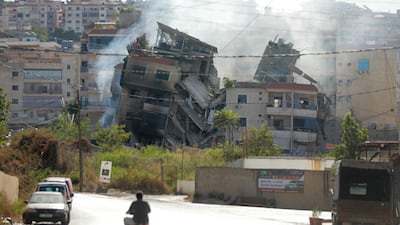
  • People drive next to a building, targeted in an Israeli air strike in Beirut's southern suburbs. AFP
    People drive next to a building, targeted in an Israeli air strike in Beirut's southern suburbs. AFP
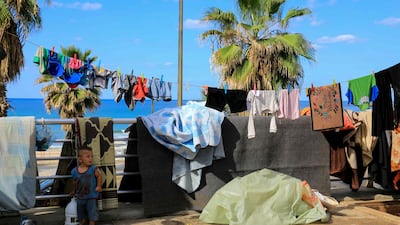
  • A displaced child outside a makeshift tent in Beirut's seaside promenade. AFP
    A displaced child outside a makeshift tent in Beirut's seaside promenade. AFP
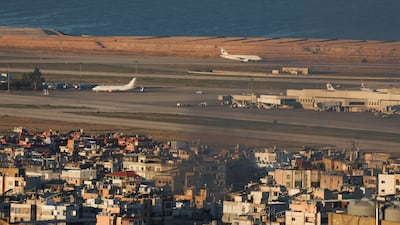
  • Smoke billows over Beirut's southern suburbs near Beirut-Rafic Hariri International Airport after an Israeli air strike. Reuters
    Smoke billows over Beirut's southern suburbs near Beirut-Rafic Hariri International Airport after an Israeli air strike. Reuters
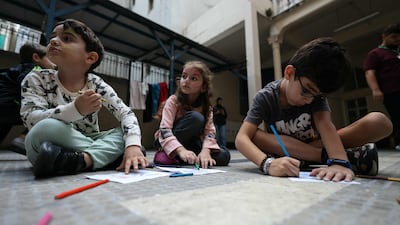
  • Children who fled Israeli bombardment in southern Lebanon, attend a drawing workshop organised by volunteers, at a shelter in Beirut. AFP
    Children who fled Israeli bombardment in southern Lebanon, attend a drawing workshop organised by volunteers, at a shelter in Beirut. AFP
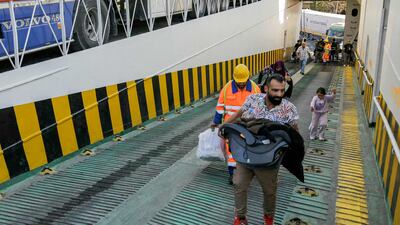
  • People displaced from Lebanon board a ship bound for Turkey at the port of the northern city of Tripoli. AFP
    People displaced from Lebanon board a ship bound for Turkey at the port of the northern city of Tripoli. AFP

Mercer, the investment consulting arm of US services company Marsh & McLennan, expects its wealth division to at least double its assets under management (AUM) in the Middle East as wealth in the region continues to grow despite economic headwinds, a company official said.

Mercer Wealth, which globally has $160 billion in AUM, plans to boost its AUM in the region to $2-$3bn in the next 2-3 years from the present $1bn, said Yasir AbuShaban, a Dubai-based principal with Mercer Wealth.

Within the next two to three years, we are looking at reaching $2 to $3 billion as a conservative estimate and we do see an opportunity to do so,” said Mr AbuShaban.

Mercer does not directly make investments, but allocates clients’ money they have discretion to, to professional asset managers. They also provide advice to clients.

“We have buying power. We can negotiate on their (client’s) behalf with asset managers to provide them lower fees than they otherwise would have to get on their own,” he added.

Mercer Wealth’s clients include sovereign wealth funds, family offices, and insurance companies among others.

From its office in Dubai, Mercer also looks after Africa, India and Turkey, where they also see opportunity for growth.

Wealth creation in Middle East and Africa (MEA) grew 8.5 per cent to $8.1 trillion last year from $7.5tn in 2015, higher than last year’s global average of 6 per cent and the second-highest growth in a region after Asia-Pacific which grew 9.9 per cent, according to consultancy Boston Consulting Group (BCG). In the region, where wealth grew just 1.9 per cent in 2015 compared with 2014, a pickup in oil prices has helped in wealth generation.

BCG is forecasting MEA wealth will rise to $12tn by 2021, growing at an annual average of 8 per cent.

Drivers of wealth generation in the region will be split evenly between new wealth creation and growth of performance of existing assets, according to BCG.

Another general trend in the region is clients’ looking for a comprehensive approach to investing, according to Mr AbuShaban.

“Institutional investors or some of the families are seeing a slowdown in the available capital they have to invest and in that sense they are looking at optimizing the way they manage their portfolios and making sure they are not investing haphazardly and different parts of their investment are working together,” said Mr AbuShaban.

Some clients also have a higher appetite for risk, given the low interest-rate environment that does not provide enough yield for some institutional investors. These clients are keen to invest in illiquid assets, such as private equity and infrastructure.

“What we have seen is a desire for higher returns in what has been a low-return environment specifically in various fixed income or bonds,” he said.

“In this environment, we have seen a de facto increase in the risk that clients are taking in things like illiquid investments, private equity investments, infrastructure and private debt, those kind of investments were higher illiquidity results in incrementally higher returns.”

The Abu Dhabi Investment Authority, one of the largest sovereign wealth funds, said in its 2016 report that has gradually increased its exposure in direct private equity and private credit transactions, mainly in Asian markets and especially in China and India. The authority’s private equity department focused on structured equities owing to “their defensive characteristics.”

Tamkeen's offering
  • Option 1: 70% in year 1, 50% in year 2, 30% in year 3
  • Option 2: 50% across three years
  • Option 3: 30% across five years 
The years Ramadan fell in May

1987

1954

1921

1888

COMPANY%20PROFILE
%3Cp%3EFounder%3A%20Hani%20Abu%20Ghazaleh%3Cbr%3EBased%3A%20Abu%20Dhabi%2C%20with%20an%20office%20in%20Montreal%3Cbr%3EFounded%3A%202018%3Cbr%3ESector%3A%20Virtual%20Reality%3Cbr%3EInvestment%20raised%3A%20%241.2%20million%2C%20and%20nearing%20close%20of%20%245%20million%20new%20funding%20round%3Cbr%3ENumber%20of%20employees%3A%2012%3C%2Fp%3E%0A
Global state-owned investor ranking by size

1.

United States

2.

China

3.

UAE

4.

Japan

5

Norway

6.

Canada

7.

Singapore

8.

Australia

9.

Saudi Arabia

10.

South Korea

How%20champions%20are%20made
%3Cp%3E%0D%3Cstrong%3EDiet%3C%2Fstrong%3E%20%0D%3Cbr%3E7am%20-%20Protein%20shake%20with%20oats%20and%20fruits%0D%3Cbr%3E10am%20-%205-6%20egg%20whites%0D%3Cbr%3E1pm%20-%20White%20rice%20or%20chapati%20(Indian%20bread)%20with%20chicken%0D%3Cbr%3E4pm%20-%20Dry%20fruits%20%0D%3Cbr%3E7.30pm%20-%20Pre%20workout%20meal%20%E2%80%93%20grilled%20fish%20or%20chicken%20with%20veggies%20and%20fruits%0D%3Cbr%3E8.30pm%20to%20midnight%20workout%0D%3Cbr%3E12.30am%20%E2%80%93%20Protein%20shake%20%0D%3Cbr%3E%3Cstrong%3ETotal%20intake%3A%3C%2Fstrong%3E%204000-4500%20calories%20%0D%3Cbr%3E%3Cstrong%3ESaidu%E2%80%99s%20weight%3A%3C%2Fstrong%3E%20110%20kg%0D%3Cbr%3E%3Cstrong%3EStats%3A%3C%2Fstrong%3E%20Biceps%2019%20inches.%20Forearms%2018%20inches%3C%2Fp%3E%0A
Juliot Vinolia’s checklist for adopting alternate-day fasting

-      Don’t do it more than once in three days

-      Don’t go under 700 calories on fasting days

-      Ensure there is sufficient water intake, as the body can go in dehydration mode

-      Ensure there is enough roughage (fibre) in the food on fasting days as well

-      Do not binge on processed or fatty foods on non-fasting days

-      Complement fasting with plant-based foods, fruits, vegetables, seafood. Cut out processed meats and processed carbohydrates

-      Manage your sleep

-      People with existing gastric or mental health issues should avoid fasting

-      Do not fast for prolonged periods without supervision by a qualified expert

The President's Cake

Director: Hasan Hadi

Starring: Baneen Ahmad Nayyef, Waheed Thabet Khreibat, Sajad Mohamad Qasem 

Rating: 4/5

MATCH INFO

Uefa Champions League semi-final, first leg

Tottenham v Ajax, Tuesday, 11pm (UAE).

Second leg

Ajax v Tottenham, Wednesday, May 8, 11pm

Games on BeIN Sports

Ziina users can donate to relief efforts in Beirut

Ziina users will be able to use the app to help relief efforts in Beirut, which has been left reeling after an August blast caused an estimated $15 billion in damage and left thousands homeless. Ziina has partnered with the United Nations High Commissioner for Refugees to raise money for the Lebanese capital, co-founder Faisal Toukan says. “As of October 1, the UNHCR has the first certified badge on Ziina and is automatically part of user's top friends' list during this campaign. Users can now donate any amount to the Beirut relief with two clicks. The money raised will go towards rebuilding houses for the families that were impacted by the explosion.”

Moving%20Out%202
%3Cp%3E%3Cstrong%3EDeveloper%3A%3C%2Fstrong%3E%20SMG%20Studio%3Cbr%3E%3Cstrong%3EPublisher%3A%3C%2Fstrong%3E%20Team17%3Cbr%3E%3Cstrong%3EConsoles%3A%3C%2Fstrong%3E%20Nintendo%20Switch%2C%20PlayStation%204%26amp%3B5%2C%20PC%20and%20Xbox%20One%3Cbr%3E%3Cstrong%3ERating%3A%3C%2Fstrong%3E%204%2F5%3C%2Fp%3E%0A
2025 Fifa Club World Cup groups

Group A: Palmeiras, Porto, Al Ahly, Inter Miami.

Group B: Paris Saint-Germain, Atletico Madrid, Botafogo, Seattle.

Group C: Bayern Munich, Auckland City, Boca Juniors, Benfica.

Group D: Flamengo, ES Tunis, Chelsea, Leon.

Group E: River Plate, Urawa, Monterrey, Inter Milan.

Group F: Fluminense, Borussia Dortmund, Ulsan, Mamelodi Sundowns.

Group G: Manchester City, Wydad, Al Ain, Juventus.

Group H: Real Madrid, Al Hilal, Pachuca, Salzburg.

Updated: October 21, 2024, 4:40 PM