


Floods and famine. Disease and pestilence. A swarm of locusts and rampaging lions. When it came to predictions of disaster, few could surpass the astrologers of ancient Babylon.
Just how bad things might have been 4,000 years ago in what is now Iraq, is revealed in four tablets held by the British Museum, the contents of which have only now been fully translated.
The tablets were acquired between 1882 and 1914 when European archaeologists first excavated Babylon. They are believed to have been unearthed from the ruins of Sippar, a Babylonian city on the east bank of the Euphrates river.
Many of these tablets have survived but have proved notoriously difficult to decipher.
The translation of the tablets into English has now been completed by two scholars: Professor Andrew George of the School of Oriental and African Studies at the University of London, and Junko Taniguchi, an independent researcher into the period. Their work is published this month in the Journal of Cuneiform Studies.
The tablets were created by court astrologers interpreting the meaning of lunar eclipses and are written in cuneiform, one of the earliest forms of writing that uses marks impressed by reed styli on to tablets of wet clay.
Astrology played a vital role for the kings of Babylon, a city about 80km south of present-day Baghdad. The impact of a lunar eclipse could depend on various factors, including the timings and whether it was full or partial.
The Babylonians believed “events in the sky were coded signs placed there by the gods as warnings about the future prospects of those on earth”, Prof George and Ms Taniguchi say.
“Celestial portents related to the highest level of political life: the affairs of kings, their persons, relatives, lands, and peoples. Like other portents observed in the night sky, omens arising from lunar eclipses were thus of great importance for good state craft and well-counselled government.”
The predictions were also “part of an elaborate method of protecting the king and regulating his behaviour in conformity with the wishes of the gods. Kings could also avoid the worst outcomes – at least for themselves – with rituals that provided an alternative and more acceptable ending. This was good news, given that the astrologers’ predictions were almost uniformly terrible”.
Of fire, floods and famine
“There will be famine, people will trade their infant children for silver, there will be a reduction in population,” the royal astronomers predict of one eclipse.
“Rain will be cut out from the sky and floodwater from the rivers. there will be a dearth of food,” reads another.
Adad, an ancient Mesopotamia god of storms, was believed to be responsible for much of the misery. “Adad will devastate my countryside. A large people will go to a small people in order to save themselves,” is said to be the likely meaning of one eclipse, believed to be the work of the moon god. “Adad will wipe out the bounty of the ocean,” reads another prediction.
Nergal, the Mesopotamian god of death, destruction, and war, also featured prominently in these warnings. “Nergal will devour, there will be fatalities in the land,” is one warning. “In spring a locust swarm will arise and strike the crops” reads another, while rampaging lions will “block the exits” of a city.
In better news for the king, some of the predictions apply to other rulers and people. “A great king will die, his throne will be lost, his land will become depopulated, his watercourse will dry up downfall of a field-corps in battle,” is a typical example.
The Elamites, who lived in a country which is now part of southern Iran, received especially dire warnings. “A king of Elam will die. A dog will go mad and nobody that it bites, whether male or female, will survive,” the astrologers say.
It was no better for Amurru, a kingdom in what is now part of Lebanon and Syria. “A king of Amurru will die and his land will everywhere perish,” reads part of one tablet.
The predictions are all linked to a single text, which the researchers say “organises the omens of lunar eclipse by time of night, movement of shadow, duration and date”.
The astrologers were not so much predicting as issuing warnings of future evils, Prof George and Ms Taniguchi say. These could be avoided by performing rituals. The tablets also only identify days when an eclipse might occur, and those when it will not.
As for the accuracy of the predictions, Prof George believes they were based on those past eclipses that had coincidentally been followed by natural disasters or catastrophes.
Tourists visit ancient city of Babylon in Iraq – in pictures
-
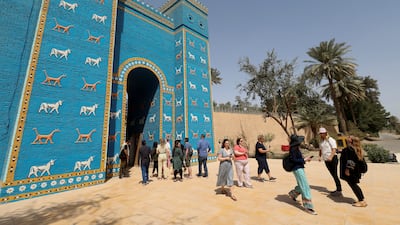
Foreign tourists visit Babylon, in Iraq. All photos: Reuters -
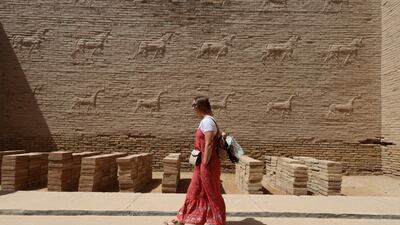
The ancient city was described on a clay tablet from the 23rd century BC -
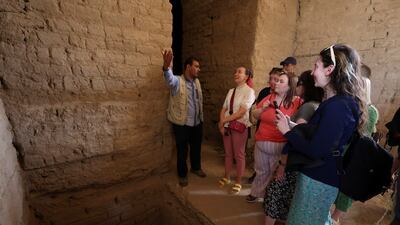
It was declared a Unesco World Heritage Site in 2019 after decades of lobbying by Iraq -
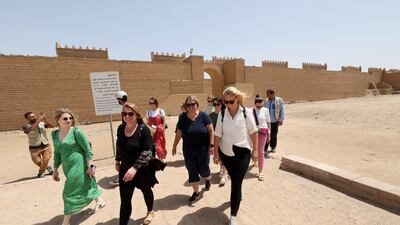
Babylon is about 85 kilometres south of Baghdad, the Iraqi capital -

The Mesopotamian city was built beside the Euphrates River -
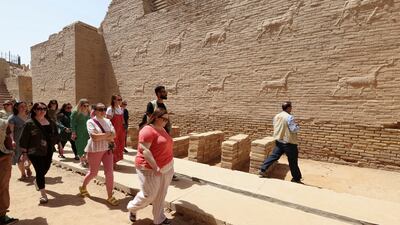
Babylon was once the centre of a vast empire, renowned for its towers and mud-brick temples



