
Chinese President Xi Jinping warned the world was facing a choice between peace or war as he held his country's largest-ever military parade on Wednesday, flanked by Russia's President Vladimir Putin and North Korea's leader Kim Jong-un.
The lavish event to mark 80 years since Japan's defeat at the end of the Second World War has been largely shunned by western leaders, with Mr Putin and Mr Kim – pariahs in the West due to the Ukraine war and Mr Kim's nuclear ambitions – the guests of honour.
Designed to project China's military might and diplomatic clout, it also comes as US President Donald Trump's trade tariffs and volatile policymaking strain its relations with allies and rivals alike.

“Today, mankind is faced with the choice of peace or war, dialogue or confrontation, win-win or zero-sum,” Mr Xi told a crowd of more than 50,000 spectators at Tiananmen Square, adding that the Chinese people “firmly stand on the right side of history”.
Riding in an open-top limousine, Mr Xi then inspected the troops and cutting-edge military equipment such as missiles, tanks and drones on display.
-
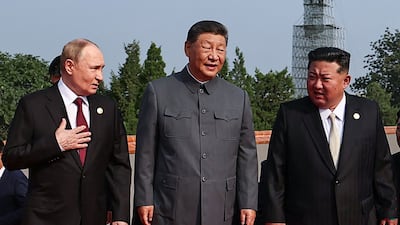
China's President Xi Jinping with Russia's President Vladimir Putin and North Korea's leader Kim Jong-un before a military parade in Beijing’s Tiananmen Square marking the 80th anniversary of victory over Japan and the end of the Second World War. AFP -

Balloons are released over in Beijing’s Tiananmen Square at the end of a military parade marking the 80th anniversary of victory over Japan and the end of the Second World War. AFP -
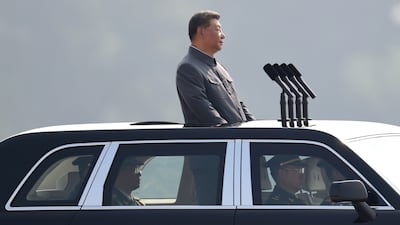
China’s President Xi Jinping attends a military parade in Tiananmen Square, Beijing, marking the 80th anniversary of victory over Japan and the end of the Second World War. Getty Images -
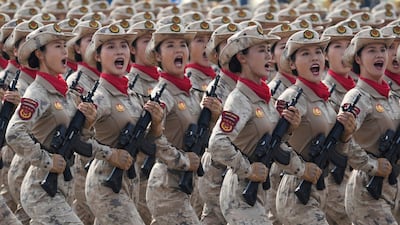
Chinese military personnel at Tiananmen Gate in Beijing take part in a parade to commemorate the 80th anniversary of Japan's Second World War surrender. AP -
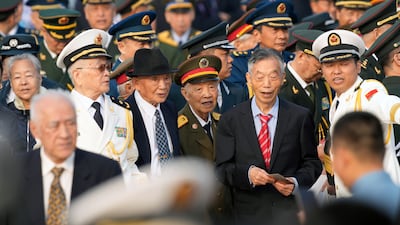
Chinese military veterans arrive at Tiananmen Square in Beijing for a parade to mark 80 years since Japan's defeat in the Second World War. Bloomberg -
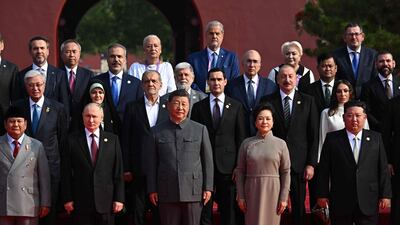
China's President Xi Jinping, his wife Peng Liyuan and dignitaries including Russia's President Vladimir Putin and North Korea's leader Kim Jong-un before a military parade in Beijing’s Tiananmen Square marking the 80th anniversary of victory over Japan and the end of the Second World War. AFP -
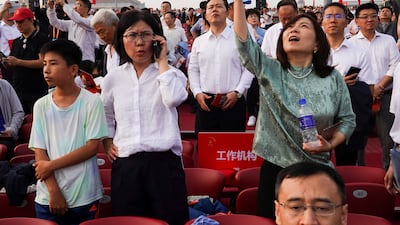
Visitors to Beijing wait for the beginning of a military parade to mark the 80th anniversary of the end of the Second World War. Reuters -

Soldiers rehearse for a military parade in Beijing to mark the 80th anniversary of the end of the Second World War. Reuters -
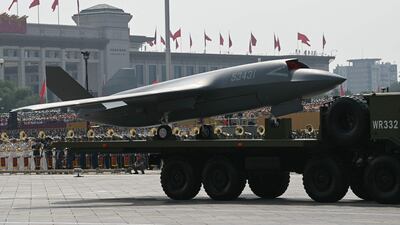
A drone is part of the convoy during a military parade marking the 80th anniversary of victory over Japan and the end of the Second World War in Beijing. AFP -

Chinese soldiers during a military parade in Beijing to mark the 80th anniversary of victory over Japan and the end of the Second World War. AFP -
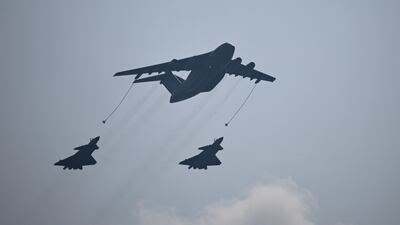
Two Mighty Dragon J-20 stealth fighters and a tanker plane of the People's Liberation Army Air Force fly over the military parade in Beijing marking the 80th anniversary of the end of the Sino-Japanese War. EPA


Helicopters trailing large banners and fighter jets flew in formation above during the 70-minute event thick with symbolism and propaganda which culminated in the release of 80,000 peace doves and colourful balloons.
Wearing a suit in the style of those worn by former leader Mao Zedong, Mr Xi earlier greeted the more than 20 leaders saying “Nice to meet you” and “Welcome to China” in English. Indonesian President Prabowo Subianto, facing widespread protests at home, made a surprise appearance.
Mr Trump, in a post on Truth Social as the parade kicked off, highlighted the US role in helping China secure its freedom from Japan.
“Please give my warmest regards to Vladimir Putin, and Kim Jong Un, as you conspire against The United States of America,” Mr Trump added.

Mr Trump had earlier told reporters he did not see the parade as a challenge to the US and reiterated his “very good relationship” with Mr Xi. Japan's top government representative declined to comment on the parade on Wednesday, adding Asia's top two economies were building constructive relations.
Vision for new global order
Mr Xi has cast the Second World War as a major turning point in the “great rejuvenation of the Chinese nation”, in which it overcame the humiliation of Japan's invasion to become an economic and geopolitical powerhouse.
Earlier this week, Mr Xi unveiled his vision of a new global order at a regional security summit, calling for unity against “hegemonism and power politics”, a thinly veiled swipe at his rival across the Pacific Ocean.
“Xi feels confident that the table has turned. It’s China that is back in the driver’s seat now,” said Wen-Ti Sung, fellow at the Atlantic Council's Global China Hub, based in Taiwan.
“It’s been Trumpian unilateralism rather than China’s wolf warrior diplomacy when people talk about the leading source of uncertainty in the international system,” he added.
Beyond the pomp, analysts are watching whether Mr Xi, Mr Putin and Mr Kim may signal closer defence relations following a pact signed by Russia and North Korea in June last year, and a similar alliance between Beijing and Pyongyang, an outcome that may alter the military calculus in the Asia-Pacific region.
Mr Putin has already used the occasion to seal deeper energy deals with China, while the gathering has given Mr Kim an opportunity to gain implicit support for his banned nuclear weapons.
Mr Kim, debuting in his first major multilateral event, became the first North Korean to attend a Chinese military parade in 66 years.
He travelled to Beijing with his daughter Ju Ae, whom South Korean intelligence consider his most probable successor although she was not seen alongside him at the parade.
Impressive strides
Over the past two years, more than a dozen generals – many formerly close to Mr Xi – have been purged from the People's Liberation Army in a sweeping corruption crackdown.
“The parade allows Xi to focus the world’s attention on its impressive strides in modernising its military hardware, while overshadowing the stubborn challenges afflicting the PLA, most notably the continued purges rolling through the ranks of its most senior officers,” said Jon Czin, a foreign-policy analyst at Brookings Institution, a US-based think tank.
Nothing was left to chance for the milestone gathering.
Major roads and schools were closed in Beijing for the parade, the culmination of weeks of painstaking security preparations and midnight rehearsals.
Local governments nationwide gathered tens of thousands of volunteers and Communist Party members to monitor for any signs of potential unrest around the parade, estimates based on online recruitment notices show.

