Indian soldiers stand guard in the Imphal Valley after a curfew was announced across the north-eastern Indian state of Manipur. AP

Manipur violence: Curfew in Indian state after police kill 10 militants in gunfight


Taniya Dutta
  • English
  • Arabic

Authorities in India's north-eastern Manipur state imposed an indefinite curfew after at least 10 militants were shot dead in clashes with government forces. The incident happened after an attack on a police station in the region gripped by ethnic tension.

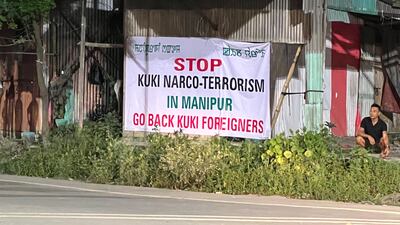
More than 200 people have been killed since May last year in clashes between the majority Meitei Hindus and minority Christian Kukis, with dozens of villages burnt and tens of thousands made homeless in the state that borders Myanmar. The unrest began was caused by a proposed government policy that would benefit the majority of the Meitei community.

The latest violence happened on Monday when the militants, suspected to be Kuki insurgents, launched an attack from two sides on a police station in the Jiribam district, Manipur Police said. The insurgents fired indiscriminately at the police station, with the exchange of fire lasting for about nearly an hour, police said.

“At about 3pm, the CRPF post located at Jakuradhor and Borobekra police station, Jiribam district, was attacked by armed militants. The security forces retaliated strongly,” police said on X. “The attack was fiercely retaliated by CRPF and Civil Police. After 40 to 45 minutes of a heavy exchange of fire, the situation was brought under control."

  • Agnes Haokip, 23, was allegedly attacked by a Meitei Hindu mob a day after ethnic clashes broke out in India's Manipur state. All photos: Taniya Dutta / The National
    Agnes Haokip, 23, was allegedly attacked by a Meitei Hindu mob a day after ethnic clashes broke out in India's Manipur state. All photos: Taniya Dutta / The National
  • Thousands of homes and religious sites have been destroyed in the violence, which began on May 3
    Thousands of homes and religious sites have been destroyed in the violence, which began on May 3
  • Soitinkam Vaiphei was killed by a mob that sexually assaulted his daughter and two other women
    Soitinkam Vaiphei was killed by a mob that sexually assaulted his daughter and two other women
  • Tonsingh Hansingh, seven, was killed by a mob as he was rushed to hospital in an ambulance
    Tonsingh Hansingh, seven, was killed by a mob as he was rushed to hospital in an ambulance
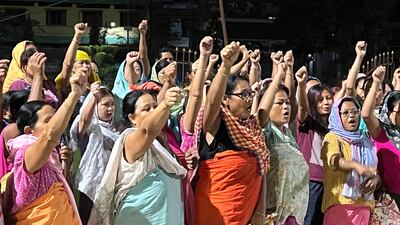
  • The Meira Paibis, a grassroots women's movement, is seeking reprisals against abusers in Manipur
    The Meira Paibis, a grassroots women's movement, is seeking reprisals against abusers in Manipur
  • The women at the night vigil are from Thoubal district in Manipur
    The women at the night vigil are from Thoubal district in Manipur
  • Empty coffins line a road in Churachandpur district as a symbol to remember Christian Kukis killed in the clashes
    Empty coffins line a road in Churachandpur district as a symbol to remember Christian Kukis killed in the clashes

Tribal groups have accused the government forces of carrying out a “premeditated” attack on the militants. “On 11 November, 2024, about 11 Hmar Village Volunteers in Jakhradawr, Jiribam region were brutally ambushed, captured, huddled together and murdered by the combined forces of the CRPF and the Manipur Police under the influence of Meitei militants,” the Hmar Students' Association said in a statement.

Violence was reported in the Imphal Valley after the attack. The Kuki-Zo Council, a prominent tribal body, said that “11 volunteers” were killed and called for a total shutdown in the hilly areas of the state on Tuesday "to express collective grief and solidarity to those who were brutally shot dead".

The state is ruled by Prime Minister Narendra Modi’s Bharatiya Janata Party. Opposition parties and critics of the government have accused Mr Modi of failing to address the violence that continues despite tens of thousands of security personnel being sent to the region.

About 40 per cent of the state's population have traditionally lived in hilly areas that comprise 90 per cent of the land. Meiteis account for more than half of the population and dominate the valley areas, but have been demanding to be included in the tribal list. Such a move would allow them to buy land in the hills dominated by tribes, including the Kuki.


Countries recognising Palestine

France, UK, Canada, Australia, Portugal, Belgium, Malta, Luxembourg, San Marino and Andorra


COMPANY PROFILE
Name: Kumulus Water
 
Started: 2021
 
Founders: Iheb Triki and Mohamed Ali Abid
 
Based: Tunisia 
 
Sector: Water technology 
 
Number of staff: 22 
 
Investment raised: $4 million 
The biog

Name: Salem Alkarbi

Age: 32

Favourite Al Wasl player: Alexandre Oliveira

First started supporting Al Wasl: 7

Biggest rival: Al Nasr

How Beautiful this world is!
The Bio

Name: Lynn Davison

Profession: History teacher at Al Yasmina Academy, Abu Dhabi

Children: She has one son, Casey, 28

Hometown: Pontefract, West Yorkshire in the UK

Favourite book: The Alchemist by Paulo Coelho

Favourite Author: CJ Sansom

Favourite holiday destination: Bali

Favourite food: A Sunday roast

Mina Cup winners

Under 12 – Minerva Academy

Under 14 – Unam Pumas

Under 16 – Fursan Hispania

Under 18 – Madenat

Ten tax points to be aware of in 2026

1. Domestic VAT refund amendments: request your refund within five years

If a business does not apply for the refund on time, they lose their credit.

2. E-invoicing in the UAE

Businesses should continue preparing for the implementation of e-invoicing in the UAE, with 2026 a preparation and transition period ahead of phased mandatory adoption. 

3. More tax audits

Tax authorities are increasingly using data already available across multiple filings to identify audit risks. 

4. More beneficial VAT and excise tax penalty regime

Tax disputes are expected to become more frequent and more structured, with clearer administrative objection and appeal processes. The UAE has adopted a new penalty regime for VAT and excise disputes, which now mirrors the penalty regime for corporate tax.

5. Greater emphasis on statutory audit

There is a greater need for the accuracy of financial statements. The International Financial Reporting Standards standards need to be strictly adhered to and, as a result, the quality of the audits will need to increase.

6. Further transfer pricing enforcement

Transfer pricing enforcement, which refers to the practice of establishing prices for internal transactions between related entities, is expected to broaden in scope. The UAE will shortly open the possibility to negotiate advance pricing agreements, or essentially rulings for transfer pricing purposes. 

7. Limited time periods for audits

Recent amendments also introduce a default five-year limitation period for tax audits and assessments, subject to specific statutory exceptions. While the standard audit and assessment period is five years, this may be extended to up to 15 years in cases involving fraud or tax evasion. 

8. Pillar 2 implementation 

Many multinational groups will begin to feel the practical effect of the Domestic Minimum Top-Up Tax (DMTT), the UAE's implementation of the OECD’s global minimum tax under Pillar 2. While the rules apply for financial years starting on or after January 1, 2025, it is 2026 that marks the transition to an operational phase.

9. Reduced compliance obligations for imported goods and services

Businesses that apply the reverse-charge mechanism for VAT purposes in the UAE may benefit from reduced compliance obligations. 

10. Substance and CbC reporting focus

Tax authorities are expected to continue strengthening the enforcement of economic substance and Country-by-Country (CbC) reporting frameworks. In the UAE, these regimes are increasingly being used as risk-assessment tools, providing tax authorities with a comprehensive view of multinational groups’ global footprints and enabling them to assess whether profits are aligned with real economic activity. 

Contributed by Thomas Vanhee and Hend Rashwan, Aurifer

Updated: November 12, 2024, 8:29 AM