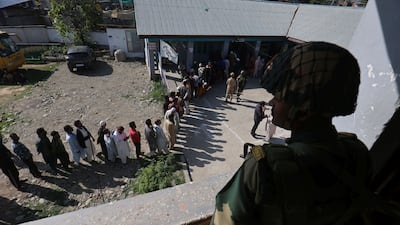
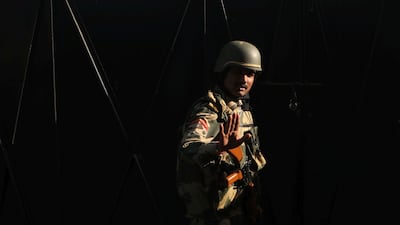
• An Indian paramilitary soldier stands guard as people wait to cast their votes in the first phase of the local assembly elections in south Kashmir. EPA
    An Indian paramilitary soldier stands guard as people wait to cast their votes in the first phase of the local assembly elections in south Kashmir. EPA
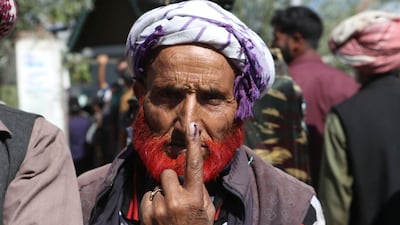
  • A Kashmiri man shows his-marked finger outside a polling station. EPA
    A Kashmiri man shows his-marked finger outside a polling station. EPA
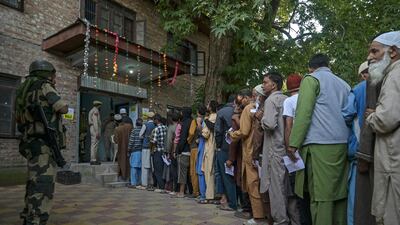
  • An Indian security personnel stands guard as voters queue to cast their ballots in Pulwama, south of Srinagar. AFP
    An Indian security personnel stands guard as voters queue to cast their ballots in Pulwama, south of Srinagar. AFP
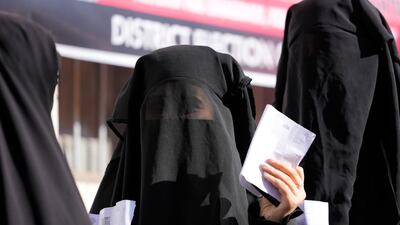
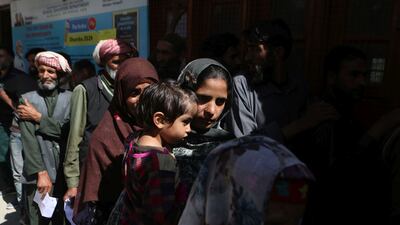
  • Muslim women queue to cast their votes in Kishtwar, India. AP
    Muslim women queue to cast their votes in Kishtwar, India. AP
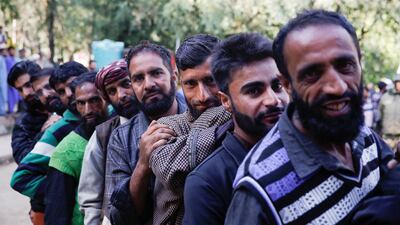
  • People stand in a queue to vote in south Kashmir's Kokernag. Reuters
    People stand in a queue to vote in south Kashmir's Kokernag. Reuters
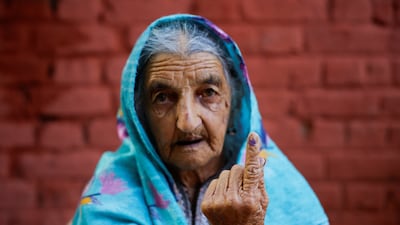
  • Taja Begum, 85, shows her ink-marked finger after casting her vote in Kokernag. Reuters
    Taja Begum, 85, shows her ink-marked finger after casting her vote in Kokernag. Reuters
  • Paramilitary soldiers stand guard as people queue up to vote in Kishtwar, India. AP
    Paramilitary soldiers stand guard as people queue up to vote in Kishtwar, India. AP
  • People wait to cast their votes in south Kashmir's Shopian district. EPA
    People wait to cast their votes in south Kashmir's Shopian district. EPA
  • An Indian paramilitary soldier stands guard outside a polling station in south Kashmir's Pulwama district. EPA
    An Indian paramilitary soldier stands guard outside a polling station in south Kashmir's Pulwama district. EPA

Indian-administered Kashmir goes to first regional elections in a decade


Taniya Dutta
  • English
  • Arabic

Voting for the regional elections in India-administered Jammu and Kashmir began on Wednesday, the first time in a decade.

Turnout was 41 per cent in the morning of the first round of the three-phase polls, the Election Commission of India said.

The vote for the legislative assembly will conclude on October 1, and counting will start on October 8 with results expected the same day. The first phase of polls is underway in 24 of the region’s 90 constituencies. Almost 2.3 million voters are registered to cast their ballots in this phase.

The National Conference (NC) and the People’s Democratic Party (PDP) are the major regional political players, along with dozens of independent candidates. Bharatiya Janata Party and the Indian National Congress, the national parties, are also in the fray in the restive region that has been in the grip of a decades-long armed turmoil.

The disputed Muslim-majority region was divided between India and Pakistan since the subcontinent gained independence from British colonial rule in 1947. Both nations claim it in its entirety.

An armed rebellion against New Delhi has been waged since late 1980s, with tens of thousands of people, mostly civilians killed in the conflict, amid regular poll boycott campaigns by separatists. The last local election in the region was held in December 2014, with the popular government stepping down in 2018 when Prime Minister Narendra Modi’s Bharatiya Janata Party pulled out of an alliance with a local party.

  • An Indian paramilitary soldier stands guard as people wait to cast their votes in the first phase of the local assembly elections in south Kashmir. EPA
    An Indian paramilitary soldier stands guard as people wait to cast their votes in the first phase of the local assembly elections in south Kashmir. EPA
  • A Kashmiri man shows his-marked finger outside a polling station. EPA
    A Kashmiri man shows his-marked finger outside a polling station. EPA
  • An Indian security personnel stands guard as voters queue to cast their ballots in Pulwama, south of Srinagar. AFP
    An Indian security personnel stands guard as voters queue to cast their ballots in Pulwama, south of Srinagar. AFP
  • Muslim women queue to cast their votes in Kishtwar, India. AP
    Muslim women queue to cast their votes in Kishtwar, India. AP
  • People stand in a queue to vote in south Kashmir's Kokernag. Reuters
    People stand in a queue to vote in south Kashmir's Kokernag. Reuters
  • Taja Begum, 85, shows her ink-marked finger after casting her vote in Kokernag. Reuters
    Taja Begum, 85, shows her ink-marked finger after casting her vote in Kokernag. Reuters
  • Paramilitary soldiers stand guard as people queue up to vote in Kishtwar, India. AP
    Paramilitary soldiers stand guard as people queue up to vote in Kishtwar, India. AP
  • People wait to cast their votes in south Kashmir's Shopian district. EPA
    People wait to cast their votes in south Kashmir's Shopian district. EPA
  • An Indian paramilitary soldier stands guard outside a polling station in south Kashmir's Pulwama district. EPA
    An Indian paramilitary soldier stands guard outside a polling station in south Kashmir's Pulwama district. EPA

The region has had no elected government since 2018 and it was brought under federal rule by Mr Modi’s government, which in a shock decision in August 2019 stripped the disputed territory of its limited autonomy, downgrading and dividing the state into federally administered regions of Jammu, Kashmir and Ladakh.

All regional parties have promised to work for the restoration of the statehood and special status of the region.

The new government will have decision-making powers only limited to the region's civic affairs and public administration, with Mr Modi’s government having absolute powers on the federal territory's law and order.

Aisha, 90, shows her ink-marked finger after casting her vote at a polling station during the first phase of the assembly election in south Kashmir's Bijbehara town. Reuters

A total of 8.7 million voters, comprising about 4.5 million males and 4.2 million females, are registered to exercise their right in these polls, according to the Election Commission of India.

The National Conference is led by former Chief Minister Omar Abdullah and is fighting the polls in alliance with Indian National Congress, the main national opposition party.

The PDP is being led by Mehbooba Mufti, who was the last chief minister of the former state and was in alliance with Mr Modi’s Bharatiya Janata Party.

The elections are taking place after the delimitation process – redrawing boundaries for assembly constituencies depending on religious voter share – in Hindu-dominated Jammu region and Muslim-dominated Kashmir that will increase seat sharing of the Hindu-majority Jammu region, a BJP stronghold.

The BJP has struggled to hold influence in Muslim-dominated Kashmir valley but has a significant presence in Hindu-dominated Jammu region and the increase in seat sharing in Jammu is expected to favour the BJP in the polls.


How to get there

Emirates (www.emirates.com) flies directly to Hanoi, Vietnam, with fares starting from around Dh2,725 return, while Etihad (www.etihad.com) fares cost about Dh2,213 return with a stop. Chuong is 25 kilometres south of Hanoi.
 

Key findings of Jenkins report
  • Founder of the Muslim Brotherhood, Hassan al Banna, "accepted the political utility of violence"
  • Views of key Muslim Brotherhood ideologue, Sayyid Qutb, have “consistently been understood” as permitting “the use of extreme violence in the pursuit of the perfect Islamic society” and “never been institutionally disowned” by the movement.
  • Muslim Brotherhood at all levels has repeatedly defended Hamas attacks against Israel, including the use of suicide bombers and the killing of civilians.
  • Laying out the report in the House of Commons, David Cameron told MPs: "The main findings of the review support the conclusion that membership of, association with, or influence by the Muslim Brotherhood should be considered as a possible indicator of extremism."
Company profile

Name: Back to Games and Boardgame Space

Started: Back to Games (2015); Boardgame Space (Mark Azzam became co-founder in 2017)

Founder: Back to Games (Mr Azzam); Boardgame Space (Mr Azzam and Feras Al Bastaki)

Based: Dubai and Abu Dhabi 

Industry: Back to Games (retail); Boardgame Space (wholesale and distribution) 

Funding: Back to Games: self-funded by Mr Azzam with Dh1.3 million; Mr Azzam invested Dh250,000 in Boardgame Space  

Growth: Back to Games: from 300 products in 2015 to 7,000 in 2019; Boardgame Space: from 34 games in 2017 to 3,500 in 2019

The years Ramadan fell in May

1987

1954

1921

1888

Updated: September 18, 2024, 9:43 AM