Smoke rises from a coal-fired power plant on the Yangtze river in Nantong in eastern China's Jiangsu province. AP

As China makes strides on climate change, new potent emissions emerge


Daniel Bardsley
  • English
  • Arabic

China is the world's biggest carbon dioxide emitter, accounting for 31 per cent of the amount generated globally last year.

The country's CO2 emissions from energy and cement production rose about 4 per cent in 2023, helping total worldwide emissions increase by 1.1 per cent to a high of 36.8 billion tonnes of CO2, the Global Carbon Budget initiative reported.

So steps taken by China, which until recently was the world’s most populous nation, are key to long-term efforts to combat climate change.

When it comes to containing emission levels, as China goes, so goes the world.

"What China’s emissions do is responsible for global emissions," said Asher Minns, executive director of the Tyndall Centre for Climate Change Research at the University of East Anglia in the UK.

"When China peaks in emissions, that completely influences the peak of global emissions, as it is the highest-emitting country."

Mr Minns said "absolutely much more" needs to be done to limit global emissions if the world is to meet its climate targets and avoid the worst effects of climate change.

Have China’s CO2 emissions already peaked?

The signs so far are that China’s CO2 emissions this year could be lower than those of 2023, according to Lauri Myllyvirta, lead analyst at the Centre for Research on Energy and Clean Air and senior fellow at the Asia Society Policy Institute.

Numerous factors are at play, notably China’s investments in renewable energy technology such as solar and wind, which have caused the share of China’s energy-generating capacity from fossil fuels to fall.

Analysis published by Carbon Brief indicated that coal generated a record low of 53 per cent of China’s electricity in May, down seven percentage points on a year earlier. The same month, clean energy generated 44 per cent of China’s electricity, the highest-ever figure.

"It's highly likely that China's emissions will fall this year because of the huge amount of clean-energy capacity that has been installed last year and this year," Mr Myllyvirta said.

"We'll continue to see big increases in power generation from clean sources, which will displace the growth in coal-fired power generation.

"There's also the ongoing fall in consumption of oil products aided by the shift to electric vehicles, and the construction sector continues to contract, so the production of steel and cement, the two most highly emitting commodities or industrial products in China, is falling."

In March, China’s monthly year-on-year CO2 emissions fell for the first time since an increase lasting more than a year began after Covid-19 restrictions were lifted.

Just as China’s emissions from power generation and industry may have peaked last year, so may those of the world as a whole.

Will China’s CO2 drop continue?

Workers inspect solar panels on the rooftop of a power plant in China's Fujian province. AFP

When it comes to China’s carbon emissions, not all forces are pushing in the same direction, Mr Myllyvirta indicated.

Local governments and many state-owned enterprises in the country were, he said, "very enthusiastically and aggressively" pursuing clean energy projects, even if some regulators were less ambitious.

China’s State Council, the country’s key executive body, is giving "renewed attention" to reducing CO2 emissions, so current trends are likely to continue for at least the next couple of years.

One caveat relates to China’s heavy investment in coal-fired power stations.

The Global Energy Monitor reported in April that China was responsible for 95 per cent of new coal power construction last year, having begun work on 70 gigawatts of capacity.

"China's been building a lot of coal-fired power plants as a back up ... to make sure there's enough generating capacity at times when demand is peaking and output from wind and solar is slow," Mr Myllyvirta said.

"The owners of those power plants of course have an interest in preserving the role of coal in the power system and that's likely to result in pushback against the clean energy growth."

Another key issue is how China’s economy evolves. The country’s economic growth has involved the expansion of energy-intensive industries, causing total energy consumption to increase significantly.

If the economy pivots towards "higher value-added sectors and services" and household consumption, Mr Myllyvirta said, growth in energy consumption may moderate, making it easier to meet increases in demand with clean energy.

Could other greenhouse gases derail China's progress?

Recent Massachusetts Institute of Technology (MIT) research sparked headlines by indicating that China was releasing larger quantities of gases much more powerful than CO2 at causing climate change.

In two studies, scientists found big increases in the release during the 2010s of perfluorocarbons, which have global warming potential that, MIT stated, is "thousands of times that of CO2".

They are also very persistent, remaining in the atmosphere for tens of thousands of years, unlike methane, for example, which lasts only about 10 years.

Emissions of tetrafluoromethane and hexafluoroethane, which are generated during aluminium smelting, jumped 78 per cent, while those of perfluorocyclobutane, created as a by-product in factories that generate a chemical used in non-stick cookware coatings, went up by 70 per cent.

China accounted for the majority of the global increase in the release of these gases, according to MIT.

Mr Myllyvirta said it was "really important" for China to include gases other than CO2 in its future climate targets.

Beijing should also, he said, confirm that the country’s commitment to reach net zero by 2060 covers all greenhouse gases, not only CO2.

"There’s a lot of potential for reducing these emissions in the short term. China can make a lot more progress over the next decade if all of these different gases are covered," Mr Myllyvirta said.

Nonetheless, he said the global warming effect of tetrafluoromethane and hexafluoroethane, while "significant", was relatively modest when compared to China’s other emissions.

"The emissions of those two gases are about 0.5 per cent of China's total," he said.

Even if China’s and the world’s emissions from energy generation and industry have peaked, the planet remains far off achieving a 45 per cent reduction in greenhouse gas emissions by 2030, said to be needed if global temperature increases are to be kept within 1.5°C of pre-industrial levels.

Eight countries with net-zero emissions - in pictures

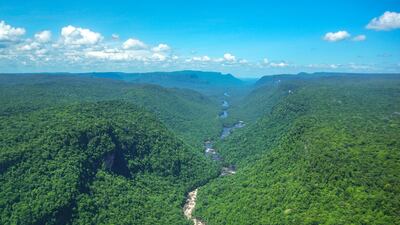
  • Guyana is net zero thanks to dense rainforest cover, despite being a newly oil-producing nation. AFP
    Guyana is net zero thanks to dense rainforest cover, despite being a newly oil-producing nation. AFP
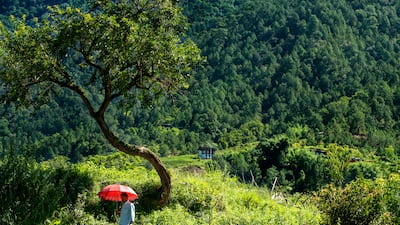
  • Bhutan was the first country to report net-zero emissions. Getty
    Bhutan was the first country to report net-zero emissions. Getty
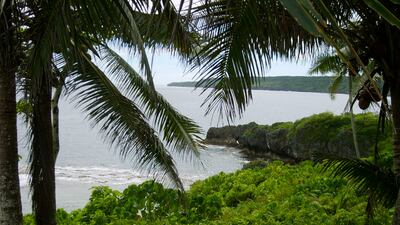
  • Niue's emissions are negligible, at less than 0.0001 per cent. Photo: Flickr
    Niue's emissions are negligible, at less than 0.0001 per cent. Photo: Flickr
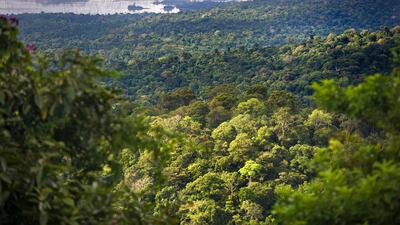
  • Suriname's forests absorb billions of tonnes of CO2. Getty
    Suriname's forests absorb billions of tonnes of CO2. Getty
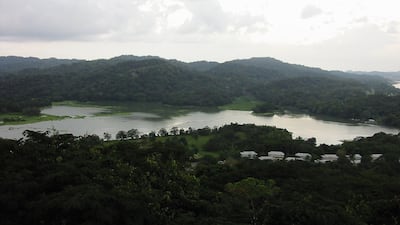
  • Panama was one of the first three countries to report net-zero emissions. Photo: Flickr
    Panama was one of the first three countries to report net-zero emissions. Photo: Flickr
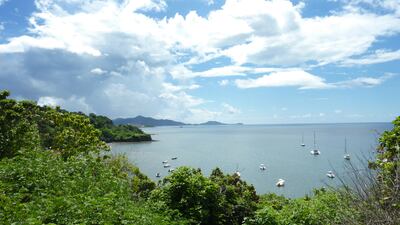
  • The Comoros government has reported its carbon emissions have been in the negative since at least 2015. AFP
    The Comoros government has reported its carbon emissions have been in the negative since at least 2015. AFP
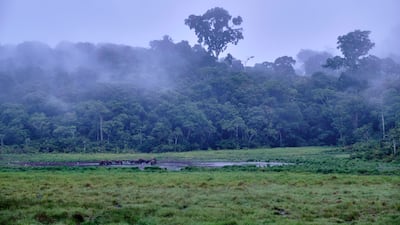
  • Almost 90 per cent of Gabon's surface is covered by forests, allowing for optimal carbon absorption. Getty
    Almost 90 per cent of Gabon's surface is covered by forests, allowing for optimal carbon absorption. Getty
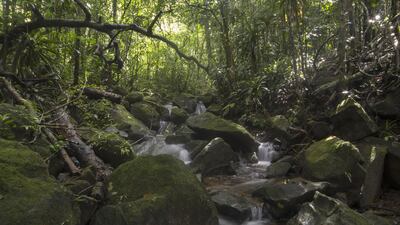
  • Madagascar may lose its net-zero status if rampant deforestation continues. Photo: Alexandra Laube / imageBROKER / Shutterstock
    Madagascar may lose its net-zero status if rampant deforestation continues. Photo: Alexandra Laube / imageBROKER / Shutterstock
Dubai Bling season three

Cast: Loujain Adada, Zeina Khoury, Farhana Bodi, Ebraheem Al Samadi, Mona Kattan, and couples Safa & Fahad Siddiqui and DJ Bliss & Danya Mohammed 

Rating: 1/5

TV: World Cup Qualifier 2018 matches will be aired on on OSN Sports HD Cricket channel

David Haye record

Total fights: 32
Wins: 28
Wins by KO: 26
Losses: 4

COMPANY PROFILE
Name: Airev
Started: September 2023
Founder: Muhammad Khalid
Based: Abu Dhabi
Sector: Generative AI
Initial investment: Undisclosed
Investment stage: Series A
Investors: Core42
Current number of staff: 47
 
Company%C2%A0profile
%3Cp%3E%3Cstrong%3EDate%20started%3A%20%3C%2Fstrong%3EMay%202022%3Cbr%3E%3Cstrong%3EFounder%3A%20%3C%2Fstrong%3EHusam%20Aboul%20Hosn%3Cbr%3E%3Cstrong%3EBased%3A%20%3C%2Fstrong%3EDIFC%3Cbr%3E%3Cstrong%3ESector%3A%20%3C%2Fstrong%3EFinTech%20%E2%80%94%20Innovation%20Hub%3Cbr%3E%3Cstrong%3EEmployees%3A%20%3C%2Fstrong%3Eeight%3Cbr%3E%3Cstrong%3EStage%3A%20%3C%2Fstrong%3Epre-seed%3Cbr%3E%3Cstrong%3EInvestors%3A%20%3C%2Fstrong%3Epre-seed%20funding%20raised%20from%20family%20and%20friends%20earlier%20this%20year%3C%2Fp%3E%0A

Mercer, the investment consulting arm of US services company Marsh & McLennan, expects its wealth division to at least double its assets under management (AUM) in the Middle East as wealth in the region continues to grow despite economic headwinds, a company official said.

Mercer Wealth, which globally has $160 billion in AUM, plans to boost its AUM in the region to $2-$3bn in the next 2-3 years from the present $1bn, said Yasir AbuShaban, a Dubai-based principal with Mercer Wealth.

Within the next two to three years, we are looking at reaching $2 to $3 billion as a conservative estimate and we do see an opportunity to do so,” said Mr AbuShaban.

Mercer does not directly make investments, but allocates clients’ money they have discretion to, to professional asset managers. They also provide advice to clients.

“We have buying power. We can negotiate on their (client’s) behalf with asset managers to provide them lower fees than they otherwise would have to get on their own,” he added.

Mercer Wealth’s clients include sovereign wealth funds, family offices, and insurance companies among others.

From its office in Dubai, Mercer also looks after Africa, India and Turkey, where they also see opportunity for growth.

Wealth creation in Middle East and Africa (MEA) grew 8.5 per cent to $8.1 trillion last year from $7.5tn in 2015, higher than last year’s global average of 6 per cent and the second-highest growth in a region after Asia-Pacific which grew 9.9 per cent, according to consultancy Boston Consulting Group (BCG). In the region, where wealth grew just 1.9 per cent in 2015 compared with 2014, a pickup in oil prices has helped in wealth generation.

BCG is forecasting MEA wealth will rise to $12tn by 2021, growing at an annual average of 8 per cent.

Drivers of wealth generation in the region will be split evenly between new wealth creation and growth of performance of existing assets, according to BCG.

Another general trend in the region is clients’ looking for a comprehensive approach to investing, according to Mr AbuShaban.

“Institutional investors or some of the families are seeing a slowdown in the available capital they have to invest and in that sense they are looking at optimizing the way they manage their portfolios and making sure they are not investing haphazardly and different parts of their investment are working together,” said Mr AbuShaban.

Some clients also have a higher appetite for risk, given the low interest-rate environment that does not provide enough yield for some institutional investors. These clients are keen to invest in illiquid assets, such as private equity and infrastructure.

“What we have seen is a desire for higher returns in what has been a low-return environment specifically in various fixed income or bonds,” he said.

“In this environment, we have seen a de facto increase in the risk that clients are taking in things like illiquid investments, private equity investments, infrastructure and private debt, those kind of investments were higher illiquidity results in incrementally higher returns.”

The Abu Dhabi Investment Authority, one of the largest sovereign wealth funds, said in its 2016 report that has gradually increased its exposure in direct private equity and private credit transactions, mainly in Asian markets and especially in China and India. The authority’s private equity department focused on structured equities owing to “their defensive characteristics.”

The burning issue

The internal combustion engine is facing a watershed moment – major manufacturer Volvo is to stop producing petroleum-powered vehicles by 2021 and countries in Europe, including the UK, have vowed to ban their sale before 2040. The National takes a look at the story of one of the most successful technologies of the last 100 years and how it has impacted life in the UAE. 

Read part four: an affection for classic cars lives on

Read part three: the age of the electric vehicle begins

Read part two: how climate change drove the race for an alternative 

MATCH RESULT

Al Jazira 3 Persepolis 2
Jazira:
Mabkhout (52'), Romarinho (77'), Al Hammadi (90' 6)
Persepolis: Alipour (42'), Mensha (84')

HIJRA

Starring: Lamar Faden, Khairiah Nathmy, Nawaf Al-Dhufairy

Director: Shahad Ameen

Rating: 3/5

EA Sports FC 24

Company profile

Name: Fruitful Day

Founders: Marie-Christine Luijckx, Lyla Dalal AlRawi, Lindsey Fournie

Based: Dubai, UAE

Founded: 2015

Number of employees: 30

Sector: F&B

Funding so far: Dh3 million

Future funding plans: None at present

Future markets: Saudi Arabia, potentially Kuwait and other GCC countries

Company%20profile
%3Cp%3EDate%20started%3A%20January%202022%3Cbr%3EFounders%3A%20Omar%20Abu%20Innab%2C%20Silvia%20Eldawi%2C%20Walid%20Shihabi%3Cbr%3EBased%3A%20Dubai%3Cbr%3ESector%3A%20PropTech%20%2F%20investment%3Cbr%3EEmployees%3A%2040%3Cbr%3EStage%3A%20Seed%3Cbr%3EInvestors%3A%20Multiple%3C%2Fp%3E%0A
Updated: July 18, 2024, 4:19 PM