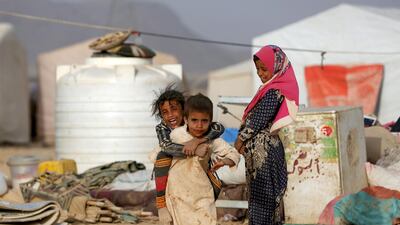
The UN launched humanitarian flights to Yemen's Marib region on Tuesday, where a Houthi rebel assault on a government-held city killed dozens of civilians and forced tens of thousands from their homes.
UN spokesman Farhan Haq said the flights were possible after co-ordination with "de facto authorities" in Yemen. A schedule for the flights was being finalised.
“Today, the UN started regular humanitarian air service flights to Marib,” Mr Haq said.
Read More
Yemen will not be a platform for attacks against Saudi Arabia, Arab League says
US Yemen envoy: work needed to get Houthis 'to put down their guns'
Yemen's 'sons of the desert' fight to save homes from Houthi offensive
“This will cut the journey down to two hours from seven and will help the humanitarian community to quickly deliver much-needed assistance.”
He said the flights, which travel from Djibouti through Aden, would deliver life-saving supplies to civilians forced from their homes by “fierce fighting” in Marib.
“Nearly 20,000 people have been displaced by violence in the region since early February and dozens of civilians have been killed or injured,” Mr Haq said.
“Humanitarian organisations are on the ground responding to these growing humanitarian needs.”
The Iran-backed Houthi rebels have made gains in the battle for Marib, advancing close to the city centre at the weekend despite enduring heavy casualties.
Marib and its surrounding oilfields are the last significant pocket of government-held territory in the north. The rest is under rebel control, including the capital Sanaa.
Analysts say the Houthis are intent on capturing the city for leverage before any negotiations with the government, amid a US push to revive peace talks.
The city's fall could worsen Yemen’s humanitarian situation, as many civilians displaced from fighting elsewhere in the country have sought refuge there.
About 140 camps have sprung up in the surrounding desert to provide basic shelter for up to two million displaced people, the Yemeni government said.
Hundreds of combatants have been killed since the offensive began.
The UN's humanitarian chief, Mark Lowcock, told the Security Council on Tuesday that civilians were paying the price for the fighting.
“Air strikes and shelling have hit farms, markets, food storage sites and fishing boats,” Mr Lowcock said.
“A study last year in Yemen showed how the use of heavy explosive weapons in populated areas has disrupted every resource and system in the country, including water and power supplies, hospitals and sanitation systems.”
Yemen’s conflict has claimed 233,000 lives and pushed the country towards famine and what the UN calls the world’s worst humanitarian emergency.
Fighting began in 2014 when the Iran-aligned Houthis seized Sanaa and later ousted the internationally recognised government of President Abdrabu Mansur Hadi.
A Saudi-led coalition intervened militarily after a request from the government.
US President Joe Biden ended US support for the war and launched a diplomatic effort for a peace deal that has yet to gain traction.
The UN envoy to Yemen, Martin Griffiths, held talks in Cairo on Monday with Egyptian officials, intent on reviving the political process to end the conflict.
“Mr Griffiths stressed the need for the attack on Marib to stop,” Mr Haq said.
“He warned of the dire humanitarian consequences of the continued attack and the risks to the prospects of the peace process.”

Who was Alfred Nobel?
The Nobel Prize was created by wealthy Swedish chemist and entrepreneur Alfred Nobel.
- In his will he dictated that the bulk of his estate should be used to fund "prizes to those who, during the preceding year, have conferred the greatest benefit to humankind".
- Nobel is best known as the inventor of dynamite, but also wrote poetry and drama and could speak Russian, French, English and German by the age of 17. The five original prize categories reflect the interests closest to his heart.
- Nobel died in 1896 but it took until 1901, following a legal battle over his will, before the first prizes were awarded.
Match info:
Burnley 0
Manchester United 2
Lukaku (22', 44')
Red card: Marcus Rashford (Man United)
Man of the match: Romelu Lukaku (Manchester United)
Super Bowl LIII schedule
What Super Bowl LIII
Who is playing New England Patriots v Los Angeles Rams
Where Mercedes-Benz Stadium in Atlanta, United States
When Sunday (start time is 3.30am on Monday UAE time)
Frankenstein in Baghdad
Ahmed Saadawi
Penguin Press
UAE currency: the story behind the money in your pockets
Results
6.30pm: Dubai Millennium Stakes Group Three US$200,000 (Turf) 2,000m; Winner: Ghaiyyath, William Buick (jockey), Charlie Appleby (trainer).
7.05pm: Handicap $135,000 (T) 1,600m; Winner: Cliffs Of Capri, Tadhg O’Shea, Jamie Osborne.
7.40pm: UAE Oaks Group Three $250,000 (Dirt) 1,900m; Winner: Down On Da Bayou, Mickael Barzalona, Salem bin Ghadayer.
8.15pm: Zabeel Mile Group Two $250,000 (T) 1,600m; Winner: Zakouski, James Doyle, Charlie Appleby.
8.50pm: Meydan Sprint Group Two $250,000 (T) 1,000m; Winner: Waady, Jim Crowley, Doug Watson.
Mercer, the investment consulting arm of US services company Marsh & McLennan, expects its wealth division to at least double its assets under management (AUM) in the Middle East as wealth in the region continues to grow despite economic headwinds, a company official said.
Mercer Wealth, which globally has $160 billion in AUM, plans to boost its AUM in the region to $2-$3bn in the next 2-3 years from the present $1bn, said Yasir AbuShaban, a Dubai-based principal with Mercer Wealth.
“Within the next two to three years, we are looking at reaching $2 to $3 billion as a conservative estimate and we do see an opportunity to do so,” said Mr AbuShaban.
Mercer does not directly make investments, but allocates clients’ money they have discretion to, to professional asset managers. They also provide advice to clients.
“We have buying power. We can negotiate on their (client’s) behalf with asset managers to provide them lower fees than they otherwise would have to get on their own,” he added.
Mercer Wealth’s clients include sovereign wealth funds, family offices, and insurance companies among others.
From its office in Dubai, Mercer also looks after Africa, India and Turkey, where they also see opportunity for growth.
Wealth creation in Middle East and Africa (MEA) grew 8.5 per cent to $8.1 trillion last year from $7.5tn in 2015, higher than last year’s global average of 6 per cent and the second-highest growth in a region after Asia-Pacific which grew 9.9 per cent, according to consultancy Boston Consulting Group (BCG). In the region, where wealth grew just 1.9 per cent in 2015 compared with 2014, a pickup in oil prices has helped in wealth generation.
BCG is forecasting MEA wealth will rise to $12tn by 2021, growing at an annual average of 8 per cent.
Drivers of wealth generation in the region will be split evenly between new wealth creation and growth of performance of existing assets, according to BCG.
Another general trend in the region is clients’ looking for a comprehensive approach to investing, according to Mr AbuShaban.
“Institutional investors or some of the families are seeing a slowdown in the available capital they have to invest and in that sense they are looking at optimizing the way they manage their portfolios and making sure they are not investing haphazardly and different parts of their investment are working together,” said Mr AbuShaban.
Some clients also have a higher appetite for risk, given the low interest-rate environment that does not provide enough yield for some institutional investors. These clients are keen to invest in illiquid assets, such as private equity and infrastructure.
“What we have seen is a desire for higher returns in what has been a low-return environment specifically in various fixed income or bonds,” he said.
“In this environment, we have seen a de facto increase in the risk that clients are taking in things like illiquid investments, private equity investments, infrastructure and private debt, those kind of investments were higher illiquidity results in incrementally higher returns.”
The Abu Dhabi Investment Authority, one of the largest sovereign wealth funds, said in its 2016 report that has gradually increased its exposure in direct private equity and private credit transactions, mainly in Asian markets and especially in China and India. The authority’s private equity department focused on structured equities owing to “their defensive characteristics.”
Who's who in Yemen conflict
Houthis: Iran-backed rebels who occupy Sanaa and run unrecognised government
Yemeni government: Exiled government in Aden led by eight-member Presidential Leadership Council
Southern Transitional Council: Faction in Yemeni government that seeks autonomy for the south
Habrish 'rebels': Tribal-backed forces feuding with STC over control of oil in government territory
