


For nearly a decade, Aymen Dridi planned his life around the 22nd of each month, the day he received his pay cheque from Tunisia’s education ministry, where he works as a maintenance technician, keeping schools clean and operational.
Last summer, that began to change.
“Since May they’ve begun paying us late. At first it was a day or two late, now it’s a week, two weeks,” said Mr Dridi.
“All my bills are set with payment dates on the 23rd, and now I’ve got a stack of late fees from the bank that adds up to more than three months’ wages. I can’t even pay my kids’ kindergarten on time.”
As Tunisia’s budget dries up amid a slow-burning financial crisis, hundreds of thousands of public sector employees like Mr Dridi – from teachers and nurses to police officers and the national guard – are facing the same squeeze.
Their financial strain threatens to destabilise further a nation already embroiled in political upheaval and could prove the unraveling of President Kais Saied, whose once robust public support has slid significantly as his promised changes to a broken system and broken economy fail to materialise.
Tunisia’s bloated public sector
Tunisia’s government employs more workers than any other company or enterprise in the country, and half of state spending goes to paying public-sector salaries – one of the highest rates in the world, according to the International Monetary Fund.
The number of state employees nearly doubled in the transition years after the country’s 2011 revolution. Creating jobs became a political priority for emerging parties to buy social peace after an uprising rooted in economic grievances. Political players sought to respond to the demands for “work, freedom and dignity” that echoed throughout Tunisia during and after the revolution – without considering an economic plan to keep up with the growing wage bill.
-
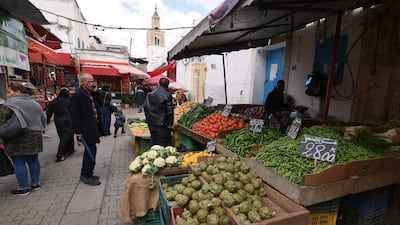
Tunisia, roiled by years of political turmoil that deepened with President Kais Saied's power grab last July, is mired in a deep recession. All photos: AFP -
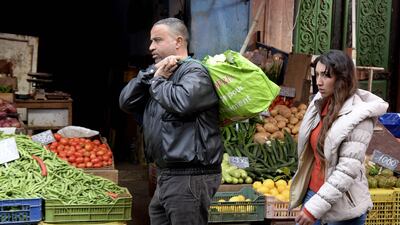
Surging prices and job losses have hurt families that were already struggling before the coronavirus pandemic. -
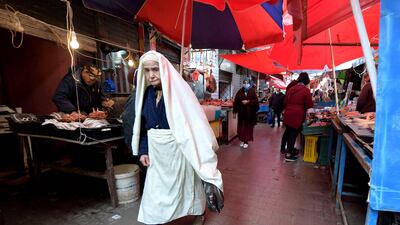
This week, Tunisia started preliminary talks with the International Monetary Fund over a bailout package. -
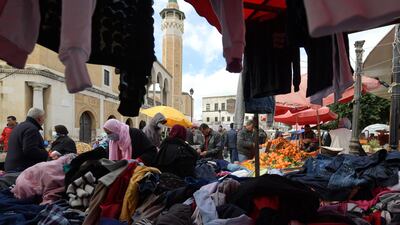
Such a deal would probably mean cuts to subsidies and public sector wages, which many fear would spell more suffering for the most vulnerable. -

That could fuel the same kind of grievances that sparked a revolution a decade ago and brought down Zine El Abidine Ben Ali after 23 years in power. -
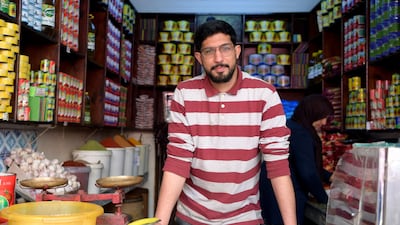
Tunisian grocer Bilel Jani sees the reality of a biting economic crisis. -
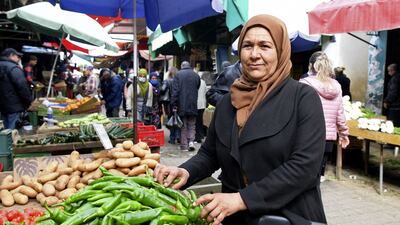
Tunisian Delila Dridi said life is a struggle on her salary from the education ministry.


Eleven years on, Tunisia is running at an 11.5 per cent deficit, with public debt reaching 90 per cent of its GDP, according to the World Bank. The country relies heavily on foreign aid and loans from the IMF to pay its debts and stay solvent.
For decades – even before the revolution, in the eras of both Habib Bourguiba and Zine El Abedine Ben Ali – the IMF has pushed aggressive cuts to the public wage bill, citing bloated agencies and record absenteeism, as a means to curb public debt.
But calls for job or wage cuts meet fierce resistance from the country’s powerful General Tunisian Labour Union (UGTT), which has the ability to cripple the economy through general strikes. The UGTT on Tuesday re-elected its influential and pugnacious leader, Noureddine Taboubbi, who has categorically dismissed any IMF deal involving wage cuts.
Pay cheque crisis
Despite Tunisia’s economic crisis, negotiations for a $4 billion relief package from the IMF planned for last summer stalled after President Kais Saied dismissed prime minister Hichem Mechichi, who was leading the talks, and consolidated all power in the country into his own hands in July, preferring to focus his attention on rewriting the constitution than mending the tattered economy.
Experts say this singular focus could prove problematic for Mr Saied.
“Kais Saied is repeating more dramatically and more profoundly the same essential mistake of the post-revolutionary period: getting so caught up in crafting political solutions that you forgo finding socioeconomic solutions,” said Monica Marks, an assistant professor of Middle East politics at New York University Abu Dhabi.
She estimates that the pay cheque crisis could have a destabilising effect, and potentially lead to major strikes or protests.

“Getting people riled up about freedom of expression or checks and balances is difficult,” she said, “but if the financial pain cuts to the bone more painfully than it already is, Saied is going to be in for an awfully tough time.”
While the IMF talks resumed last week, Mr Saied's singular focus on constitutional reform has not gone unnoticed by those who rely on his government for their salary.
“If there's any economic reform happening at all, it's going very slowly,” said Mootaz Ghothbani, a university professor whose pay has been late for several months in a row.
He says that between the delayed payments, high interest rates from banks and rising inflation, saving towards the future is impossible. He says he picks up extra work as a translator or interpreter to supplement his salary and to be able to put fuel in his car to make the 120-kilometre drive to work in weeks when his pay is delayed.
“Even with the extra work, it's still difficult to save enough to make to make a substantial change in your life,” Mr Ghothbani said.
“I do my bit, and the state should do theirs. How can you find an excuse for an apparatus that has all the power?”
Mr Dridi, the school maintenance technician, said there is only one person to blame for his inability to support his family. “Kais Saied is the only person ruling today, so he is the one responsible,” he said.
“On July 25th he said he'd fight corruption,” he said, referring to Mr Saied's promise to root out crooked actors inside business and government when he took sole control of the country, “but now he's treating all employees of the state as if we were corrupt”.
Security forces receiving salaries late
The pay cheque crisis deepened last month when, for the first, time, security forces – the police, interior ministry forces, the national guard and the army – received their salaries late, a potentially painful point for the Saied regime.
Sources close to the Ministry of the Interior say it is Mr Saied's only remaining pillar of support, as he has isolated himself from political parties, the unions and civil society. Recent actions, including the late-night announcement of Mr Saied's plan to dissolve the supreme judicial council – made not at the Carthage Palace, but from the Ministry of the Interior – drive that relationship home.
Alienating that base of support could have dire consequences for Mr Saied, even leading to a military takeover if the state cannot function, the sources told The National.

In a rare interview, a security forces officer, who spoke on condition of anonymity, told The National about the strain the late payment put on him.
“We normally get our paychecks on the 17th, we're always the first to get paid,” he said. “But last month it didn't come on time. I'm supposed to get married this spring but I have to keep putting off paying for the wedding hall and all the necessaries,” he said.
Security forces, including those standing guard outside the Ministry of the Interior near the presidential palace, donned red armbands last week in protest of the late payments.
Of the protest, the security officer said plainly: “It's an internal matter. Those who need to receive the message will.”

