

Efforts to revive a peace process in Syria’s 11-year conflict are in doubt because Damascus has questioned the neutrality of the proposed host of the talks, Switzerland, a UN official said on Monday.
There had been speculation the Syrian government was unhappy with Switzerland observing international sanctions against its close ally Russia, believing that the Swiss could no longer be considered an impartial mediator.
The negotiations — the first since a stalled Russian-sponsored peace effort in 2018 — were scheduled for July 25 in Geneva.
Syria’s civil war, which began in 2011 after a violent crackdown on anti-government protesters led to armed rebellion, has largely ended. President Bashar Al Assad’s forces have regained most of the country from rebel groups, ISIS and Al Qaeda-linked militias.
-
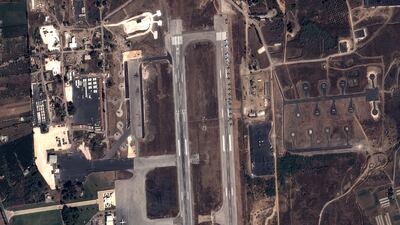
A Pleiades Satellite image from September 20, 2015, shows Russian fighter jets and helicopters at a military base in the government-controlled coastal Syrian city of Latakia. Syria said on September 22, 2015 it had received sophisticated new arms from Russia, including warplanes, and used them against rebels, as signs grew of a major shift in the country's four-year conflict. AFP -
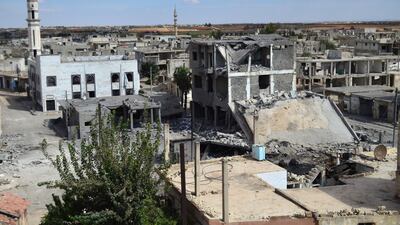
Deserted streets and damaged buildings in the central Syrian town of Talbisseh in Homs province, September 30, 2015. Russia confirmed on September 30 that it carried out its first air strike in Syria, near the city of Homs, marking the formal start of Moscow's military intervention. AFP -
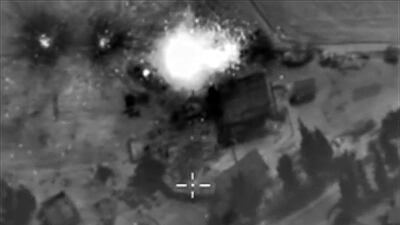
A video grab from October 1, 2015 shows an image taken from the Russian Defence Ministry's official website, purporting to show an air strike in Syria. President Vladimir Putin on October 1 dismissed claims that Russian air strikes had killed civilians in Syria as 'information warfare' but said Moscow would look into those reports. AFP -
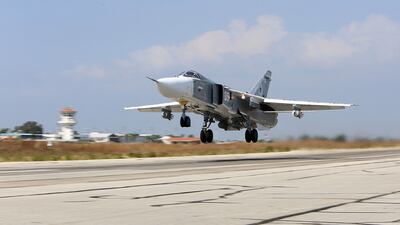
A Russian Sukhoi Su-24 bomber takes off from the Hmeimim airbase in the Syrian province of Latakia, October 3, 2015. AFP -
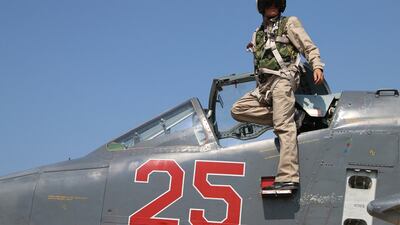
A Russian pilot leaving his Sukhoi Su-25 ground attack aircraft at Hmeimim airbase in the Syrian province of Latakia. AFP -
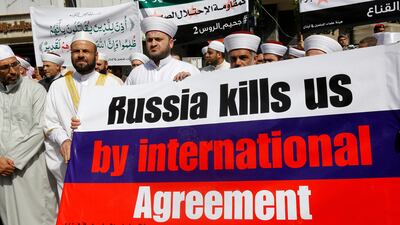
Members of the Sunni Committee of Muslim Scholars outside the Russian embassy in the capital Beirut during a protest on October 14, 2015 against Russia's intervention in Syria . AFP -
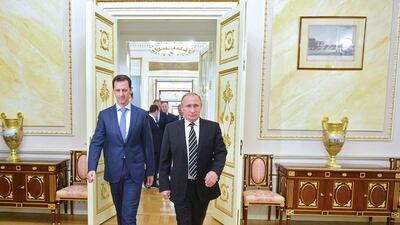
Russian President Vladimir Putin, right, with his Syrian counterpart Bashar Al Assad upon the latter's for a meeting at the Kremlin in Moscow on October 20, 2015. AFP -

Russia deployed its S-400 air defence system in Syria, the Russian defence ministry said on November 26, 2015, with the units covering the area around its airbase in coastal Latakia. AFP -
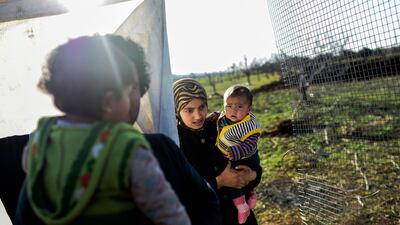
About 30,000 Syrians were at the Turkish border after fleeing a Russia-backed regime offensive on the northern region of Aleppo, Turkish Prime Minister Ahmet Davutoglu said on February 8, 2016, as his country faced pressure to open its border. AFP -
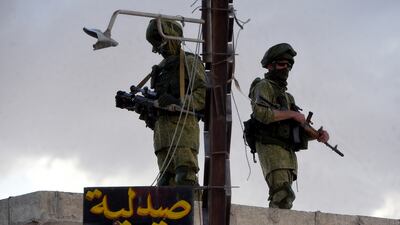
Russian soldiers on guard as a Russian military convoy passes through a small Syrian village near the city of Hama on May 4, 2016. AFP -
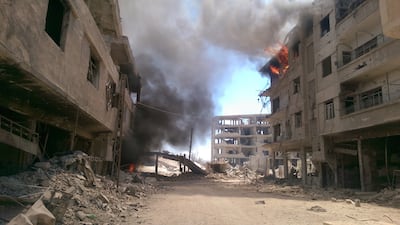
Fires after air strikes on the besieged rebel-held town of Daraya, near the capital Damascus, on August 16, 2016. AFP -

A member of the White Helmets, a Syrian civil defence volunteer unit, on the rubble of destroyed buildings during a rescue operation in Aleppo after a government forces air strike on the rebel-held neighbourhood of Bustan Al Basha, on October 4, 2016. AFP -
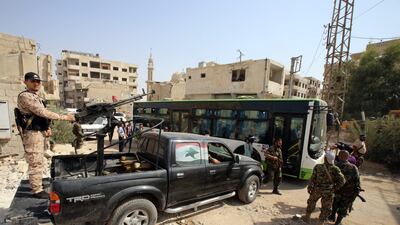
Syrian government troops on guard as a bus drives by with people from the evacuated town of Daraya outside the capital Damascus on August 26, 2016. The move was part of a deal agreed between the government and opposition fighters after a four-year army siege. AFP -
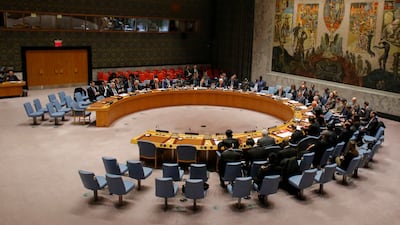
Members of the UN Security Council meet on December 31, 2016, at the UN headquarters in New York, after unanimously approving a resolution supporting a Russian-Turkish peace initiative for Syria. AFP


Turkish-backed rebel forces and Al Qaeda-linked group Hayat Tahrir Al Sham still control areas of the north of the country, and there are concerns that the situation there could escalate. A US-backed Kurdish force controls much of the north-east of the country.
UN deputy spokesman Farhan Haq did not directly explain the reason for Damascus rejecting talks in Geneva.
But on Monday he said: “We do reaffirm the neutrality of Switzerland as a venue for much of the work that the United Nations does.”
Geneva is the UN's major European headquarters.
UN special envoy for Syria Geir Pedersen said a ninth round of talks on revising the constitution of the conflict-torn country could not be held, and alluded to the neutrality issue.
He stressed the importance of all parties “protecting and firewalling the Syrian political process from their differences elsewhere in the world”.
Mr Haq said that “discussions on Syria need to be kept as much as possible separate and apart from discussions on other topics”.
A 2012 UN road map to peace in Syria approved by representatives of the organisation, the Arab League, EU, Turkey and all five permanent Security Council members — including Russia — calls for the drafting of a new constitution.
This would lead to UN-supervised elections with all Syrians, including members of the diaspora, eligible to participate.
A Security Council resolution adopted in December 2015 unanimously endorsed the road map.
At a Russia-hosted Syrian peace conference in January 2018, an agreement was reached to form a 150-member committee to draft a new constitution.
A smaller, 45-member body would do the actual drafting, including 15 members each from the government, opposition and civil society.
It took until September 2019 for the committee to be formed, and after eight rounds of talks little progress has been achieved.
Russia's military support for Syria changed the trajectory of the Syrian conflict.
The EU imposed sanctions on Russia after it annexed Crimea from Ukraine in 2014 and added more after President Vladimir Putin's February 24 invasion of Ukraine.
Mr Pedersen encouraged the Syrian parties “to engage in constructive diplomacy” and said he would continue to engage with them “and provide more information in due course”.
Mr Haq said Mr Pedersen did not want “any sorts of events that are just for show” when it became clear that the July 25 to July 29 meeting could not take place in Geneva.
“He’ll keep working to see what actual substantive results he can make for the Syrian people, who have been waiting for far too long for progress on this,” Mr Haq said.
“At this stage, I don’t have any other venue … and we will see what happens next.”

