Live updates: Follow the latest news on Israel-Gaza
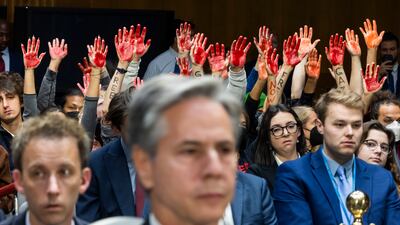
The US on Friday vetoed a UN Security Council resolution calling for an immediate humanitarian ceasefire in the Gaza Strip, after Secretary General Antonio Guterres took the rare step of declaring the conflict a threat to world peace and security.
The Arab drafted resolution tabled by the UAE received 13 votes in favour, an abstention from Britain and the US veto.
Co-sponsored by about 100 nations, the resolution had expressed “grave concern over the catastrophic humanitarian situation in the Gaza Strip and the suffering of the Palestinian civilian population”.
After the vote, Robert Wood, the US deputy ambassador to the UN, said the resolution was “divorced from reality” and he criticised it for “failing to acknowledge that Israel has the right to defend itself against terrorism, consistent with international law”.
He also said it was “unfathomable” that the resolution “declined to include language condemning Hamas's horrific terrorist attack on Israel on October 7.”
The US “engaged in good faith on this text” but “nearly all of our recommendations were ignored”, Mr Wood added.
Britain’s UN ambassador Barbara Woodward said Westminster also could not support a resolution that failed to “condemn the atrocities Hamas committed against innocent Israeli civilians on October 7 “.
Mohamed Abushahab, the UAE's deputy ambassador to the UN, said his country was “deeply disappointed” with the vote.
“Regrettably, and in the face of untold misery, this council is unable to demand a humanitarian ceasefire,” he said.
Mr Abushahab also said the broad support for the resolution, which drew about 100 co-sponsors in 24 hours, was a reflection of global support for efforts to end the war and save Palestinian lives.
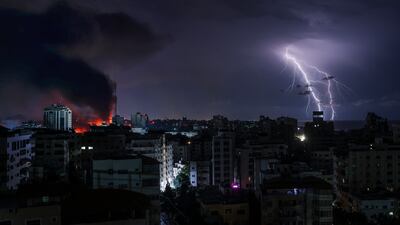
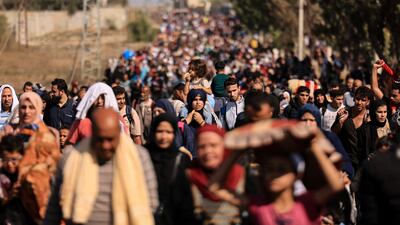
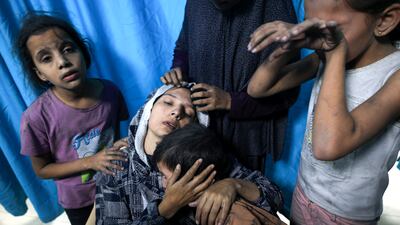
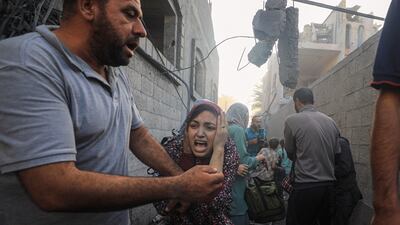
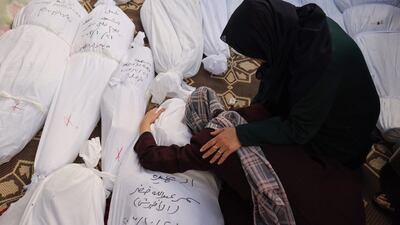
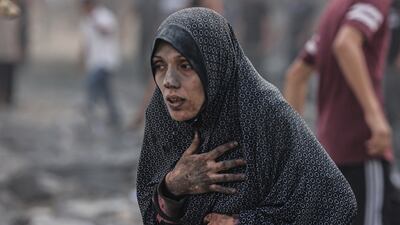
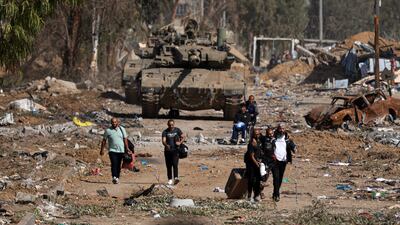
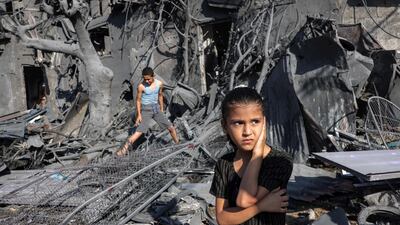
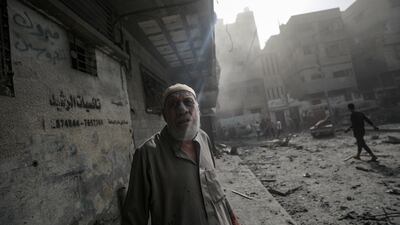
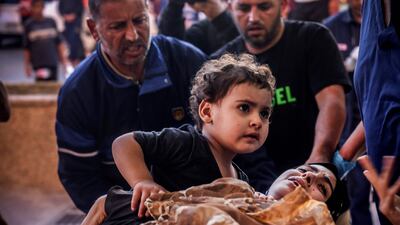
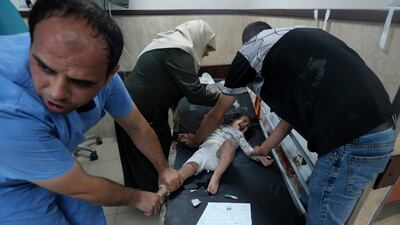
Israel Gaza war two months on – in pictures
Before the vote, he said: “There is no defensible moral, political nor military justification for this carnage to continue.”
Mr Guterres said the Hamas attacks did not “justify the collective punishment” of people in Gaza.
“Some 130 hostages are still held captive. I call for their immediate and unconditional release, as well as their humane treatment and visits from the International Committee of the Red Cross until they are freed,” Mr Guterres said.
“At the same time, the brutality perpetrated by Hamas can never justify the collective punishment of the Palestinian people.”
Russia’s deputy UN ambassador Dmitry Polyansky called the vote “one of the darkest days in the history of the Middle East” and accused the US of issuing “a death sentence to thousands, if not tens of thousands more civilians in Palestine and Israel, including women and children”.
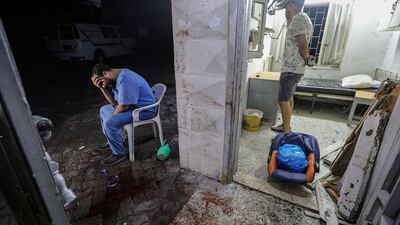
The Security Council vote came as Israel continued its bombardment and ground invasion of Gaza following last week's collapse of a seven-day truce.
While indiscriminate rocket fire by Hamas into Israel and the use of civilians as human shields contravene the laws of war, Mr Guterres said, such conduct does not absolve Israel of its own breaches of international humanitarian law.
In a letter to the council on Wednesday, Mr Guterres took the extraordinary step of invoking Article 99 of the UN Charter, which states that a Secretary General may bring to the attention of the council “any matter which in his opinion may threaten the maintenance of international peace and security”.
Mr Guterres informed the 15-member Security Council that he had invoked Article 99 because the world body's inability to help civilians in Gaza had reached “a breaking point”.
“Between 3 and 5 December – the two days preceding my letter – the UN could only distribute aid in one of Gaza’s five governorates,” he said.
He spoke of a complete breakdown in the humanitarian support system in Gaza, emphasising that such an outcome would lead to “devastating consequences”, including the destruction of public order and heightened pressure for a large-scale displacement towards Egypt.
In a post on X, Philippe Lazzarini, the head of the UN agency for Palestinian refugees, said he had written a letter to the President of the UN General Assembly to inform him that UNRWA's ability to continue delivering its mandate in Gaza has now become “severely limited”.
He said that in his 35 years of work in complex emergencies, he would never have expected to write such a letter predicting the killing of his staff and the collapse of the mandate that UNRWA is expected to fulfil.
The Health Ministry in the Hamas-run Gaza Strip said on Friday the death toll had risen to at least 17,487.

UN chief: 'Gaza in midst of epic humanitarian catastrophe' – video
Ten tax points to be aware of in 2026
1. Domestic VAT refund amendments: request your refund within five years
If a business does not apply for the refund on time, they lose their credit.
2. E-invoicing in the UAE
Businesses should continue preparing for the implementation of e-invoicing in the UAE, with 2026 a preparation and transition period ahead of phased mandatory adoption.
3. More tax audits
Tax authorities are increasingly using data already available across multiple filings to identify audit risks.
4. More beneficial VAT and excise tax penalty regime
Tax disputes are expected to become more frequent and more structured, with clearer administrative objection and appeal processes. The UAE has adopted a new penalty regime for VAT and excise disputes, which now mirrors the penalty regime for corporate tax.
5. Greater emphasis on statutory audit
There is a greater need for the accuracy of financial statements. The International Financial Reporting Standards standards need to be strictly adhered to and, as a result, the quality of the audits will need to increase.
6. Further transfer pricing enforcement
Transfer pricing enforcement, which refers to the practice of establishing prices for internal transactions between related entities, is expected to broaden in scope. The UAE will shortly open the possibility to negotiate advance pricing agreements, or essentially rulings for transfer pricing purposes.
7. Limited time periods for audits
Recent amendments also introduce a default five-year limitation period for tax audits and assessments, subject to specific statutory exceptions. While the standard audit and assessment period is five years, this may be extended to up to 15 years in cases involving fraud or tax evasion.
8. Pillar 2 implementation
Many multinational groups will begin to feel the practical effect of the Domestic Minimum Top-Up Tax (DMTT), the UAE's implementation of the OECD’s global minimum tax under Pillar 2. While the rules apply for financial years starting on or after January 1, 2025, it is 2026 that marks the transition to an operational phase.
9. Reduced compliance obligations for imported goods and services
Businesses that apply the reverse-charge mechanism for VAT purposes in the UAE may benefit from reduced compliance obligations.
10. Substance and CbC reporting focus
Tax authorities are expected to continue strengthening the enforcement of economic substance and Country-by-Country (CbC) reporting frameworks. In the UAE, these regimes are increasingly being used as risk-assessment tools, providing tax authorities with a comprehensive view of multinational groups’ global footprints and enabling them to assess whether profits are aligned with real economic activity.
Contributed by Thomas Vanhee and Hend Rashwan, Aurifer
Mercer, the investment consulting arm of US services company Marsh & McLennan, expects its wealth division to at least double its assets under management (AUM) in the Middle East as wealth in the region continues to grow despite economic headwinds, a company official said.
Mercer Wealth, which globally has $160 billion in AUM, plans to boost its AUM in the region to $2-$3bn in the next 2-3 years from the present $1bn, said Yasir AbuShaban, a Dubai-based principal with Mercer Wealth.
“Within the next two to three years, we are looking at reaching $2 to $3 billion as a conservative estimate and we do see an opportunity to do so,” said Mr AbuShaban.
Mercer does not directly make investments, but allocates clients’ money they have discretion to, to professional asset managers. They also provide advice to clients.
“We have buying power. We can negotiate on their (client’s) behalf with asset managers to provide them lower fees than they otherwise would have to get on their own,” he added.
Mercer Wealth’s clients include sovereign wealth funds, family offices, and insurance companies among others.
From its office in Dubai, Mercer also looks after Africa, India and Turkey, where they also see opportunity for growth.
Wealth creation in Middle East and Africa (MEA) grew 8.5 per cent to $8.1 trillion last year from $7.5tn in 2015, higher than last year’s global average of 6 per cent and the second-highest growth in a region after Asia-Pacific which grew 9.9 per cent, according to consultancy Boston Consulting Group (BCG). In the region, where wealth grew just 1.9 per cent in 2015 compared with 2014, a pickup in oil prices has helped in wealth generation.
BCG is forecasting MEA wealth will rise to $12tn by 2021, growing at an annual average of 8 per cent.
Drivers of wealth generation in the region will be split evenly between new wealth creation and growth of performance of existing assets, according to BCG.
Another general trend in the region is clients’ looking for a comprehensive approach to investing, according to Mr AbuShaban.
“Institutional investors or some of the families are seeing a slowdown in the available capital they have to invest and in that sense they are looking at optimizing the way they manage their portfolios and making sure they are not investing haphazardly and different parts of their investment are working together,” said Mr AbuShaban.
Some clients also have a higher appetite for risk, given the low interest-rate environment that does not provide enough yield for some institutional investors. These clients are keen to invest in illiquid assets, such as private equity and infrastructure.
“What we have seen is a desire for higher returns in what has been a low-return environment specifically in various fixed income or bonds,” he said.
“In this environment, we have seen a de facto increase in the risk that clients are taking in things like illiquid investments, private equity investments, infrastructure and private debt, those kind of investments were higher illiquidity results in incrementally higher returns.”
The Abu Dhabi Investment Authority, one of the largest sovereign wealth funds, said in its 2016 report that has gradually increased its exposure in direct private equity and private credit transactions, mainly in Asian markets and especially in China and India. The authority’s private equity department focused on structured equities owing to “their defensive characteristics.”
In numbers: PKK’s money network in Europe
Germany: PKK collectors typically bring in $18 million in cash a year – amount has trebled since 2010
Revolutionary tax: Investigators say about $2 million a year raised from ‘tax collection’ around Marseille
Extortion: Gunman convicted in 2023 of demanding $10,000 from Kurdish businessman in Stockholm
Drug trade: PKK income claimed by Turkish anti-drugs force in 2024 to be as high as $500 million a year
Denmark: PKK one of two terrorist groups along with Iranian separatists ASMLA to raise “two-digit million amounts”
Contributions: Hundreds of euros expected from typical Kurdish families and thousands from business owners
TV channel: Kurdish Roj TV accounts frozen and went bankrupt after Denmark fined it more than $1 million over PKK links in 2013
Dubai Bling season three
Cast: Loujain Adada, Zeina Khoury, Farhana Bodi, Ebraheem Al Samadi, Mona Kattan, and couples Safa & Fahad Siddiqui and DJ Bliss & Danya Mohammed
Rating: 1/5
Our legal columnist
Name: Yousef Al Bahar
Advocate at Al Bahar & Associate Advocates and Legal Consultants, established in 1994
Education: Mr Al Bahar was born in 1979 and graduated in 2008 from the Judicial Institute. He took after his father, who was one of the first Emirati lawyers
Countries recognising Palestine
France, UK, Canada, Australia, Portugal, Belgium, Malta, Luxembourg, San Marino and Andorra
The years Ramadan fell in May
Korean Film Festival 2019 line-up
Innocent Witness, June 26 at 7pm
On Your Wedding Day, June 27 at 7pm
The Great Battle, June 27 at 9pm
The Witch: Part 1. The Subversion, June 28 at 4pm
Romang, June 28 at 6pm
Mal Mo E: The Secret Mission, June 28 at 8pm
Underdog, June 29 at 2pm
Nearby Sky, June 29 at 4pm
A Resistance, June 29 at 6pm
Who's who in Yemen conflict
Houthis: Iran-backed rebels who occupy Sanaa and run unrecognised government
Yemeni government: Exiled government in Aden led by eight-member Presidential Leadership Council
Southern Transitional Council: Faction in Yemeni government that seeks autonomy for the south
Habrish 'rebels': Tribal-backed forces feuding with STC over control of oil in government territory
STAGE%201%20RESULTS
%3Cp%3E1)%20Tim%20Merlier%20(Soudal-Quick-Step)%2C%203h%2017%E2%80%99%2035%E2%80%9D%3Cbr%3E2)%20Caleb%20Ewan%20(Lotto%20Dstny)%20same%20time%3Cbr%3E3)%20Mark%20Cavendish%20(Astana%20Qazaqstan%20Team)%20same%20time%3Cbr%3E%3Cstrong%3EGeneral%20Classification%3A%3C%2Fstrong%3E%3Cbr%3E1)%20Tim%20Merlier%20(Soudal%20Quick-Step)%203%3A17%3A25%3Cbr%3E2%20-%20Caleb%20Ewan%20(Lotto%20Dstny)%20%2B4%22%3Cbr%3E3%20-%20Luke%20Plapp%20(Ineos%20Grenadiers)%20%2B5%22%3C%2Fp%3E%0A
French business
France has organised a delegation of leading businesses to travel to Syria. The group was led by French shipping giant CMA CGM, which struck a 30-year contract in May with the Syrian government to develop and run Latakia port. Also present were water and waste management company Suez, defence multinational Thales, and Ellipse Group, which is currently looking into rehabilitating Syrian hospitals.
Labour dispute
The insured employee may still file an ILOE claim even if a labour dispute is ongoing post termination, but the insurer may suspend or reject payment, until the courts resolve the dispute, especially if the reason for termination is contested. The outcome of the labour court proceedings can directly affect eligibility.
- Abdullah Ishnaneh, Partner, BSA Law
School counsellors on mental well-being
Schools counsellors in Abu Dhabi have put a number of provisions in place to help support pupils returning to the classroom next week.
Many children will resume in-person lessons for the first time in 10 months and parents previously raised concerns about the long-term effects of distance learning.
Schools leaders and counsellors said extra support will be offered to anyone that needs it. Additionally, heads of years will be on hand to offer advice or coping mechanisms to ease any concerns.
“Anxiety this time round has really spiralled, more so than from the first lockdown at the beginning of the pandemic,” said Priya Mitchell, counsellor at The British School Al Khubairat in Abu Dhabi.
“Some have got used to being at home don’t want to go back, while others are desperate to get back.
“We have seen an increase in depressive symptoms, especially with older pupils, and self-harm is starting younger.
“It is worrying and has taught us how important it is that we prioritise mental well-being.”
Ms Mitchell said she was liaising more with heads of year so they can support and offer advice to pupils if the demand is there.
The school will also carry out mental well-being checks so they can pick up on any behavioural patterns and put interventions in place to help pupils.
At Raha International School, the well-being team has provided parents with assessment surveys to see how they can support students at home to transition back to school.
“They have created a Well-being Resource Bank that parents have access to on information on various domains of mental health for students and families,” a team member said.
“Our pastoral team have been working with students to help ease the transition and reduce anxiety that [pupils] may experience after some have been nearly a year off campus.
"Special secondary tutorial classes have also focused on preparing students for their return; going over new guidelines, expectations and daily schedules.”
Our legal columnist
Name: Yousef Al Bahar
Advocate at Al Bahar & Associate Advocates and Legal Consultants, established in 1994
Education: Mr Al Bahar was born in 1979 and graduated in 2008 from the Judicial Institute. He took after his father, who was one of the first Emirati lawyers
You may remember …
Robbie Keane (Atletico de Kolkata) The Irish striker is, along with his former Spurs teammate Dimitar Berbatov, the headline figure in this season’s ISL, having joined defending champions ATK. His grand entrance after arrival from Major League Soccer in the US will be delayed by three games, though, due to a knee injury.
Dimitar Berbatov (Kerala Blasters) Word has it that Rene Meulensteen, the Kerala manager, plans to deploy his Bulgarian star in central midfield. The idea of Berbatov as an all-action, box-to-box midfielder, might jar with Spurs and Manchester United supporters, who more likely recall an always-languid, often-lazy striker.
Wes Brown (Kerala Blasters) Revived his playing career last season to help out at Blackburn Rovers, where he was also a coach. Since then, the 23-cap England centre back, who is now 38, has been reunited with the former Manchester United assistant coach Meulensteen, after signing for Kerala.
Andre Bikey (Jamshedpur) The Cameroonian defender is onto the 17th club of a career has taken him to Spain, Portugal, Russia, the UK, Greece, and now India. He is still only 32, so there is plenty of time to add to that tally, too. Scored goals against Liverpool and Chelsea during his time with Reading in England.
Emiliano Alfaro (Pune City) The Uruguayan striker has played for Liverpool – the Montevideo one, rather than the better-known side in England – and Lazio in Italy. He was prolific for a season at Al Wasl in the Arabian Gulf League in 2012/13. He returned for one season with Fujairah, whom he left to join Pune.