

Live updates: Follow the latest news on Israel-Gaza
Wassim Rady, seven, rushes through the doors of the only ice cream vendor still operating in southern Gaza.
He runs past a long queue of customers to the fridge, where he presses his face to its cold, condensation-covered glass panel to inspect the many colours and flavours.
“Uncle, vanilla and chocolate please,” Wassim tells the ice cream seller, shortly before his parents remind him to join the queue.
After more than a month of shelling by Israel, much of the “normal” existence that the more than two million residents of the besieged Palestinian enclave had become accustomed to has been erased.
Israel has cut Gaza’s electricity, fuel and clean water supplies and is only allowing a fraction of humanitarian aid and food to enter the enclave through Egypt’s Rafah border crossing.
However, one ice cream seller is making sure Palestinians in the southern part of Gaza can still experience a little joy amid the gloom.
Nedal Al Nefisi, the owner of the shop, says he understands why many of his regular customers are staying away in the circumstances.
“But there are many others who are looking for an opportunity to smile,” he tells The National.
Customers queuing outside the shop can hear the sounds of bombings and see the remains of missile-hit homes reduced to rubble.
But in the few minutes it takes them to finish their ice cream, they can afford to put aside their trauma and panic.
“It has been so long since I had ice cream,” says young Wassim, between spoonfuls of ice cream.
“I used to have this almost every day. I’ve been asking my father for it and I am so happy the shop is open. It’s like before the war.”

Life must go on, says Wassim's father Tamer, 30.
"It may seem strange to find ice cream in these circumstances, especially when there is no electricity and people are being killed,” he says.
“People feel self-conscious to be here for ice cream while others can’t find a bite of bread, or have lost loved ones or their homes. But people want to feel normal.”
Tamer says he had to leave his home in Gaza city earlier this week, along with his parents, siblings and their families.
The UN’s humanitarian agency Ocha said only 650 lorries carrying food, medicines, health supplies, bottled water and hygiene products had been allowed to enter Gaza from Egypt since October 21.
Before the war started, an average of 500 aid lorries entered Gaza every working day.
This has reduced the average food intake of a Palestinian in Gaza to only two pieces of bread a day, said the UN’s Palestinian refugee agency, the UNRWA.
‘It’s about the smiles’
Much of the besieged enclave sits in darkness after the fuel needed to power hospitals, bakeries and essentials ran out.
For Ismail Al Bouek, who is in his 50s, it came as a surprise to find the ice cream parlour open.
While it may appear not to make much sense to find an ice cream store open at a time when essential foods are in short supply across the enclave, Mr Al Bouek says “to find something to eat, and for only two shekels ($0.52), is remarkable”.
Mr Al Nefisi is able to keep his shop running thanks to solar panels.
“It’s a good reminder for everyone that this too shall pass and that we, as Palestinians, always find a way to adjust and we survive,” he says, adding that people always come to his shop to charge their phones and batteries.
-

Smoke rises as displaced Palestinians take shelter at Al Shifa hospital. Reuters -

A Palestinian girl wounded in Israeli strikes waits for treatment at Al Shifa hospital, in Gaza city. Reuters -

Flames rage in a field near the border village of Burj Al-Mamluk, in southern Lebanon's Khiam plain, after an Israeli bombardment. AFP -

Smoke rises after air strikes during direct combat between the Israeli army and Hamas, near the beach road in Gaza city. EPA -
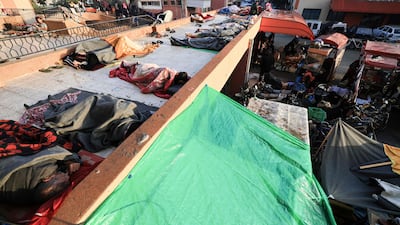
Palestinians from the Gaza Strip, looking for safety, camp on the grounds of Al Nasser Hospital in Khan Younis in the southern Gaza Strip. AFP -

People search through buildings, destroyed during Israeli air strikes in Khan Younis, Gaza. Getty Images -
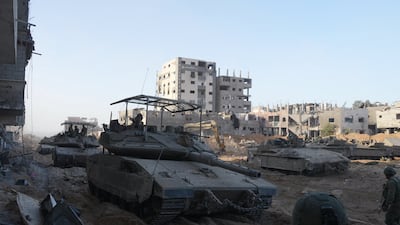
Israeli troops during operations in northern Gaza. AFP -
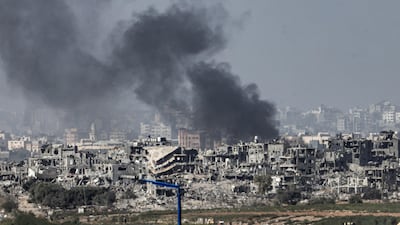
A photo taken from the Israeli side of the border with Gaza shows the continued Israeli bombardment of the northern Gaza Strip. AFP -

Palestinian men pray over the bodies of members of the Abu Taim family before burial in Khan Younis. AFP -
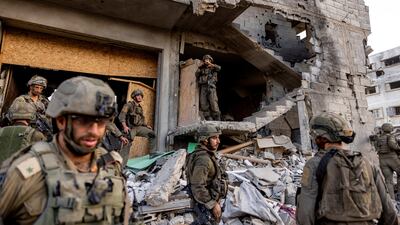
Israeli soldiers stand amid rubble during the ground invasion against Palestinian militant group Hamas, in the northern Gaza Strip. Reuters -
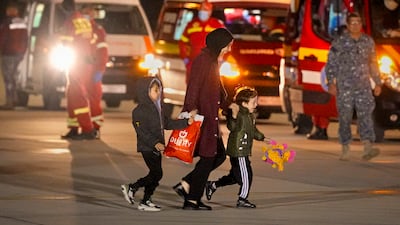
A woman and two children evacuated from Gaza walk on the tarmac at the Baza 90 air force base in Otopeni, Romania, after arriving from Egypt. AP -
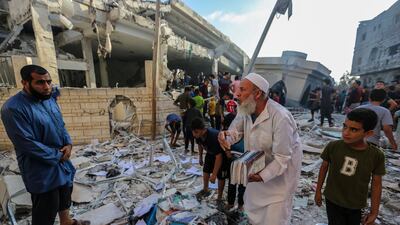
Gazans inspect the Khaled bin Al-Walid Mosque, which was destroyed during Israeli air raids in Khan Younis. Getty Images -
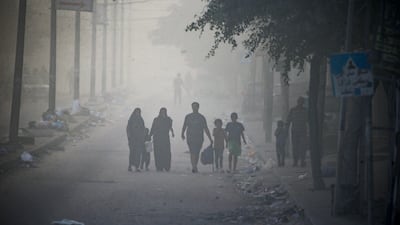
Residents flee from Al Shatea refugee camp during combat between the Israeli army and Hamas in Gaza city. EPA -
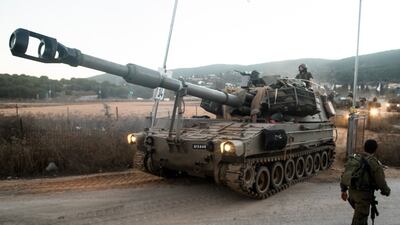
An artillery unit moves near the border with Lebanon, in Tel Aviv, Israel. Getty Images -
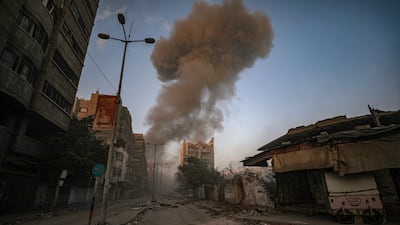
Smoke rises during direct combat between the Israeli army and militants of the Ezz Al-Din Al Qassam militia, the military wing of the Hamas movement, at the beach road in west-centre Gaza City. EPA -
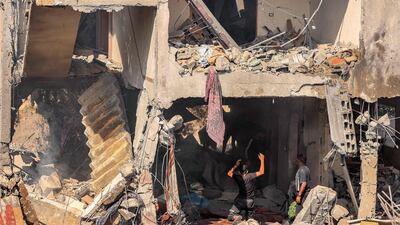
People search for survivors and bodies after a building was hit by Israeli bombing in Khan Younis in the southern Gaza Strip. AFP -
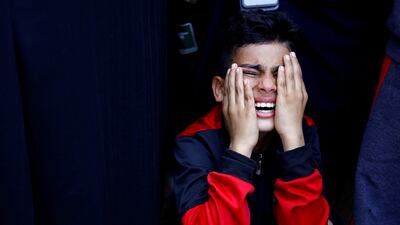
A boy learns his father has been killed in an Israeli air strike at a hospital in Khan Younis. Reuters -
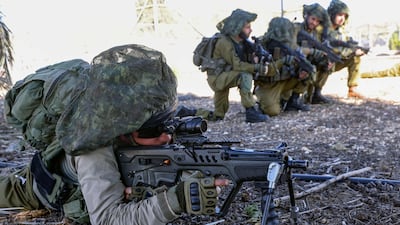
Israeli soldiers training in the upper Galilee region, near the border with Lebanon. AFP -
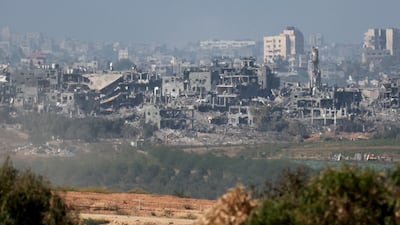
Destruction in the northern Gaza Strip, as seen from Sderot in southern Israel. Reuters -
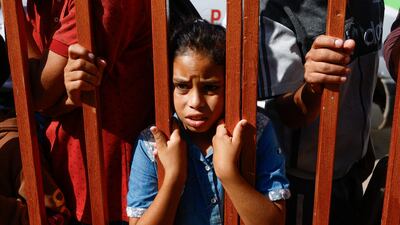
A girl looks on as bodies of Palestinians killed in Israeli strikes are laid out at Nasser Hospital in Khan Younis. Reuters -
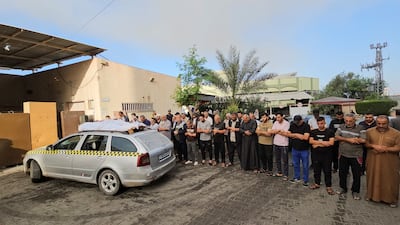
Mourners pray next to the bodies of members of the Daher family, who were killed by Israel strikes, at the Indonesian Hospital in the northern Gaza Strip. Reuters -
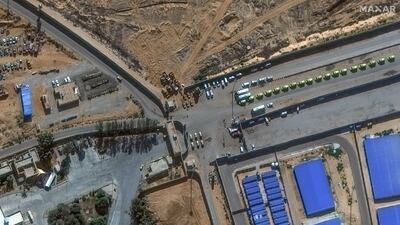
A satellite image shows the Rafah border crossing between Gaza and Egypt. Reuters -

People search through the rubble of buildings destroyed during Israeli air raids in Khan Younis. Getty Images -
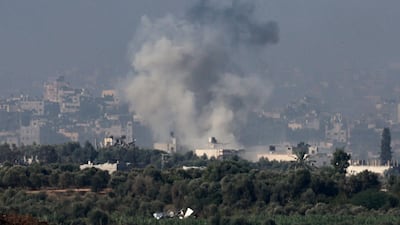
Smoke rises over the northern Gaza Strip, as seen from Sderot. Reuters -
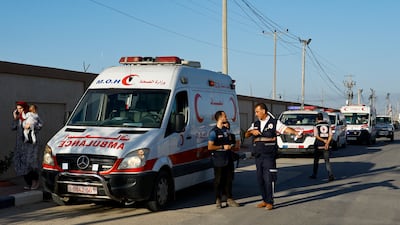
An ambulance transporting injured Palestinians to Egyptian hospitals for treatment waits on the Gaza side of the Rafah crossing. Reuters -

Palestinian doctor Mohammad Abu Namoos, who chose to stay in Gaza to treat patients, says goodbye to his family before they leave. Reuters -
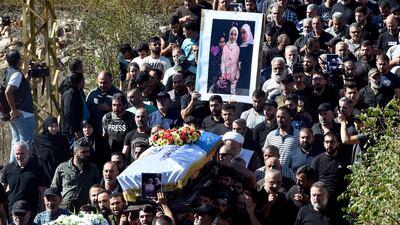
The funeral of three children and their grandmother killed in an Israeli air strike in Blida, Lebanon. EPA -
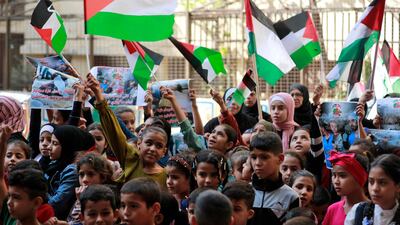
Palestinian children denouncing the killing of children in Gaza by waving banners and flags during a sit-in protest at the Shatila refugee camp in Beirut. AFP -
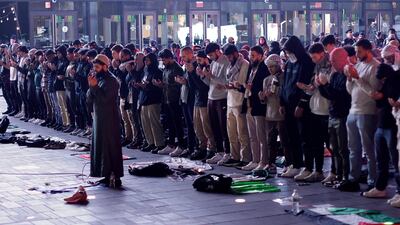
Men pray during a rally in support of Palestinians outside Barclays Centre in Brooklyn, New York. AFP -

A teddy bear symbolising hostages and missing children is placed on a bench in Tel Aviv, as people gather for a vigil to mark the one-month anniversary of the October 7 attack by Hamas militants on Israel. Reuters -
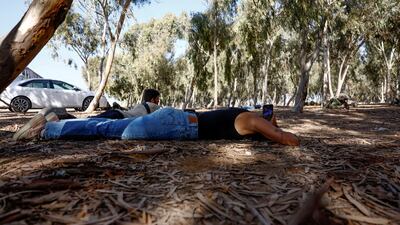
A survivor of the Nova Festival attack, May Hayat, takes cover as rocket sirens sound, during her first visit to the scene of the attack, near Re'im, Israel. Reuters -

Palestinians flee Gaza city to the southern Gaza Strip on Salah al-Din street in Bureij. AP -
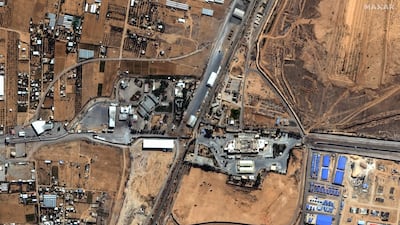
A satellite picture showing the Rafah border crossing to Egypt. AFP -
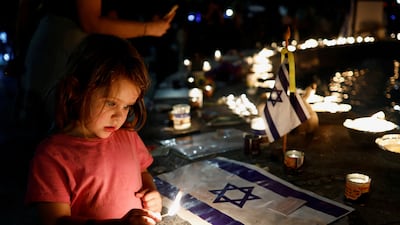
People gather in Tel Aviv for a candlelit vigil to mark the one-month anniversary of the October 7 deadly attack by Hamas militants on Israel. Reuters -
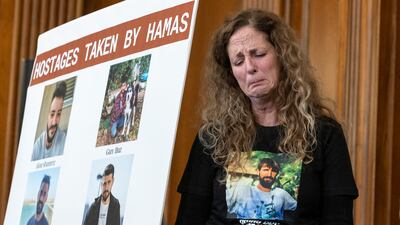
Doris Liber, whose son Guy Iluz is being held hostage in Gaza, during a press conference with House Republicans at the Capitol in Washington. AP -
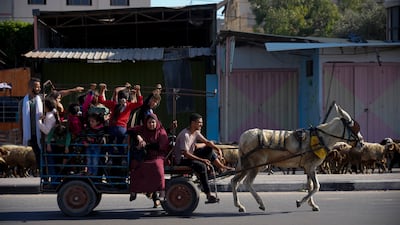
Palestinians flee to the southern Gaza Strip on Salah al-Din Street in Bureij. AP -
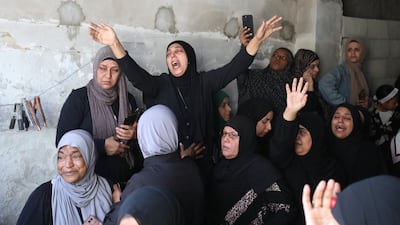
Mourners attend the funeral of four Palestinians killed by Israeli troops at Tulkarm refugee camp, in the occupied West Bank. EPA


As his supplies run low, and acutely aware of the grave risk of keeping his shop open, Mr Al Nefisi says he will sell ice cream for as long as he can.
Since the armed wing of Hamas carried out a bloody incursion into south Israel on October 7, leaving about 1,400 dead and taking more than 200 captives, Israel has waged a war on Gaza that has killed more than 10,000 people, about half of them children, said the Hamas-run Health Ministry.
‘Easing their panic’
As her young son gulps spoonfuls of pink and yellow ice cream, Um Hazem, who was forced to flee her home in the eastern part of Khan Younis, tells The National she tries to come to the shop as often as possible.
“It helps my children overcome the constant panic and horror they are living through and the death and devastation they are witnessing,” she says.
Um Hazem says as children are denied a normal life, “the least we can do is walk long distances and observe the marks of the war, risking so much in the process, just to eat ice cream”.
“Their smiles are worth it,” she says.
“We took ice cream for granted before but today, it’s a reminder that there is a life out there, that there is a chance that this will end and that we can go back to our plans and dreams, and make it out of this genocide,” she says.
Mr Al Bouek says “frankly, this place is a comforting sight. Something from before the war still exists, despite the destruction of all aspects of life. This place represents hope for survival”.
This story has been published in collaboration with Egab.

