

In April 1975, just days before the Lebanese Civil War broke out, Pele arrived in Beirut as part of a global football exhibition tour.
His powers may have been on the wane — it had been five years since he won his third and final World Cup with Brazil — but Pele's presence still drew more than 35,000 fans to the stadium.
He had just joined the New York Cosmos, who had sent the Brazilian great and its other stars on the tour to help promote the team.
Pele, for a day, would play for local side Nejmeh against a French-language university team. Nejmeh would prevail, winning 2-0 after two late goals, although, remarkably, neither came from the three-time World Cup winner.
French-language Lebanese newspaper L'Orient Le Jour reported that he played only the first half — spending the first 10 or so minutes in goal — before he moved to his more normal position in attack.
-

Christ the Redeemer statue is illuminated in the colours of the Brazilian national flag to honour late football legend Pele, in Rio de Janeiro, Brazil, on Thursday, December 29, 2022. AP -

Christ the Redeemer statue is lit with the colours of the Brazilian flag to pay homage to Pele. Getty -

A person takes a photo of Christ the Redeemer statue, which is lit up in Brazilian colours as a tribute to late Pele. Reuters -

Wembley Stadium's arch is lit up in the colours of Brazil to pay tribute to Pele. PA -

Wembley Stadium's arch is lit up in the colours of Brazil following the death of Pele. PA -

Wembley Stadium's arch is lit up in the colours of Brazil to pay tribute to Pele. PA -
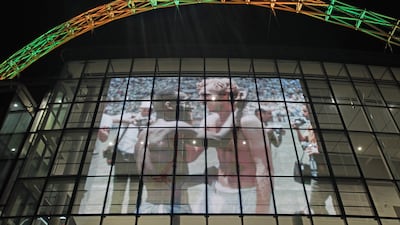
Wembley Stadium's arch is lit up in the colours of Brazil and displays the famous photo of Pele with Bobby Moore. PA -

An electric news headline ticker in Times Square announces the death of Pele. AP -

An image of Brazilian soccer legend Pele is projected on the South American Football Confederation (Conmebol) building, in Luque, Paraguay. Reuters -

The Maracana stadium is illuminated with a golden light in honour of Pele. Reuters -
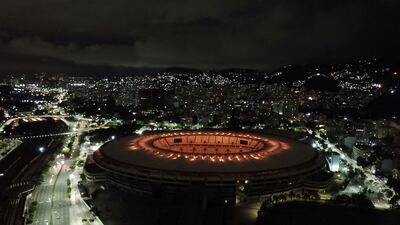
The Maracana stadium is seen illuminated with golden lights to honour Pele. Reuters -

A drone photo shows the Maracana stadium illuminated with golden colours. EPA


The defunct Daily Star, an English-language Lebanese newspaper, reported that about 100 journalists crammed into the Holiday Inn Ballroom the night before the game to pepper Pele with questions.
His joining of the Cosmos and arrival in Beirut was, remarkably, partly the result of US political intervention.
The Cosmos had recently received financial backing from Warner Communications and its chief executive, Steve Ross, credited by many for helping to grow football in the US. It meant the Cosmos were able to attract football superstars, including German great Franz Beckenbauer in 1977.
But Pele's arrival was partly the result of a visit by Henry Kissinger, who was US secretary of state at the time, during a visit to Sao Paulo.
“Henry Kissinger. He invited me to go to the cafe with him, and there he said, ‘Listen. You know I'm from the United States, and I'm in politics there. Soccer is coming along there — they're playing it in the schools. Would you like to help us promote soccer in the United States?’ And I said, ‘My God,'” Pele once told Esquire.
But, for all the joy and positivity surrounding his trip, only days after Pele's departure from Lebanon the civil war broke out.
The war lasted more than 15 years and killed about 120,000 people.

While tensions had been simmering for some time, on April 13, 1975, sectarian clashes and retaliatory attacks would begin, widely credited as being the start of a war, the repercussions of which are felt in Lebanon to this day.
Late on Thursday, as news of Pele's death broke, Lebanon's football association shared a short tweet, crediting him with taking the sport to another level — referring simply to him as “King Pele”.

