
A Lebanese parliamentary session scheduled for Thursday will be a formality following the departure of President Michel Aoun on Monday night, as senior leaders hold background negotiations to find his successor and end a widening leadership vacuum.
Before his departure from the Baabda presidential palace on Sunday, Mr Aoun signed a decree recognising the resignation of the current Cabinet. He also sent a letter to parliament notifying them of the government’s resignation.
In the letter, Mr Aoun called on parliament to “take the necessary measures or decisions to prevent things from deviating in a direction that is not in the interest of the country”.
The letter also called for caretaker Prime Minister Najib Mikati to resign, stating that he is “uninterested” in forming a new government.
But the present government had already gone into caretaker status following Lebanon’s May 15 parliamentary elections.
Although parliament could technically dismiss the prime minister with a two-thirds vote, Mr Aoun’s last-minute decree means little, said constitutional expert Wissam Lahham.
Parliament is not constitutionally permitted to designate another prime minister. Only a president can do so.
“Aoun demanded that we should take away the premiership from Mikati but of course they can’t choose another premier when there is no president any more,” Mr Lahham said. “They can’t do anything. Of course, the government will continue as it is.”
Meanwhile, it is unclear who will take the presidential reins from Mr Aoun. Lebanon’s deeply divided parliament has failed to agree on a successor.
“No other topic [beyond Mr Aoun’s letter] will be on the agenda,” a source with knowledge of the matter told The National, confirming that Thursday’s session will not be to elect a president.
-
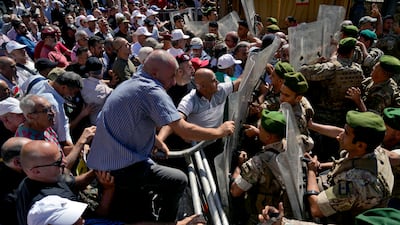
Soldiers scuffle with retired army members outside the Beirut parliament building. AP -
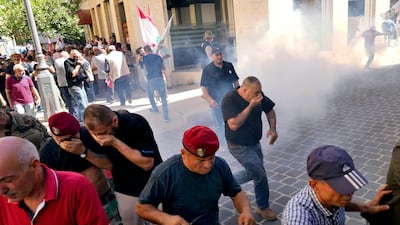
Retired army members run from tear gas fired by riot police. AP -
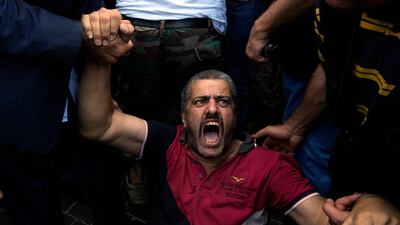
A retired army member chants slogans from the ground. AP -
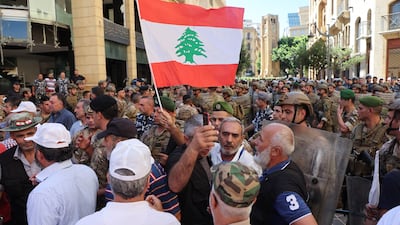
A demonstrator holds a Lebanese flag during the protest. Reuters -
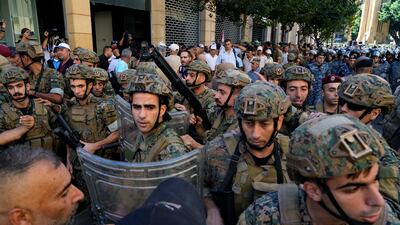
The was a heavy army presence. AP -

Emotions run high in central Beirut. EPA -

Lebanese army soldiers clash with protesters. EPA -
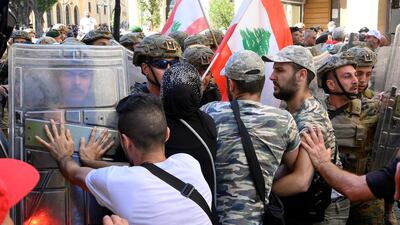
Politicians were attending a parliament session to approve the 2022 budget. EPA -
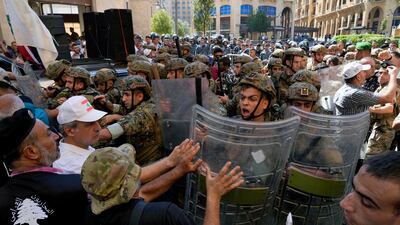
Retired army members tried to enter to the parliament building. AP


The strangely timed decree recognising the resignation of Mr Mikati’s government has raised eyebrows.
The decree “was issued on a date that raises controversy”, Mr Lahham said.
A parliamentary source said the decree, combined with Mr Aoun’s letter to parliament, was a common strategy on the part of the departing president.
“President Aoun during his mandate sent three or four letters to the parliament and every time when he failed to do something, he tried to throw the ball to parliament’s court,” the source said.
Confessional politics
Deciding on Lebanon’s next president is normally a drawn-out affair — in 2016, it took 46 sessions and 29 months to elect Mr Aoun, whose ascendancy came after a series of backdoor deals between key players.
In the country’s confessional system, the presidency is always held by a Maronite Christian, the parliamentary speaker a Shiite Muslim and the prime minister a Sunni Muslim.
Now those backdoor discussions are once again under way as political factions seek a consensus candidate.
“Speaker [Nabih] Berri is trying to call for a dialogue to try to bridge the gaps between the various groups in the parliament,” the source said.
Two thirds of the vote in the 128-seat parliament is needed for a presidential candidate to secure a win in the first round of voting. An absolute majority is required in subsequent rounds.
After four sessions, Michel Moawad is the only person to receive any significant support, but he is seen as too divisive to get the required votes. His support — 39 votes in the most recent session — has consistently been outnumbered by blank ballots. It is not known when the next presidential session will be held.
Lebanon is no stranger to presidential vacuums, but forging on with no president and no fully empowered government is a first in the nation's history.
There are fears that the vacuum will hinder attempts to enact desperately needed reforms to support Lebanon's economic recovery.
A financial collapse that first became apparent in 2019 has been described by the World Bank as one of the worst in modern history and has plunged the majority of the population into poverty.
The local currency has lost more than 95 per cent of its value and there are widespread shortages in basic essentials, including clean water, electricity, bread and medicines.

