


Lebanese officials are closing in on a loan with the World Bank that could reach up to $600m to fund a regional power deal that would provide Lebanon with six more hours of electricity per day in the coming months, Energy Minister Walid Fayad has said.
Egypt has committed to selling a minimum quantity of gas to Lebanon equivalent to 650 million cubic metres per year to provide 450 megawatts of electricity, said Mr Fayad. Jordan is expected to transfer 250MW from its power grid to Lebanon.
The loan, to be disbursed over the next two years, is aimed at alleviating Lebanon’s worsening electricity shortages.
But the plan is fraught with long-term challenges. Experts say that while it could help in the near term, it does not address the reforms the Lebanese government needs to make in order to resolve the country's power crisis.
Reforms include the creation of an independent Electricity Regulatory Authority, to set tariffs, lay the legal groundwork for resolving disputes between public and private companies, and encouraging private investment in the sector.
Only then, experts say, can Lebanon experience sustainable, long term electricity generation.
"The World Bank was working on the premise of $300m for gas and is currently rounding up more funds to also finance the Jordan electricity deal. The likely funding is expected to begin between $500m and $600m for the combined deals," Mr Fayad told The National on Tuesday evening.
Following the mapping of the Arab Gas Pipeline, Egyptian gas sent to Lebanon must go through Syria. Countries involved in the deal will be able to avoid US sanctions on Syria issued in 2019 via the Caesar Act by paying in kind instead of in cash for transit services, with Damascus keeping a small portion of the gas.
“Jordan and Egypt received letters of reassurance from the US administration [regarding US sanctions] but they need to continue the due diligence process to make sure all companies are properly listed,” said Mr Fayad.
Lebanon will pay Egypt between $7 and $10 per million per BTU (British Thermal Unit) — a measure used for energy sources including natural gas — of which Syria would take the equivalent of $0.75 per BTU, said Mr Fayad.
It remains unclear whether or not the 650 million cubic metres of gas will include the portion that goes to Syria.
Lebanon's Energy Minister
Iran and the US are both attempting to alleviate Lebanon’s power shortage in a battle for influence in the crises-ridden country. In a deal brokered by Tehran-backed Lebanese group Hezbollah, Iranian tankers docked at the Syrian port of Baniyas in mid-September and lorries then transported the fuel over the border into Lebanon.
The Iranian fuel oil is being used by private generator owners but has not been integrated into the state-run utility company Electricite du Liban.
Hezbollah leader Hassan Nasrallah said in a speech last week that more lorries were expected to arrive in early December. He claimed that the group had spent $10m to provide cheap fuel for the country since September.
The US supports the regional power deal currently in discussion between Lebanon, Syria, Egypt and Jordan that involves Lebanese officials such as Electricite du Liban and the Energy Ministry.
The US special envoy and co-ordinator for international energy affairs, Amos Hochstein, told CNBC on Tuesday that “there’s a lot of work being done in order to get electricity stabilised”.
In describing the Iranian fuel delivered to Lebanon, he said it was “very dirty and bad for air quality".
“I’m very hopeful that [the deal] will mature and work. The World Bank is working on it diligently. I think there is a lot of technical work that has to be done,” said Mr Hochstein, who visited Beirut in late October to meet Mr Fayad and other Lebanese officials.
Large portions of the Arab Gas Pipeline have fallen into disrepair since it was commissioned in 2003.
The Egyptian-owned Technical Company for Gas Pipeline Operation Services will start this week to repair the section of the pipeline that crosses Lebanese territory, said Mr Fayad. The Lebanese central bank will pay $1m for the work, which is scheduled to be completed over the course of a month.
“I’m now carving out the budget being done with the central bank with the approval of the prime minister and the presidency,” said Mr Fayad. “It’s paid by us at this stage because we have to move fast. We cannot delay it. We cannot get the gas without fixing the network.”
-
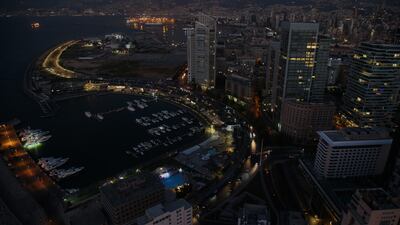
A view of Lebanon's capital, Beirut, with the lights on only in some buildings. Lebanese rely on highly polluting diesel generators run by private neighbourhood operators to make up for shortfalls in electricity supply from the state utility. EPA -

A fisherman uses a headlamp at the seaside corniche in Beirut, Lebanon. EPA -

A vendor sells LED balloons in full darkness at the corniche in Beirut. EPA -

The near collapse of the national grid has increased the duration of power cuts across Lebanon. EPA -
Residents of Beirut are experiencing power cuts of up to 20 hours a day. EPA


While Mr Hochstein said that he expected the deal to be enacted within “two to three months”, Mr Fayad was more cautious about giving a deadline.
“Technically, we can do it faster, but some decisions, like funding or Caesar Act reassurances, are not in my hands.”
But importing electricity from Egypt and Jordan is “not the ultimate solution”, Mr Hochstein said.
“Those two projects just give you several hours of power a day.”
A longer-term solution would be to invest in a new power plant in Lebanon, said Marc Ayoub, an energy policy researcher at the American University of Beirut’s Issam Fares Institute for Public Policy and International Affairs.
“We could build a 1,000MW power plant for $800 to $900m” or up to 50 per cent more than the World Bank loan currently under discussion, he said.
“This would be a long-term solution. I’m not saying that a deal with Egypt and Jordan isn’t good — but it’s subject to regional energy and security issues and is thus unsustainable.”

