


Ever since the Ottomans imposed a salt tax centuries ago on their subjects, the arid land along the border of Jordan and Syria has been dominated by smuggling.
Its latest incarnation is the stimulant pill known as Captagon, the market for which flows from Syria to Jordan, then to more lucrative markets in inner Arabia.
In the past few weeks Jordan has stepped up security operations across the kingdom in efforts to curb the illicit trade of the highly profitable drug.
This followed a stalled, Russian-brokered agreement between Amman and Damascus to help secure the border.
Moscow has also largely ignored Jordan’s requests to help it tackle the smuggling by pressuring Iran to prevent the drug flow from its allies in Syria.
-
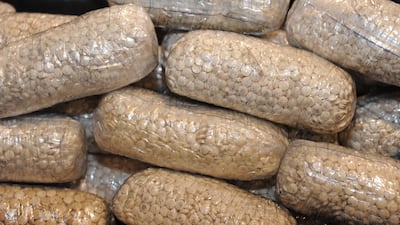
According to the United Nations Office on Drugs and Crime, trafficking in amphetamines has increased in the Middle East in recent years. Photo: Dubai Customs -
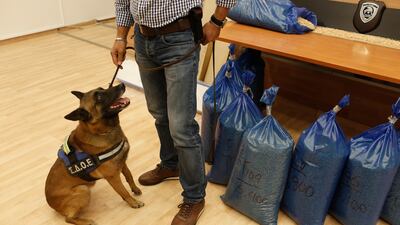
Specially trained K-9 units are often used by border forces to intercept shipments. EPA -
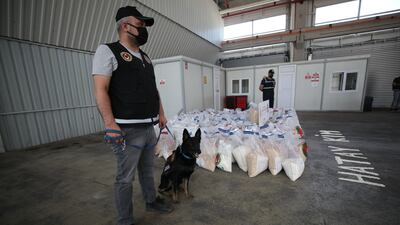
Experts believe the amount intercepted accounts for only around a tenth of the total quantity of pills being smuggled out of places like Syria and Jordan. EPA -
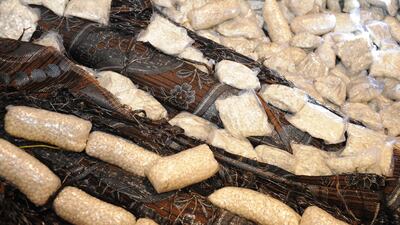
Dubai Customs thwarted 398 attempts to smuggle drugs into the city in the first three months of this year. Photo: Dubai Customs -
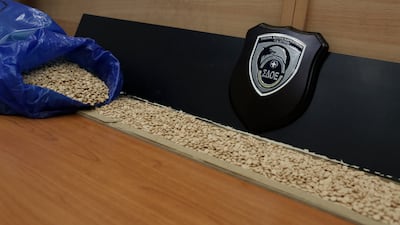
Captagon pills on display after being seized in Greece in 2019. EPA -
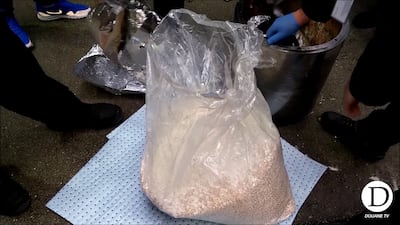
Captagon became synonymous with the Syrian Civil War. AFP -
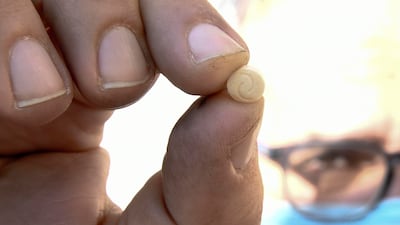
The small, off-white pills have quickly become one of the most widely consumed drugs in the Middle East. EPA -

Millions of Captagon pills are seized around the world each year. EPA -
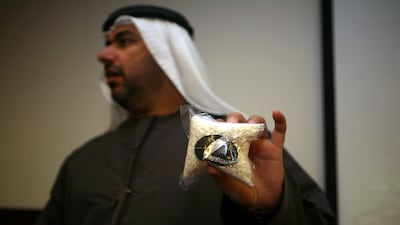
Captagon pills on display after a major interception of a shipment in 2009. Nicole Hill / The National -
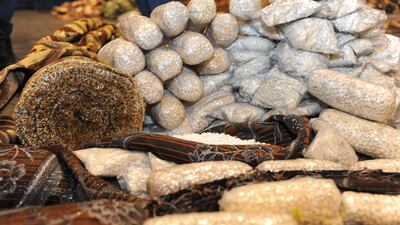
Customs officers say Captagon smugglers prefer to use sea ports rather than airports because of the size of shipping containers, enabling them to conceal larger quantities of drugs. Photo: Dubai Customs


“Everyone I know except my grandmother operates a Captagon factory and seeks to move the output south,” a pro-regime businessman said by phone from Damascus.
Although Jordan has sent more troops to its northern border, its response has been complicated by tribal politics in an area hit by a stagnant economy and 23 per cent unemployment.
Meanwhile, a Captagon pill, often produced at converted medicine factories in Damascus, costs as little as a few cents to produce but sells for several dollars in Jordan.
The rank and file recruited by the Syrian drug cartels to carry out the smuggling are mostly young members of clans who have relatives on the Jordanian side.
They cross into Jordan on foot under the cover of night or in poor visibility to earn $6,000 to $12,000 per drug run, although dozens have been shot by the Jordanian military over the past year, Syrian opposition sources say.
More sophisticated operations involve smuggling vast amounts of Captagon on pick-up trucks, aided by reconnaissance work by the Syrian army or pro-Iranian militias at the border, they say.
Balancing act
Since the Russian invasion of Ukraine in February, Jordan has been blaming the Syrian military and pro-Iranian militias in southern Syria for the Captagon trade, a position more publicly aligned with Washington.
At the same time, relations have deepened between Russia and Iran, making Moscow less likely to challenge Tehran’s role in Syria.
The Captagon boom started in 2018, when Russian intervention in Syria enabled President Bashar Al Assad’s forces to recapture most of country’s south from rebels fighting the regime.
This excluded the US-controlled Al Tanf pocket at the intersection of Syria’s borders with Jordan and Iraq.
Under a Russian-US-Israeli deal, the regime was allowed to retake the south as long as Hezbollah and other pro-Iranian militias kept away from the frontier.
But a security official monitoring the Jordanian side of the border says the militias “are literally inches from the borderline”.
He cites frequent instances of Iranian drones flying from Syrian regime border posts towards Jordan, either carrying drugs or doing reconnaissance for larger shipments.
“Hezbollah members are operating the drones right from the border posts,” he says.
The drones and other infiltration are monitored by a tower surveillance system costing hundreds of millions of dollars that alerts Jordanian patrols.
It was installed and paid for by the United States and other allied countries to help Jordan curb the smuggling and protect their own troops in the kingdom.
But the system is less effective in bad weather, especially along a 100km rugged strip of the 360km border called Al Harra.
It is difficult to operate patrols and build border barriers on this terrain without an even greater sum being spent.
Another security official says the challenge of stopping the drug flow from Al Harra is compounded by the unwillingness of tribes to hand over their own members.
He cited a 22-year old Jordanian man who has emerged as a drug kingpin in the area.
“Every time we lay a trap and think we are about to get him, he receives a tip [off] that we are coming and vanishes,” the official said.
For decades, Jordanian authorities have sought to create a modicum of law and order in outlying regions while giving tribes leeway in maintaining an unofficial economy and ties with their kin in Syria.
The balance has been largely maintained since Jordan was founded as a protectorate during the last chapter of the British empire a century ago, when the border with Syria came into being.
Market dynamics
During Ottoman times, salt produced in Al Azraq Oasis near the present border with Syria used to be smuggled to Damascus to bypass tuz resmi, the Turkish name for salt tax.
The tax was so hated that tuz entered into the Arabic vernacular as a profanity.
Smugglers would load the salt on to donkeys who, due to repeated trips, would memorise some of the smuggling treks through Al Harra, dispensing the need to lead them along routes still used today.
As Syria became a Soviet-style economy and many consumer goods were no longer available, Jordan became a source of everything from electricity sockets to toilet paper.
Cigarettes were smuggled through Syria, as were sheep, and hashish, mostly originating from the Beqaa valley, controlled by leftist Turkish and Palestinian groups, and later Hezbollah.
While thousands of tonnes of hashish are still flowing, that trade is dwarfed by an estimated multibillion-dollar Captagon market.
Jordanian counter-terrorism analyst Saud Al Sharafat says there needs to be a broader approach by Jordan and its allies to end the Captagon threat.
He suggests developing the border areas and eliminating the Al Harra gap, as well as reckoning with the likelihood of significant use of Captagon in Jordan, as indicated by several dozen drug busts in the past few weeks alone.
Ultimately, any solution would have to address the supply side and therefore Tehran’s role in the problem, although there are no open hostilities between the two countries, he says.
Mr Al Sharafat sees no incentive for Iran to co-operate with Jordan because Captagon revenue lessens the financial strain Iran is already under as its relations with its neighbours and the West remain at a deadlock.
“Iran is using the Captagon as one of the tools in its regional arsenal,” Mr Al Sharafat says.

