• Supporters of Israeli Prime Minister Benjamin Netanyahu rally in Tel Aviv. His reign could come to an end after opposition figures agreed to form a coalition. AFP
    Supporters of Israeli Prime Minister Benjamin Netanyahu rally in Tel Aviv. His reign could come to an end after opposition figures agreed to form a coalition. AFP
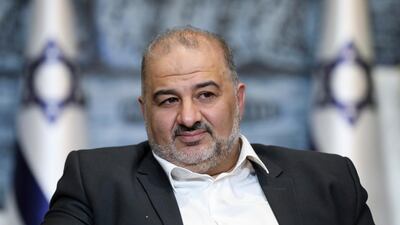
  • Mansour Abbas, head of the Islamic conservative Raam party, has joined a coalition that could force Israeli Prime Minister Benjamin Netanyahu out of office. Getty
    Mansour Abbas, head of the Islamic conservative Raam party, has joined a coalition that could force Israeli Prime Minister Benjamin Netanyahu out of office. Getty
  • Mr Abbas has agreed to be part of a 'change' coalition in Israel that could unseat Mr Netanyahu, who has led the country since 2009. Getty
    Mr Abbas has agreed to be part of a 'change' coalition in Israel that could unseat Mr Netanyahu, who has led the country since 2009. Getty
  • Supporters of Mr Netanyahu rally in Tel Aviv. Israel's opposition leader Yair Lapid says he has succeeded in forming a coalition to end the rule of the country's longest serving leader. AFP
    Supporters of Mr Netanyahu rally in Tel Aviv. Israel's opposition leader Yair Lapid says he has succeeded in forming a coalition to end the rule of the country's longest serving leader. AFP
  • Supporters of Mr Netanyahu gather in Tel Aviv. His long reign as Israel's prime minister will end if a coalition of opposition figures is confirmed by the 120-member Knesset. AFP
    Supporters of Mr Netanyahu gather in Tel Aviv. His long reign as Israel's prime minister will end if a coalition of opposition figures is confirmed by the 120-member Knesset. AFP
  • Supporters of the Israeli "change" coalition gather in Tel Aviv. The coalition is led by opposition leader Yair Lapid. AFP
    Supporters of the Israeli "change" coalition gather in Tel Aviv. The coalition is led by opposition leader Yair Lapid. AFP
  • Israeli right-wing supporters in the central city of Ramat Gan protest against the potential new government. AP
    Israeli right-wing supporters in the central city of Ramat Gan protest against the potential new government. AP
  • Israeli left-wing supporters take part in a demonstration in Ramat Gan to back a potential new coalition government. A sign in Hebrew reads: "We are the hope." AP
    Israeli left-wing supporters take part in a demonstration in Ramat Gan to back a potential new coalition government. A sign in Hebrew reads: "We are the hope." AP

Benjamin Netanyahu calls on Knesset members to oppose 'dangerous' new Israel government


  • English
  • Arabic

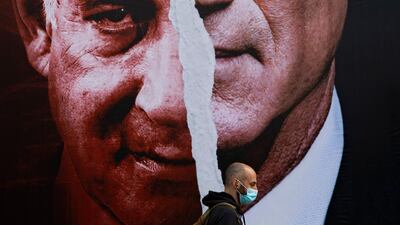
Israel’s Prime Minister Benjamin Netanyahu fought back on Thursday against an agreement by his political opponents to unseat him, calling the new coalition government "dangerous".

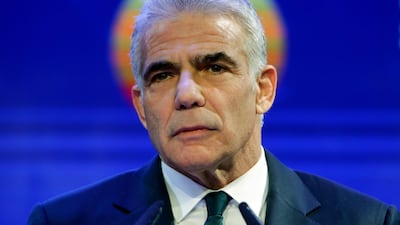
Opposition leader Yair Lapid said late on Wednesday that he has managed to form a broad-based coalition to unseat Mr Netanyahu and end the reign of the longest-serving prime minister in the country’s history.

Mr Netanyahu responded on Twitter that "all legislators elected by votes from the right must oppose this dangerous left-wing government".

If ratified by parliament in a confidence vote in the coming week, the new Israeli government will make history by becoming the first to include an Arab party after Mansour Abbas, head of the conservative RAAM, signed the agreement.

The coalition commands a razor-thin majority of 61 votes in parliament.

Now the question is whether the group's votes will hold together to name a new parliament speaker. The speaker would preside over a Knesset vote required to confirm the new government.
The current parliament speaker is a Netanyahu ally who could use his position to delay the vote and give Mr Netanyahu more time to sabotage the coalition.

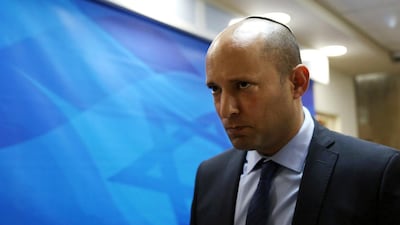
As the Lapid-Bennett coalition was coming together in recent days, Mr Netanyahu and his supporters ramped up a pressure campaign against former hawkish allies, including right-wing nationalist tech millionaire Naftali Bennett and his closest ally the Yamina party, Ayelet Shaked.
Mr Netanyahu accused them of betraying right-wing values. His supporters launched vicious social media campaigns and staged noisy protests outside Mr Shaked's home.

The prime minister's Likud party also advertised a demonstration on Thursday night outside the home of Yamina lawmaker Nir Orbach, urging him to quit the coalition.
That's a taste of the pressure to be expected for lawmakers on the right, while some on the left now have time to think about whether they will pay for this partnership in the next election.
"There will be a lot of pressure, especially on right-wingers, especially for religious right-wingers," Gideon Rahat, a political-science professor at Hebrew University, told the Associated Press.

"They will go to the synagogue and people will pressure them. It will be a nightmare for some of them."
Mr Netanyahu and his supporters called a meeting later on Thursday to discuss their next steps.

Should last-minute defections scupper the "change" alliance, Israel would likely have to hold yet another election, the fifth in bout two years.

Coalition government formed

  • Yair Lapid fell behind with 45 nominations in consultations with the president. AP
    Yair Lapid fell behind with 45 nominations in consultations with the president. AP
  • Mr Netanyahu’s bloc could be boosted by the right-wing Yamina party, which nominated its leader Naftali Bennett for the premiership. Reuters
    Mr Netanyahu’s bloc could be boosted by the right-wing Yamina party, which nominated its leader Naftali Bennett for the premiership. Reuters
  • Israeli Arab politician, leader of the United Arab list, Mansour Abbas, is seen as a potential kingmaker in resolving the impasse. AP
    Israeli Arab politician, leader of the United Arab list, Mansour Abbas, is seen as a potential kingmaker in resolving the impasse. AP
  • Israeli President Reuven Rivlin voiced doubt that any candidate can forge a majority coalition. AFP
    Israeli President Reuven Rivlin voiced doubt that any candidate can forge a majority coalition. AFP
  • Mr Netanyahu's fragile coalition with Benny Gantz collapsed in December. AP
    Mr Netanyahu's fragile coalition with Benny Gantz collapsed in December. AP

"I succeeded," Mr Lapid, a former TV news anchor, wrote on Facebook. "I promise that this government will work in the service of all of the citizens of Israel, those who voted for it and those who did not."

Mr Bennett would serve first as prime minister in a rotation agreement, with Mr Lapid to take over after two years.

"With the help of God, we will do together what is good for Israel and we'll get Israel back on track," Mr Bennett told Israel's President Reuven Rivlin after Mr Lapid informed Mr Rivlin of their coalition.

The new coalition is made up of (from left to right): Yesh Atid led by Yair Lapid, Yamina led by Naftali Bennett, New Hope led by Gideon Sa'ar, Israel Beiteinu led by Avigdor Lieberman, Meretz led by Nitzan Horowitz, Kahol Lavan led by Benny Gantz, RAAM led by Mansour Abbas and Labour led by Merav Michaeli. AFP

Mr Lapid was tasked with forming a government after Mr Netanyahu failed to put together his own coalition following March elections, the fourth inconclusive vote in less than two years.

Mr Netanyahu has become a divisive figure in Israeli politics over his tenure and is currently facing criminal charges.

Three parties in the last election were led by former top aides who fell out with him.

To build the anti-Netanyahu bloc, Mr Lapid had to sign individual agreements with seven parties.

Who is in the new Israeli coalition?

  • Yair Lapid's Yesh Atid (centrist) with 17 seats
  • Benny Gantz's Kahol Lavan (Blue and White) (centrist) with eight
  • Avigdor Lieberman's Israel Beiteinu (centre-right to right-wing nationalist) with seven
  • Merav Michaeli's Labor (social-democratic) with seven
  • Naftali Bennett's Yamina (right-wing) with seven
  • Gideon Sa'ar's New Hope (centre-right to right-wing) with six
  • Nitzan Horowitz's Meretz (left-wing, social-democratic) six
  • Mansour Abbas's RAAM (Arab Islamic) with four

Defence Minister Benny Gantz, who unsuccessfully challenged Mr Netanyahu in three previous votes, tweeted it was a "night of great hope," as he headed to Washington for pre-scheduled talks.

The change alliance also includes the Arab Israeli Islamic conservative party RAAM, whose head Mansour Abbas announced that he had joined in order to secure funding and policies to benefit Israel's 20 per cent minority of Palestinian descent.

"I just signed an agreement with Yair Lapid so that he can declare that he can form a government after reaching . agreements on various issues that serve the interest of Arab society," he said.

Other Arab lawmakers supported the late prime minister Yitzhak Rabin from outside his coalition in the 1990s, but Mr Abbas was the first Arab politician in Israel to openly bargain for a role in the coalition, said political analyst Afif Abu Much.

Mr Abu Much noted that lawmakers with other parties representing Arab citizens of Israel announced they would oppose the government headed by Mr Bennett, a strong supporter of Jewish settlements in the West Bank.

Wednesday night's deal deepens the woes of Mr Netanyahu, 71, who is on trial for criminal charges of fraud, bribery and breach of trust while in office – accusations he denies.

If he loses power, he will not be able to push through changes to basic laws that could give him immunity, and will lose control over certain justice ministry nominations.

The swearing-in is expected to take place on June 9, giving Mr Netanyahu another week to try to persuade legislators to leave the new coalition.

– Additional reporting by agencies

Benjamin Netanyahu's political career – in pictures

  • Israeli Prime Minister Benjamin Netanyahu speaks to the press at southern port of Eilat, on March 10, 2014, as Israel displayed advanced rockets seized from a ship allegedly transporting arms from Iran to Gaza. AFP
    Israeli Prime Minister Benjamin Netanyahu speaks to the press at southern port of Eilat, on March 10, 2014, as Israel displayed advanced rockets seized from a ship allegedly transporting arms from Iran to Gaza. AFP
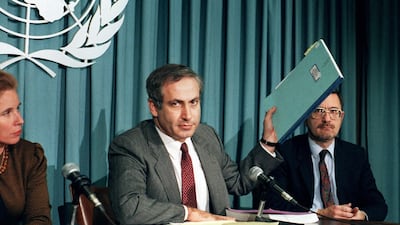
  • Benjamin Netanyahu, the then Israeli permanent envoy to the United Nations, holds up a file on Nazi criminal Alois Brunner during a news conference at the UN headquarters in November 1987. AFP
    Benjamin Netanyahu, the then Israeli permanent envoy to the United Nations, holds up a file on Nazi criminal Alois Brunner during a news conference at the UN headquarters in November 1987. AFP
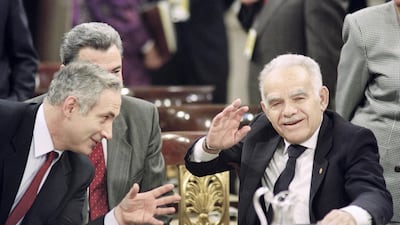
  • Benjamin Netanyahu, left, adviser to the then Israeli prime minister Yitzhak Shamir, right, in Madrid on October 30, 1991. AFP
    Benjamin Netanyahu, left, adviser to the then Israeli prime minister Yitzhak Shamir, right, in Madrid on October 30, 1991. AFP
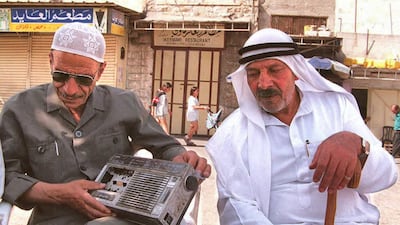
  • Palestinians listen to the radio for the results of Israeli elections where Benjamin Netanyahu was an important player, in Jerusalem's Old City on May 30, 1996. AFP
    Palestinians listen to the radio for the results of Israeli elections where Benjamin Netanyahu was an important player, in Jerusalem's Old City on May 30, 1996. AFP
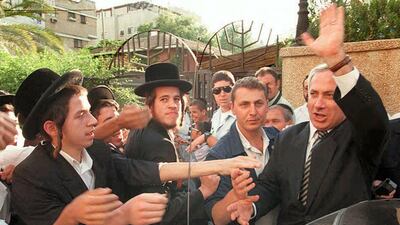
  • Likud party leader Benjamin Netanyahu, right, shakes hands with ultra orthodox students of a religious school in Beni Brak, near Tel Aviv, in May 1996. AFP
    Likud party leader Benjamin Netanyahu, right, shakes hands with ultra orthodox students of a religious school in Beni Brak, near Tel Aviv, in May 1996. AFP
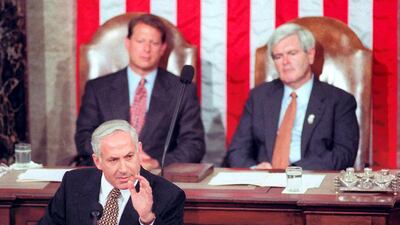
  • Israeli Prime Minister Benjamin Netanyahu addresses the joint session of US Congress as Speaker of the US House Newt Gingrich, right, and US Vice President Al Gore, left, listen on July 10, 1996. AFP
    Israeli Prime Minister Benjamin Netanyahu addresses the joint session of US Congress as Speaker of the US House Newt Gingrich, right, and US Vice President Al Gore, left, listen on July 10, 1996. AFP
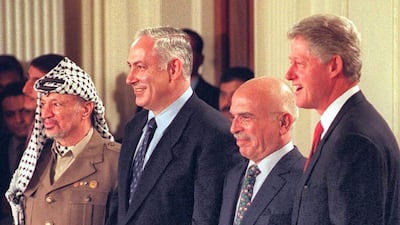
  • Benjamin Netanyahu, second left, US President Bill Clinton, right, Palestinian President Yasser Arafat, left, and King Hussein of Jordan at the White House in October 1996. AFP
    Benjamin Netanyahu, second left, US President Bill Clinton, right, Palestinian President Yasser Arafat, left, and King Hussein of Jordan at the White House in October 1996. AFP
  • Benjamin Netanyahu announces his resignation from the Israeli parliament, the Knesset, during a meeting of the Likud party central committee in Tel Aviv, on May 27, 1999, following his election defeat to Ehud Barak. AFP
    Benjamin Netanyahu announces his resignation from the Israeli parliament, the Knesset, during a meeting of the Likud party central committee in Tel Aviv, on May 27, 1999, following his election defeat to Ehud Barak. AFP
  • Mr Netanyahu, then Israeli finance minister, visits the biology lab of the Lauder-Reut school in the Romanian capital Bucharest on December 18, 2003. AFP
    Mr Netanyahu, then Israeli finance minister, visits the biology lab of the Lauder-Reut school in the Romanian capital Bucharest on December 18, 2003. AFP
  • Likud party leader Benjamin Netanyahu visits an archaeological site just outside the walls of the Old City in Jerusalem, on February 2, 2009. AFP
    Likud party leader Benjamin Netanyahu visits an archaeological site just outside the walls of the Old City in Jerusalem, on February 2, 2009. AFP
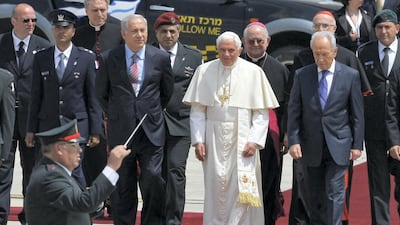
  • Israeli Prime Minister Benjamin Netanyahu, left, and President Shimon Peres, right, escort Pope Benedict XVI after the pontiff's arrival at Ben Gurion airport near Tel Aviv on May 11, 2009. AFP
    Israeli Prime Minister Benjamin Netanyahu, left, and President Shimon Peres, right, escort Pope Benedict XVI after the pontiff's arrival at Ben Gurion airport near Tel Aviv on May 11, 2009. AFP
  • Israeli Prime Minister Benjamin Netanyahu, left, and US President Barack Obama during their meeting at the White House in Washington on May 18, 2009. AFP
    Israeli Prime Minister Benjamin Netanyahu, left, and US President Barack Obama during their meeting at the White House in Washington on May 18, 2009. AFP
  • Benjamin Netanyahu, left, Italian Prime minister Silvio Berlusconi, second left, and Slovenian Prime minister Borut Pahor, second right, at the Organisation for Economic Cooperation and Development meeting on May 27, 2010 in Paris. AFP
    Benjamin Netanyahu, left, Italian Prime minister Silvio Berlusconi, second left, and Slovenian Prime minister Borut Pahor, second right, at the Organisation for Economic Cooperation and Development meeting on May 27, 2010 in Paris. AFP
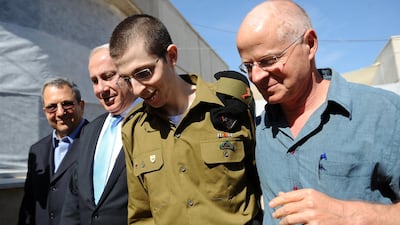
  • Benjamin Netanyahu and Defence Minister Ehud Barak watch as Israeli soldier Gilad Shalit, second right, is received by his father Noam, right, following his release from the Hamas captivity, in Tel Aviv on October 18, 2011. AFP
    Benjamin Netanyahu and Defence Minister Ehud Barak watch as Israeli soldier Gilad Shalit, second right, is received by his father Noam, right, following his release from the Hamas captivity, in Tel Aviv on October 18, 2011. AFP
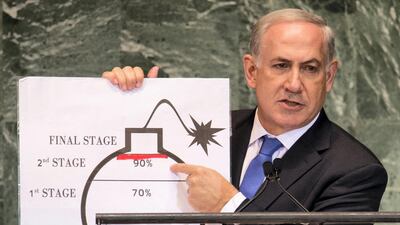
  • Israeli Prime Minister Benjamin Netanyahu uses a diagram to describe Iran's nuclear programme at the 67th United Nations General Assembly meeting on September 27, 2012, in New York. AFP
    Israeli Prime Minister Benjamin Netanyahu uses a diagram to describe Iran's nuclear programme at the 67th United Nations General Assembly meeting on September 27, 2012, in New York. AFP
  • Israeli Prime Minister Benjamin Netanyahu, second right, his wife Sara, then US Vice President Joe Biden, right and former British prime minister Tony Blair attend a state memorial service for Israel's former prime minister Ariel Sharon on January 13, 2014. Getty Images
    Israeli Prime Minister Benjamin Netanyahu, second right, his wife Sara, then US Vice President Joe Biden, right and former British prime minister Tony Blair attend a state memorial service for Israel's former prime minister Ariel Sharon on January 13, 2014. Getty Images
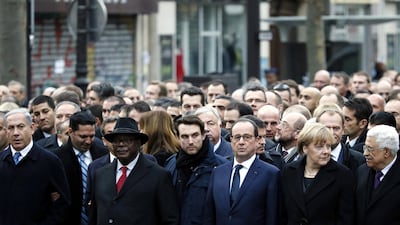
  • Benjamin Netanyahu along with other heads of state takes part in a unity rally in Paris on January 11, 2015, after a three-day killing spree by homegrown extremists. AFP
    Benjamin Netanyahu along with other heads of state takes part in a unity rally in Paris on January 11, 2015, after a three-day killing spree by homegrown extremists. AFP
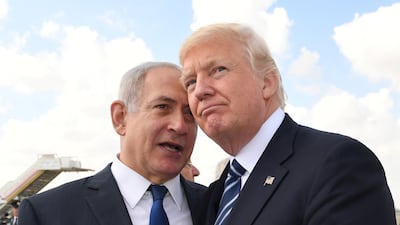
  • Israeli Prime Minister Benjamin Netanyahu and Donald Trump before the US president's departure from Tel Aviv on May 23, 2017. Getty Images
    Israeli Prime Minister Benjamin Netanyahu and Donald Trump before the US president's departure from Tel Aviv on May 23, 2017. Getty Images
  • Mr Netanyahu and his wife, Sara, greet supporters during his post-ballot speech on April 10, 2019 in Tel Aviv. Getty Images
    Mr Netanyahu and his wife, Sara, greet supporters during his post-ballot speech on April 10, 2019 in Tel Aviv. Getty Images
  • Israeli Prime Minister Benjamin Netanyahu, Bahrain's Foreign Minister Abdullatif Al Zayani, US President Donald Trump and Sheikh Abdullah bin Zayed, the UAE's Minister of Foreign Affairs and International Co-operation, after signing the Abraham Accord in Washington in September 2020. AFP
    Israeli Prime Minister Benjamin Netanyahu, Bahrain's Foreign Minister Abdullatif Al Zayani, US President Donald Trump and Sheikh Abdullah bin Zayed, the UAE's Minister of Foreign Affairs and International Co-operation, after signing the Abraham Accord in Washington in September 2020. AFP
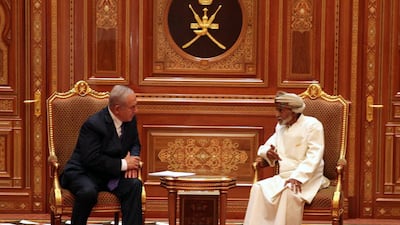
  • Sultan of Oman Qaboos bin Said meets Benjamin Netanyahu in Muscat. EPA
    Sultan of Oman Qaboos bin Said meets Benjamin Netanyahu in Muscat. EPA
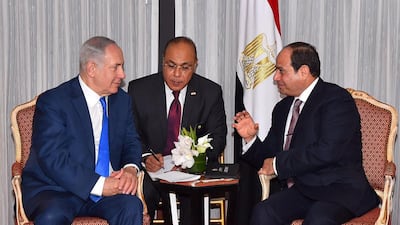
  • Egyptian President Abdel Fattah El Sisi (right) speaks with Israeli prime minister Benjamin Netanyahu at the United Nations General Assembly in New York on September 18, 2017, in their first public meeting together. Reuters
    Egyptian President Abdel Fattah El Sisi (right) speaks with Israeli prime minister Benjamin Netanyahu at the United Nations General Assembly in New York on September 18, 2017, in their first public meeting together. Reuters
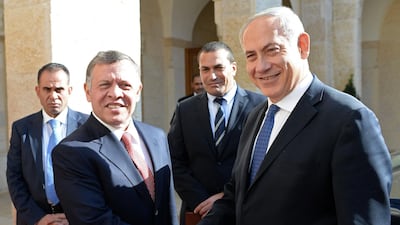
  • King Abdullah II of Jordan shakes hands with Benjamin Netanyahu ahead of their meeting in Amman on January 16, 2014. AFP
    King Abdullah II of Jordan shakes hands with Benjamin Netanyahu ahead of their meeting in Amman on January 16, 2014. AFP
ALRAWABI%20SCHOOL%20FOR%20GIRLS
%3Cp%3ECreator%3A%20Tima%20Shomali%3C%2Fp%3E%0A%3Cp%3EStarring%3A%C2%A0Tara%20Abboud%2C%C2%A0Kira%20Yaghnam%2C%20Tara%20Atalla%3C%2Fp%3E%0A%3Cp%3ERating%3A%204%2F5%3C%2Fp%3E%0A
How to apply for a drone permit
  • Individuals must register on UAE Drone app or website using their UAE Pass
  • Add all their personal details, including name, nationality, passport number, Emiratis ID, email and phone number
  • Upload the training certificate from a centre accredited by the GCAA
  • Submit their request
What are the regulations?
  • Fly it within visual line of sight
  • Never over populated areas
  • Ensure maximum flying height of 400 feet (122 metres) above ground level is not crossed
  • Users must avoid flying over restricted areas listed on the UAE Drone app
  • Only fly the drone during the day, and never at night
  • Should have a live feed of the drone flight
  • Drones must weigh 5 kg or less

Mercer, the investment consulting arm of US services company Marsh & McLennan, expects its wealth division to at least double its assets under management (AUM) in the Middle East as wealth in the region continues to grow despite economic headwinds, a company official said.

Mercer Wealth, which globally has $160 billion in AUM, plans to boost its AUM in the region to $2-$3bn in the next 2-3 years from the present $1bn, said Yasir AbuShaban, a Dubai-based principal with Mercer Wealth.

Within the next two to three years, we are looking at reaching $2 to $3 billion as a conservative estimate and we do see an opportunity to do so,” said Mr AbuShaban.

Mercer does not directly make investments, but allocates clients’ money they have discretion to, to professional asset managers. They also provide advice to clients.

“We have buying power. We can negotiate on their (client’s) behalf with asset managers to provide them lower fees than they otherwise would have to get on their own,” he added.

Mercer Wealth’s clients include sovereign wealth funds, family offices, and insurance companies among others.

From its office in Dubai, Mercer also looks after Africa, India and Turkey, where they also see opportunity for growth.

Wealth creation in Middle East and Africa (MEA) grew 8.5 per cent to $8.1 trillion last year from $7.5tn in 2015, higher than last year’s global average of 6 per cent and the second-highest growth in a region after Asia-Pacific which grew 9.9 per cent, according to consultancy Boston Consulting Group (BCG). In the region, where wealth grew just 1.9 per cent in 2015 compared with 2014, a pickup in oil prices has helped in wealth generation.

BCG is forecasting MEA wealth will rise to $12tn by 2021, growing at an annual average of 8 per cent.

Drivers of wealth generation in the region will be split evenly between new wealth creation and growth of performance of existing assets, according to BCG.

Another general trend in the region is clients’ looking for a comprehensive approach to investing, according to Mr AbuShaban.

“Institutional investors or some of the families are seeing a slowdown in the available capital they have to invest and in that sense they are looking at optimizing the way they manage their portfolios and making sure they are not investing haphazardly and different parts of their investment are working together,” said Mr AbuShaban.

Some clients also have a higher appetite for risk, given the low interest-rate environment that does not provide enough yield for some institutional investors. These clients are keen to invest in illiquid assets, such as private equity and infrastructure.

“What we have seen is a desire for higher returns in what has been a low-return environment specifically in various fixed income or bonds,” he said.

“In this environment, we have seen a de facto increase in the risk that clients are taking in things like illiquid investments, private equity investments, infrastructure and private debt, those kind of investments were higher illiquidity results in incrementally higher returns.”

The Abu Dhabi Investment Authority, one of the largest sovereign wealth funds, said in its 2016 report that has gradually increased its exposure in direct private equity and private credit transactions, mainly in Asian markets and especially in China and India. The authority’s private equity department focused on structured equities owing to “their defensive characteristics.”

Trump v Khan

2016: Feud begins after Khan criticised Trump’s proposed Muslim travel ban to US

2017: Trump criticises Khan’s ‘no reason to be alarmed’ response to London Bridge terror attacks

2019: Trump calls Khan a “stone cold loser” before first state visit

2019: Trump tweets about “Khan’s Londonistan”, calling him “a national disgrace”

2022:  Khan’s office attributes rise in Islamophobic abuse against the major to hostility stoked during Trump’s presidency

July 2025 During a golfing trip to Scotland, Trump calls Khan “a nasty person”

Sept 2025 Trump blames Khan for London’s “stabbings and the dirt and the filth”.

Dec 2025 Trump suggests migrants got Khan elected, calls him a “horrible, vicious, disgusting mayor”

Desert Warrior

Starring: Anthony Mackie, Aiysha Hart, Ben Kingsley

Director: Rupert Wyatt

Rating: 3/5

BUNDESLIGA FIXTURES

Friday (UAE kick-off times)

Borussia Dortmund v Paderborn (11.30pm)

Saturday 

Bayer Leverkusen v SC Freiburg (6.30pm)

Werder Bremen v Schalke (6.30pm)

Union Berlin v Borussia Monchengladbach (6.30pm)

Eintracht Frankfurt v Wolfsburg (6.30pm)

Fortuna Dusseldof v  Bayern Munich (6.30pm)

RB Leipzig v Cologne (9.30pm)

Sunday

Augsburg v Hertha Berlin (6.30pm)

Hoffenheim v Mainz (9pm)


RACE RESULTS

1. Valtteri Bottas (FIN/Mercedes) 1hr 21min 48.527sec
2. Sebastian Vettel (GER/Ferrari) at 0.658sec
3. Daniel Ricciardo (AUS/Red Bull) 6.012 
4. Lewis Hamilton (GBR/Mercedes) 7.430
5. Kimi Räikkönen (FIN/Ferrari) 20.370
6. Romain Grosjean (FRA/Haas) 1:13.160
7. Sergio Pérez (MEX/Force India) 1 lap
8. Esteban Ocon (FRA/Force India) 1 lap
9. Felipe Massa (BRA/Williams) 1 lap
10. Lance Stroll (CAN/Williams) 1 lap
11. Jolyon Palmer (GBR/Renault) 1 lap
12. Stoffel Vandoorne (BEL/McLaren) 1 lap
13. Nico Hülkenberg (GER/Renault) 1 lap
14. Pascal Wehrlein (GER/Sauber) 1 lap
15. Marcus Ericsson (SWE/Sauber) 2 laps
16. Daniil Kvyat (RUS/Toro Rosso) 3 laps

Brief scoreline:

Crystal Palace 2

Milivojevic 76' (pen), Van Aanholt 88'

Huddersfield Town 0