• Supporters of Israeli Prime Minister Benjamin Netanyahu rally in Tel Aviv. His reign could come to an end after opposition figures agreed to form a coalition. AFP
    Supporters of Israeli Prime Minister Benjamin Netanyahu rally in Tel Aviv. His reign could come to an end after opposition figures agreed to form a coalition. AFP
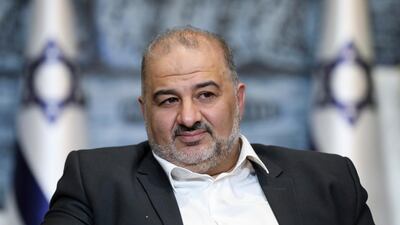
  • Mansour Abbas, head of the Islamic conservative Raam party, has joined a coalition that could force Israeli Prime Minister Benjamin Netanyahu out of office. Getty
    Mansour Abbas, head of the Islamic conservative Raam party, has joined a coalition that could force Israeli Prime Minister Benjamin Netanyahu out of office. Getty
  • Mr Abbas has agreed to be part of a 'change' coalition in Israel that could unseat Mr Netanyahu, who has led the country since 2009. Getty
    Mr Abbas has agreed to be part of a 'change' coalition in Israel that could unseat Mr Netanyahu, who has led the country since 2009. Getty
  • Supporters of Mr Netanyahu rally in Tel Aviv. Israel's opposition leader Yair Lapid says he has succeeded in forming a coalition to end the rule of the country's longest serving leader. AFP
    Supporters of Mr Netanyahu rally in Tel Aviv. Israel's opposition leader Yair Lapid says he has succeeded in forming a coalition to end the rule of the country's longest serving leader. AFP
  • Supporters of Mr Netanyahu gather in Tel Aviv. His long reign as Israel's prime minister will end if a coalition of opposition figures is confirmed by the 120-member Knesset. AFP
    Supporters of Mr Netanyahu gather in Tel Aviv. His long reign as Israel's prime minister will end if a coalition of opposition figures is confirmed by the 120-member Knesset. AFP
  • Supporters of the Israeli "change" coalition gather in Tel Aviv. The coalition is led by opposition leader Yair Lapid. AFP
    Supporters of the Israeli "change" coalition gather in Tel Aviv. The coalition is led by opposition leader Yair Lapid. AFP
  • Israeli right-wing supporters in the central city of Ramat Gan protest against the potential new government. AP
    Israeli right-wing supporters in the central city of Ramat Gan protest against the potential new government. AP
  • Israeli left-wing supporters take part in a demonstration in Ramat Gan to back a potential new coalition government. A sign in Hebrew reads: "We are the hope." AP
    Israeli left-wing supporters take part in a demonstration in Ramat Gan to back a potential new coalition government. A sign in Hebrew reads: "We are the hope." AP

Benjamin Netanyahu calls on Knesset members to oppose 'dangerous' new Israel government


  • English
  • Arabic

Israel’s Prime Minister Benjamin Netanyahu fought back on Thursday against an agreement by his political opponents to unseat him, calling the new coalition government "dangerous".

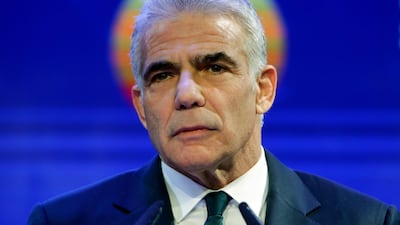
Opposition leader Yair Lapid said late on Wednesday that he has managed to form a broad-based coalition to unseat Mr Netanyahu and end the reign of the longest-serving prime minister in the country’s history.

Mr Netanyahu responded on Twitter that "all legislators elected by votes from the right must oppose this dangerous left-wing government".

If ratified by parliament in a confidence vote in the coming week, the new Israeli government will make history by becoming the first to include an Arab party after Mansour Abbas, head of the conservative RAAM, signed the agreement.

The coalition commands a razor-thin majority of 61 votes in parliament.

Now the question is whether the group's votes will hold together to name a new parliament speaker. The speaker would preside over a Knesset vote required to confirm the new government.
The current parliament speaker is a Netanyahu ally who could use his position to delay the vote and give Mr Netanyahu more time to sabotage the coalition.

As the Lapid-Bennett coalition was coming together in recent days, Mr Netanyahu and his supporters ramped up a pressure campaign against former hawkish allies, including right-wing nationalist tech millionaire Naftali Bennett and his closest ally the Yamina party, Ayelet Shaked.
Mr Netanyahu accused them of betraying right-wing values. His supporters launched vicious social media campaigns and staged noisy protests outside Mr Shaked's home.

The prime minister's Likud party also advertised a demonstration on Thursday night outside the home of Yamina lawmaker Nir Orbach, urging him to quit the coalition.
That's a taste of the pressure to be expected for lawmakers on the right, while some on the left now have time to think about whether they will pay for this partnership in the next election.
"There will be a lot of pressure, especially on right-wingers, especially for religious right-wingers," Gideon Rahat, a political-science professor at Hebrew University, told the Associated Press.

"They will go to the synagogue and people will pressure them. It will be a nightmare for some of them."
Mr Netanyahu and his supporters called a meeting later on Thursday to discuss their next steps.

Should last-minute defections scupper the "change" alliance, Israel would likely have to hold yet another election, the fifth in bout two years.

Coalition government formed

  • Yair Lapid fell behind with 45 nominations in consultations with the president. AP
    Yair Lapid fell behind with 45 nominations in consultations with the president. AP
  • Mr Netanyahu’s bloc could be boosted by the right-wing Yamina party, which nominated its leader Naftali Bennett for the premiership. Reuters
    Mr Netanyahu’s bloc could be boosted by the right-wing Yamina party, which nominated its leader Naftali Bennett for the premiership. Reuters
  • Israeli Arab politician, leader of the United Arab list, Mansour Abbas, is seen as a potential kingmaker in resolving the impasse. AP
    Israeli Arab politician, leader of the United Arab list, Mansour Abbas, is seen as a potential kingmaker in resolving the impasse. AP
  • Israeli President Reuven Rivlin voiced doubt that any candidate can forge a majority coalition. AFP
    Israeli President Reuven Rivlin voiced doubt that any candidate can forge a majority coalition. AFP
  • Mr Netanyahu's fragile coalition with Benny Gantz collapsed in December. AP
    Mr Netanyahu's fragile coalition with Benny Gantz collapsed in December. AP

"I succeeded," Mr Lapid, a former TV news anchor, wrote on Facebook. "I promise that this government will work in the service of all of the citizens of Israel, those who voted for it and those who did not."

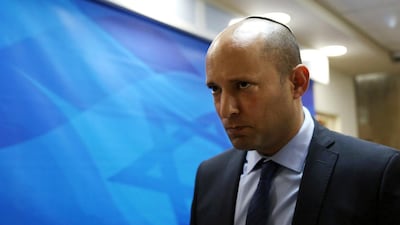
Mr Bennett would serve first as prime minister in a rotation agreement, with Mr Lapid to take over after two years.

"With the help of God, we will do together what is good for Israel and we'll get Israel back on track," Mr Bennett told Israel's President Reuven Rivlin after Mr Lapid informed Mr Rivlin of their coalition.

The new coalition is made up of (from left to right): Yesh Atid led by Yair Lapid, Yamina led by Naftali Bennett, New Hope led by Gideon Sa'ar, Israel Beiteinu led by Avigdor Lieberman, Meretz led by Nitzan Horowitz, Kahol Lavan led by Benny Gantz, RAAM led by Mansour Abbas and Labour led by Merav Michaeli. AFP

Mr Lapid was tasked with forming a government after Mr Netanyahu failed to put together his own coalition following March elections, the fourth inconclusive vote in less than two years.

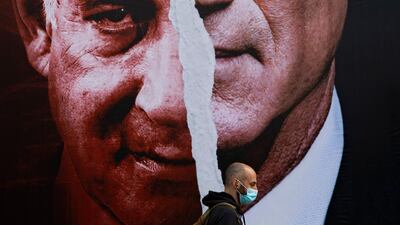
Mr Netanyahu has become a divisive figure in Israeli politics over his tenure and is currently facing criminal charges.

Three parties in the last election were led by former top aides who fell out with him.

To build the anti-Netanyahu bloc, Mr Lapid had to sign individual agreements with seven parties.

Who is in the new Israeli coalition?

  • Yair Lapid's Yesh Atid (centrist) with 17 seats
  • Benny Gantz's Kahol Lavan (Blue and White) (centrist) with eight
  • Avigdor Lieberman's Israel Beiteinu (centre-right to right-wing nationalist) with seven
  • Merav Michaeli's Labor (social-democratic) with seven
  • Naftali Bennett's Yamina (right-wing) with seven
  • Gideon Sa'ar's New Hope (centre-right to right-wing) with six
  • Nitzan Horowitz's Meretz (left-wing, social-democratic) six
  • Mansour Abbas's RAAM (Arab Islamic) with four

Defence Minister Benny Gantz, who unsuccessfully challenged Mr Netanyahu in three previous votes, tweeted it was a "night of great hope," as he headed to Washington for pre-scheduled talks.

The change alliance also includes the Arab Israeli Islamic conservative party RAAM, whose head Mansour Abbas announced that he had joined in order to secure funding and policies to benefit Israel's 20 per cent minority of Palestinian descent.

"I just signed an agreement with Yair Lapid so that he can declare that he can form a government after reaching . agreements on various issues that serve the interest of Arab society," he said.

Other Arab lawmakers supported the late prime minister Yitzhak Rabin from outside his coalition in the 1990s, but Mr Abbas was the first Arab politician in Israel to openly bargain for a role in the coalition, said political analyst Afif Abu Much.

Mr Abu Much noted that lawmakers with other parties representing Arab citizens of Israel announced they would oppose the government headed by Mr Bennett, a strong supporter of Jewish settlements in the West Bank.

Wednesday night's deal deepens the woes of Mr Netanyahu, 71, who is on trial for criminal charges of fraud, bribery and breach of trust while in office – accusations he denies.

If he loses power, he will not be able to push through changes to basic laws that could give him immunity, and will lose control over certain justice ministry nominations.

The swearing-in is expected to take place on June 9, giving Mr Netanyahu another week to try to persuade legislators to leave the new coalition.

– Additional reporting by agencies

Benjamin Netanyahu's political career – in pictures

  • Israeli Prime Minister Benjamin Netanyahu speaks to the press at southern port of Eilat, on March 10, 2014, as Israel displayed advanced rockets seized from a ship allegedly transporting arms from Iran to Gaza. AFP
    Israeli Prime Minister Benjamin Netanyahu speaks to the press at southern port of Eilat, on March 10, 2014, as Israel displayed advanced rockets seized from a ship allegedly transporting arms from Iran to Gaza. AFP
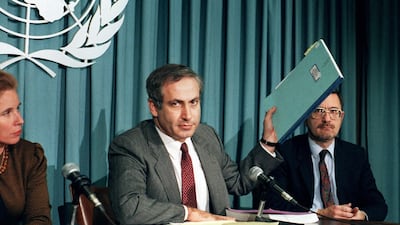
  • Benjamin Netanyahu, the then Israeli permanent envoy to the United Nations, holds up a file on Nazi criminal Alois Brunner during a news conference at the UN headquarters in November 1987. AFP
    Benjamin Netanyahu, the then Israeli permanent envoy to the United Nations, holds up a file on Nazi criminal Alois Brunner during a news conference at the UN headquarters in November 1987. AFP
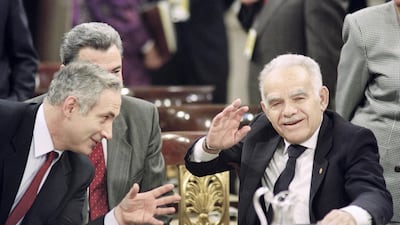
  • Benjamin Netanyahu, left, adviser to the then Israeli prime minister Yitzhak Shamir, right, in Madrid on October 30, 1991. AFP
    Benjamin Netanyahu, left, adviser to the then Israeli prime minister Yitzhak Shamir, right, in Madrid on October 30, 1991. AFP
  • Palestinians listen to the radio for the results of Israeli elections where Benjamin Netanyahu was an important player, in Jerusalem's Old City on May 30, 1996. AFP
    Palestinians listen to the radio for the results of Israeli elections where Benjamin Netanyahu was an important player, in Jerusalem's Old City on May 30, 1996. AFP
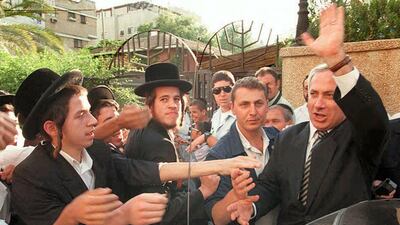
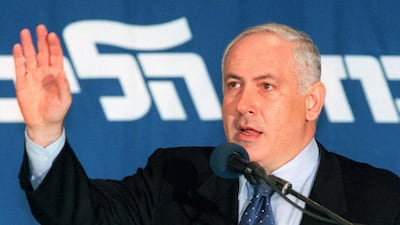
  • Likud party leader Benjamin Netanyahu, right, shakes hands with ultra orthodox students of a religious school in Beni Brak, near Tel Aviv, in May 1996. AFP
    Likud party leader Benjamin Netanyahu, right, shakes hands with ultra orthodox students of a religious school in Beni Brak, near Tel Aviv, in May 1996. AFP
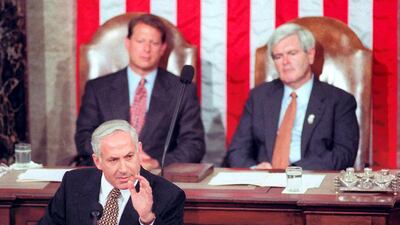
  • Israeli Prime Minister Benjamin Netanyahu addresses the joint session of US Congress as Speaker of the US House Newt Gingrich, right, and US Vice President Al Gore, left, listen on July 10, 1996. AFP
    Israeli Prime Minister Benjamin Netanyahu addresses the joint session of US Congress as Speaker of the US House Newt Gingrich, right, and US Vice President Al Gore, left, listen on July 10, 1996. AFP
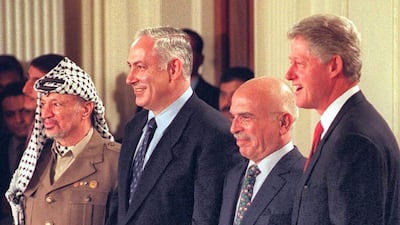
  • Benjamin Netanyahu, second left, US President Bill Clinton, right, Palestinian President Yasser Arafat, left, and King Hussein of Jordan at the White House in October 1996. AFP
    Benjamin Netanyahu, second left, US President Bill Clinton, right, Palestinian President Yasser Arafat, left, and King Hussein of Jordan at the White House in October 1996. AFP
  • Benjamin Netanyahu announces his resignation from the Israeli parliament, the Knesset, during a meeting of the Likud party central committee in Tel Aviv, on May 27, 1999, following his election defeat to Ehud Barak. AFP
    Benjamin Netanyahu announces his resignation from the Israeli parliament, the Knesset, during a meeting of the Likud party central committee in Tel Aviv, on May 27, 1999, following his election defeat to Ehud Barak. AFP
  • Mr Netanyahu, then Israeli finance minister, visits the biology lab of the Lauder-Reut school in the Romanian capital Bucharest on December 18, 2003. AFP
    Mr Netanyahu, then Israeli finance minister, visits the biology lab of the Lauder-Reut school in the Romanian capital Bucharest on December 18, 2003. AFP
  • Likud party leader Benjamin Netanyahu visits an archaeological site just outside the walls of the Old City in Jerusalem, on February 2, 2009. AFP
    Likud party leader Benjamin Netanyahu visits an archaeological site just outside the walls of the Old City in Jerusalem, on February 2, 2009. AFP
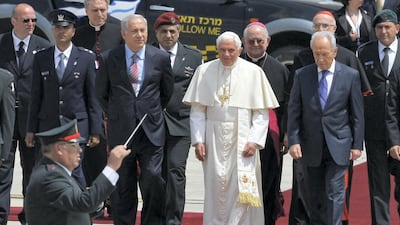
  • Israeli Prime Minister Benjamin Netanyahu, left, and President Shimon Peres, right, escort Pope Benedict XVI after the pontiff's arrival at Ben Gurion airport near Tel Aviv on May 11, 2009. AFP
    Israeli Prime Minister Benjamin Netanyahu, left, and President Shimon Peres, right, escort Pope Benedict XVI after the pontiff's arrival at Ben Gurion airport near Tel Aviv on May 11, 2009. AFP
  • Israeli Prime Minister Benjamin Netanyahu, left, and US President Barack Obama during their meeting at the White House in Washington on May 18, 2009. AFP
    Israeli Prime Minister Benjamin Netanyahu, left, and US President Barack Obama during their meeting at the White House in Washington on May 18, 2009. AFP
  • Benjamin Netanyahu, left, Italian Prime minister Silvio Berlusconi, second left, and Slovenian Prime minister Borut Pahor, second right, at the Organisation for Economic Cooperation and Development meeting on May 27, 2010 in Paris. AFP
    Benjamin Netanyahu, left, Italian Prime minister Silvio Berlusconi, second left, and Slovenian Prime minister Borut Pahor, second right, at the Organisation for Economic Cooperation and Development meeting on May 27, 2010 in Paris. AFP
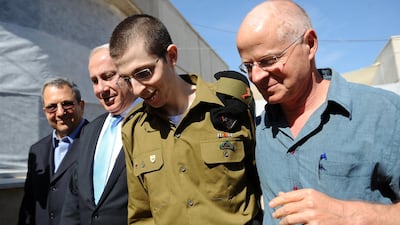
  • Benjamin Netanyahu and Defence Minister Ehud Barak watch as Israeli soldier Gilad Shalit, second right, is received by his father Noam, right, following his release from the Hamas captivity, in Tel Aviv on October 18, 2011. AFP
    Benjamin Netanyahu and Defence Minister Ehud Barak watch as Israeli soldier Gilad Shalit, second right, is received by his father Noam, right, following his release from the Hamas captivity, in Tel Aviv on October 18, 2011. AFP
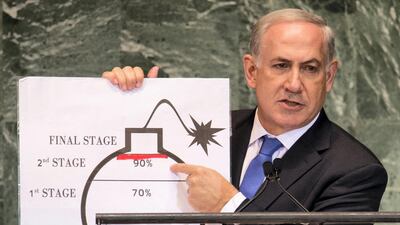
  • Israeli Prime Minister Benjamin Netanyahu uses a diagram to describe Iran's nuclear programme at the 67th United Nations General Assembly meeting on September 27, 2012, in New York. AFP
    Israeli Prime Minister Benjamin Netanyahu uses a diagram to describe Iran's nuclear programme at the 67th United Nations General Assembly meeting on September 27, 2012, in New York. AFP
  • Israeli Prime Minister Benjamin Netanyahu, second right, his wife Sara, then US Vice President Joe Biden, right and former British prime minister Tony Blair attend a state memorial service for Israel's former prime minister Ariel Sharon on January 13, 2014. Getty Images
    Israeli Prime Minister Benjamin Netanyahu, second right, his wife Sara, then US Vice President Joe Biden, right and former British prime minister Tony Blair attend a state memorial service for Israel's former prime minister Ariel Sharon on January 13, 2014. Getty Images
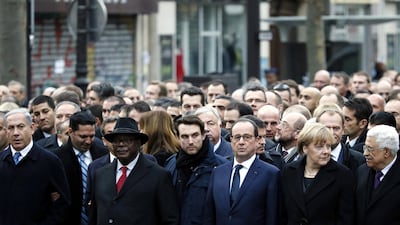
  • Benjamin Netanyahu along with other heads of state takes part in a unity rally in Paris on January 11, 2015, after a three-day killing spree by homegrown extremists. AFP
    Benjamin Netanyahu along with other heads of state takes part in a unity rally in Paris on January 11, 2015, after a three-day killing spree by homegrown extremists. AFP
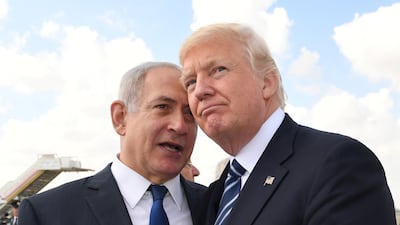
  • Israeli Prime Minister Benjamin Netanyahu and Donald Trump before the US president's departure from Tel Aviv on May 23, 2017. Getty Images
    Israeli Prime Minister Benjamin Netanyahu and Donald Trump before the US president's departure from Tel Aviv on May 23, 2017. Getty Images
  • Mr Netanyahu and his wife, Sara, greet supporters during his post-ballot speech on April 10, 2019 in Tel Aviv. Getty Images
    Mr Netanyahu and his wife, Sara, greet supporters during his post-ballot speech on April 10, 2019 in Tel Aviv. Getty Images
  • Israeli Prime Minister Benjamin Netanyahu, Bahrain's Foreign Minister Abdullatif Al Zayani, US President Donald Trump and Sheikh Abdullah bin Zayed, the UAE's Minister of Foreign Affairs and International Co-operation, after signing the Abraham Accord in Washington in September 2020. AFP
    Israeli Prime Minister Benjamin Netanyahu, Bahrain's Foreign Minister Abdullatif Al Zayani, US President Donald Trump and Sheikh Abdullah bin Zayed, the UAE's Minister of Foreign Affairs and International Co-operation, after signing the Abraham Accord in Washington in September 2020. AFP
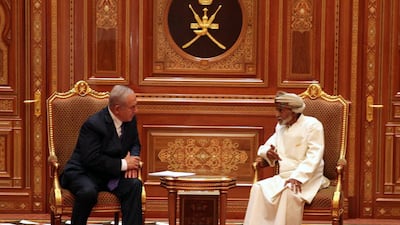
  • Sultan of Oman Qaboos bin Said meets Benjamin Netanyahu in Muscat. EPA
    Sultan of Oman Qaboos bin Said meets Benjamin Netanyahu in Muscat. EPA
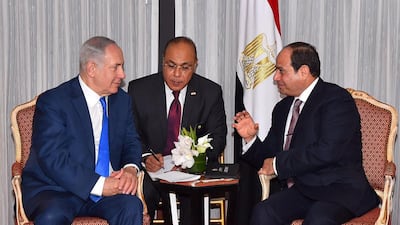
  • Egyptian President Abdel Fattah El Sisi (right) speaks with Israeli prime minister Benjamin Netanyahu at the United Nations General Assembly in New York on September 18, 2017, in their first public meeting together. Reuters
    Egyptian President Abdel Fattah El Sisi (right) speaks with Israeli prime minister Benjamin Netanyahu at the United Nations General Assembly in New York on September 18, 2017, in their first public meeting together. Reuters
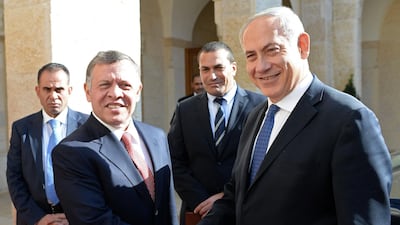
  • King Abdullah II of Jordan shakes hands with Benjamin Netanyahu ahead of their meeting in Amman on January 16, 2014. AFP
    King Abdullah II of Jordan shakes hands with Benjamin Netanyahu ahead of their meeting in Amman on January 16, 2014. AFP
The candidates

Dr Ayham Ammora, scientist and business executive

Ali Azeem, business leader

Tony Booth, professor of education

Lord Browne, former BP chief executive

Dr Mohamed El-Erian, economist

Professor Wyn Evans, astrophysicist

Dr Mark Mann, scientist

Gina MIller, anti-Brexit campaigner

Lord Smith, former Cabinet minister

Sandi Toksvig, broadcaster


Dubai Bling season three

Cast: Loujain Adada, Zeina Khoury, Farhana Bodi, Ebraheem Al Samadi, Mona Kattan, and couples Safa & Fahad Siddiqui and DJ Bliss & Danya Mohammed 

Rating: 1/5

How to apply for a drone permit
  • Individuals must register on UAE Drone app or website using their UAE Pass
  • Add all their personal details, including name, nationality, passport number, Emiratis ID, email and phone number
  • Upload the training certificate from a centre accredited by the GCAA
  • Submit their request
What are the regulations?
  • Fly it within visual line of sight
  • Never over populated areas
  • Ensure maximum flying height of 400 feet (122 metres) above ground level is not crossed
  • Users must avoid flying over restricted areas listed on the UAE Drone app
  • Only fly the drone during the day, and never at night
  • Should have a live feed of the drone flight
  • Drones must weigh 5 kg or less
Company profile

Company name: Nestrom

Started: 2017

Co-founders: Yousef Wadi, Kanaan Manasrah and Shadi Shalabi

Based: Jordan

Sector: Technology

Initial investment: Close to $100,000

Investors: Propeller, 500 Startups, Wamda Capital, Agrimatico, Techstars and some angel investors

Dust and sand storms compared

Sand storm

  • Particle size: Larger, heavier sand grains
  • Visibility: Often dramatic with thick "walls" of sand
  • Duration: Short-lived, typically localised
  • Travel distance: Limited 
  • Source: Open desert areas with strong winds

Dust storm

  • Particle size: Much finer, lightweight particles
  • Visibility: Hazy skies but less intense
  • Duration: Can linger for days
  • Travel distance: Long-range, up to thousands of kilometres
  • Source: Can be carried from distant regions
While you're here
UPI facts

More than 2.2 million Indian tourists arrived in UAE in 2023
More than 3.5 million Indians reside in UAE
Indian tourists can make purchases in UAE using rupee accounts in India through QR-code-based UPI real-time payment systems
Indian residents in UAE can use their non-resident NRO and NRE accounts held in Indian banks linked to a UAE mobile number for UPI transactions

Company profile

Date started: 2015

Founder: John Tsioris and Ioanna Angelidaki

Based: Dubai

Sector: Online grocery delivery

Staff: 200

Funding: Undisclosed, but investors include the Jabbar Internet Group and Venture Friends

New UK refugee system


  • A new “core protection” for refugees moving from permanent to a more basic, temporary protection
  • Shortened leave to remain - refugees will receive 30 months instead of five years
  • A longer path to settlement with no indefinite settled status until a refugee has spent 20 years in Britain
  • To encourage refugees to integrate the government will encourage them to out of the core protection route wherever possible.
  • Under core protection there will be no automatic right to family reunion
  • Refugees will have a reduced right to public funds

TO ALL THE BOYS: ALWAYS AND FOREVER

Directed by: Michael Fimognari

Starring: Lana Condor and Noah Centineo

Two stars

Ten tax points to be aware of in 2026

1. Domestic VAT refund amendments: request your refund within five years

If a business does not apply for the refund on time, they lose their credit.

2. E-invoicing in the UAE

Businesses should continue preparing for the implementation of e-invoicing in the UAE, with 2026 a preparation and transition period ahead of phased mandatory adoption. 

3. More tax audits

Tax authorities are increasingly using data already available across multiple filings to identify audit risks. 

4. More beneficial VAT and excise tax penalty regime

Tax disputes are expected to become more frequent and more structured, with clearer administrative objection and appeal processes. The UAE has adopted a new penalty regime for VAT and excise disputes, which now mirrors the penalty regime for corporate tax.

5. Greater emphasis on statutory audit

There is a greater need for the accuracy of financial statements. The International Financial Reporting Standards standards need to be strictly adhered to and, as a result, the quality of the audits will need to increase.

6. Further transfer pricing enforcement

Transfer pricing enforcement, which refers to the practice of establishing prices for internal transactions between related entities, is expected to broaden in scope. The UAE will shortly open the possibility to negotiate advance pricing agreements, or essentially rulings for transfer pricing purposes. 

7. Limited time periods for audits

Recent amendments also introduce a default five-year limitation period for tax audits and assessments, subject to specific statutory exceptions. While the standard audit and assessment period is five years, this may be extended to up to 15 years in cases involving fraud or tax evasion. 

8. Pillar 2 implementation 

Many multinational groups will begin to feel the practical effect of the Domestic Minimum Top-Up Tax (DMTT), the UAE's implementation of the OECD’s global minimum tax under Pillar 2. While the rules apply for financial years starting on or after January 1, 2025, it is 2026 that marks the transition to an operational phase.

9. Reduced compliance obligations for imported goods and services

Businesses that apply the reverse-charge mechanism for VAT purposes in the UAE may benefit from reduced compliance obligations. 

10. Substance and CbC reporting focus

Tax authorities are expected to continue strengthening the enforcement of economic substance and Country-by-Country (CbC) reporting frameworks. In the UAE, these regimes are increasingly being used as risk-assessment tools, providing tax authorities with a comprehensive view of multinational groups’ global footprints and enabling them to assess whether profits are aligned with real economic activity. 

Contributed by Thomas Vanhee and Hend Rashwan, Aurifer

The specs

Engine: 5.2-litre twin-turbo V12

Transmission: eight-speed automatic

Power: 715bhp

Torque: 900Nm

Price: Dh1,289,376

On sale: now

UAE currency: the story behind the money in your pockets
Skoda Superb Specs

Engine: 2-litre TSI petrol

Power: 190hp

Torque: 320Nm

Price: From Dh147,000

Available: Now

Bookshops: A Reader's History by Jorge Carrión (translated from the Spanish by Peter Bush),
Biblioasis

Get stories like this one in your inbox each morning.

Sign up for our daily newsletter here

HOW TO WATCH

Facebook: TheNationalNews 

Twitter: @thenationalnews 

Instagram: @thenationalnews.com 

TikTok: @thenationalnews   

Name: Peter Dicce

Title: Assistant dean of students and director of athletics

Favourite sport: soccer

Favourite team: Bayern Munich

Favourite player: Franz Beckenbauer

Favourite activity in Abu Dhabi: scuba diving in the Northern Emirates 


The National's picks

4.35pm: Tilal Al Khalediah
5.10pm: Continous
5.45pm: Raging Torrent
6.20pm: West Acre
7pm: Flood Zone
7.40pm: Straight No Chaser
8.15pm: Romantic Warrior
8.50pm: Calandogan
9.30pm: Forever Young

Company profile

Name: Thndr

Started: October 2020

Founders: Ahmad Hammouda and Seif Amr

Based: Cairo, Egypt

Sector: FinTech

Initial investment: pre-seed of $800,000

Funding stage: series A; $20 million

Investors: Tiger Global, Beco Capital, Prosus Ventures, Y Combinator, Global Ventures, Abdul Latif Jameel, Endure Capital, 4DX Ventures, Plus VC,  Rabacap and MSA Capital

ICC Women's T20 World Cup Asia Qualifier 2025, Thailand

UAE fixtures
May 9, v Malaysia
May 10, v Qatar
May 13, v Malaysia
May 15, v Qatar
May 18 and 19, semi-finals
May 20, final

ZIMBABWE V UAE, ODI SERIES

All matches at the Harare Sports Club:

1st ODI, Wednesday - Zimbabwe won by 7 wickets

2nd ODI, Friday, April 12

3rd ODI, Sunday, April 14

4th ODI, Tuesday, April 16

UAE squad: Mohammed Naveed (captain), Rohan Mustafa, Ashfaq Ahmed, Shaiman Anwar, Mohammed Usman, CP Rizwan, Chirag Suri, Mohammed Boota, Ghulam Shabber, Sultan Ahmed, Imran Haider, Amir Hayat, Zahoor Khan, Qadeer Ahmed

'Cheb%20Khaled'
%3Cp%3E%3Cstrong%3EArtist%3A%20%3C%2Fstrong%3EKhaled%3Cbr%3E%3Cstrong%3ELabel%3A%20%3C%2Fstrong%3EBelieve%3Cbr%3E%3Cstrong%3ERating%3A%3C%2Fstrong%3E%204%2F5%3C%2Fp%3E%0A