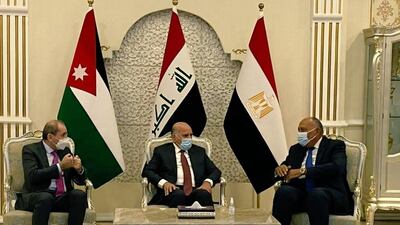
Iraqi Foreign Minister Fuad Hussein, centre, and his Egyptian and Jordanian counterparts, Sameh Shoukry and Ayman Safadi. MFA Egypt

Iraq, Egypt and Jordan aim to forge stronger ties as ministers meet in Baghdad


Sinan Mahmoud
  • English
  • Arabic

The foreign ministers of Jordan and Egypt travelled to Baghdad on Monday to meet Iraqi Foreign Minister Fuad Hussein.

Mr Hussein hosted his Egyptian and Jordanian counterparts, Sameh Shoukry and Ayman Safadi, at a trilateral meeting before a summit that will bring the leaders of all three countries together.

The meeting between Iraqi Prime Minister Mustafa Al Kadhimi, Jordan's King Abdullah II and Egyptian President Abdel Fattah El Sisi was delayed because of a deadly train crash in Egypt.

The US has been pushing Iraq and other Arab countries to strengthen ties to counter Iranian influence in the region, which has been growing since the US-led invasion that toppled Saddam Hussein's regime.

For months, the three countries have been hammering out co-operation deals, mainly in the energy sector, but no major progress has been made.

In August, the leaders of the three nations held in a summit in Amman followed by ministerial meetings.

In January, Iraq and Jordan signed memorandums of understanding in the fields of health, higher education and scientific research.

Four months earlier, both countries reached a deal where Iraq would buy electricity from Jordan to meet growing demand in the war-ravaged country and to reduce its reliance on Iran. The deal has yet to be enacted.

Iraq also plans to build a 1 million-barrel capacity oil pipeline to export crude from Jordan’s Port of Aqaba. Of that, 150,000 barrels a day would supply Jordan's Zarqa refinery.

The project has been delayed, however, owing to the spiralling security situation in Iraq and a lack of cash.

The Birkin bag is made by Hermès. 
It is named after actress and singer Jane Birkin
Noone from Hermès will go on record to say how much a new Birkin costs, how long one would have to wait to get one, and how many bags are actually made each year.

FROM%20THE%20ASHES
%3Cp%3EDirector%3A%20Khalid%20Fahad%3C%2Fp%3E%0A%3Cp%3EStarring%3A%20Shaima%20Al%20Tayeb%2C%20Wafa%20Muhamad%2C%20Hamss%20Bandar%3C%2Fp%3E%0A%3Cp%3ERating%3A%203%2F5%3C%2Fp%3E%0A
UAE%20SQUAD
%3Cp%3E%0DJemma%20Eley%2C%20Maria%20Michailidou%2C%20Molly%20Fuller%2C%20Chloe%20Andrews%20(of%20Dubai%20College)%2C%20Eliza%20Petricola%2C%20Holly%20Guerin%2C%20Yasmin%20Craig%2C%20Caitlin%20Gowdy%20(Dubai%20English%20Speaking%20College)%2C%20Claire%20Janssen%2C%20Cristiana%20Morall%20(Jumeirah%20English%20Speaking%20School)%2C%20Tessa%20Mies%20(Jebel%20Ali%20School)%2C%20Mila%20Morgan%20(Cranleigh%20Abu%20Dhabi).%3C%2Fp%3E%0A
Gertrude Bell's life in focus

A feature film

At one point, two feature films were in the works, but only German director Werner Herzog’s project starring Nicole Kidman would be made. While there were high hopes he would do a worthy job of directing the biopic, when Queen of the Desert arrived in 2015 it was a disappointment. Critics panned the film, in which Herzog largely glossed over Bell’s political work in favour of her ill-fated romances.

A documentary

A project that did do justice to Bell arrived the next year: Sabine Krayenbuhl and Zeva Oelbaum’s Letters from Baghdad: The Extraordinary Life and Times of Gertrude Bell. Drawing on more than 1,000 pieces of archival footage, 1,700 documents and 1,600 letters, the filmmakers painstakingly pieced together a compelling narrative that managed to convey both the depth of Bell’s experience and her tortured love life.

Books, letters and archives

Two biographies have been written about Bell, and both are worth reading: Georgina Howell’s 2006 book Queen of the Desert and Janet Wallach’s 1996 effort Desert Queen. Bell published several books documenting her travels and there are also several volumes of her letters, although they are hard to find in print. Original documents are housed at the Gertrude Bell Archive at the University of Newcastle, which has an online catalogue.
 

Mercer, the investment consulting arm of US services company Marsh & McLennan, expects its wealth division to at least double its assets under management (AUM) in the Middle East as wealth in the region continues to grow despite economic headwinds, a company official said.

Mercer Wealth, which globally has $160 billion in AUM, plans to boost its AUM in the region to $2-$3bn in the next 2-3 years from the present $1bn, said Yasir AbuShaban, a Dubai-based principal with Mercer Wealth.

Within the next two to three years, we are looking at reaching $2 to $3 billion as a conservative estimate and we do see an opportunity to do so,” said Mr AbuShaban.

Mercer does not directly make investments, but allocates clients’ money they have discretion to, to professional asset managers. They also provide advice to clients.

“We have buying power. We can negotiate on their (client’s) behalf with asset managers to provide them lower fees than they otherwise would have to get on their own,” he added.

Mercer Wealth’s clients include sovereign wealth funds, family offices, and insurance companies among others.

From its office in Dubai, Mercer also looks after Africa, India and Turkey, where they also see opportunity for growth.

Wealth creation in Middle East and Africa (MEA) grew 8.5 per cent to $8.1 trillion last year from $7.5tn in 2015, higher than last year’s global average of 6 per cent and the second-highest growth in a region after Asia-Pacific which grew 9.9 per cent, according to consultancy Boston Consulting Group (BCG). In the region, where wealth grew just 1.9 per cent in 2015 compared with 2014, a pickup in oil prices has helped in wealth generation.

BCG is forecasting MEA wealth will rise to $12tn by 2021, growing at an annual average of 8 per cent.

Drivers of wealth generation in the region will be split evenly between new wealth creation and growth of performance of existing assets, according to BCG.

Another general trend in the region is clients’ looking for a comprehensive approach to investing, according to Mr AbuShaban.

“Institutional investors or some of the families are seeing a slowdown in the available capital they have to invest and in that sense they are looking at optimizing the way they manage their portfolios and making sure they are not investing haphazardly and different parts of their investment are working together,” said Mr AbuShaban.

Some clients also have a higher appetite for risk, given the low interest-rate environment that does not provide enough yield for some institutional investors. These clients are keen to invest in illiquid assets, such as private equity and infrastructure.

“What we have seen is a desire for higher returns in what has been a low-return environment specifically in various fixed income or bonds,” he said.

“In this environment, we have seen a de facto increase in the risk that clients are taking in things like illiquid investments, private equity investments, infrastructure and private debt, those kind of investments were higher illiquidity results in incrementally higher returns.”

The Abu Dhabi Investment Authority, one of the largest sovereign wealth funds, said in its 2016 report that has gradually increased its exposure in direct private equity and private credit transactions, mainly in Asian markets and especially in China and India. The authority’s private equity department focused on structured equities owing to “their defensive characteristics.”

Dengue%20fever%20symptoms
%3Cul%3E%0A%3Cli%3EHigh%20fever%3C%2Fli%3E%0A%3Cli%3EIntense%20pain%20behind%20your%20eyes%3C%2Fli%3E%0A%3Cli%3ESevere%20headache%3C%2Fli%3E%0A%3Cli%3EMuscle%20and%20joint%20pains%3C%2Fli%3E%0A%3Cli%3ENausea%3C%2Fli%3E%0A%3Cli%3EVomiting%3C%2Fli%3E%0A%3Cli%3ESwollen%20glands%3C%2Fli%3E%0A%3Cli%3ERash%3C%2Fli%3E%0A%3C%2Ful%3E%0A%3Cp%3EIf%20symptoms%20occur%2C%20they%20usually%20last%20for%20two-seven%20days%3C%2Fp%3E%0A
