Turkish army tanks are used in drills in Silopi, near the Habur border crossing with Iraq’s autonomous Kurdish region, in 2017. AP

Turkish ambassador to Iraq defends military operations after five soldiers die


  • English
  • Arabic

Five Turkish soldiers serving in northern Iraq as part of operations against Kurdish militants were killed on Tuesday, the defence ministry said on Wednesday.

Another two soldiers were wounded during fighting, the ministry statement said. It did not say where the clash had occurred.

Turkey’s official news agency, Anadolu, said the soldiers had clashed with fighters from the Kurdistan Workers’ Party (PKK), which Ankara says is a terrorist organisation.

The PKK has training camps and bases in autonomous Iraqi Kurdistan and has waged an insurgency against the Turkish state since 1984.

About 40,000 people, many of them civilians, have been killed in the conflict.

  • A group of PKK soldiers walk near their base camp high in the mountains of northern Iraq on June 1, 2004. Reuters
    A group of PKK soldiers walk near their base camp high in the mountains of northern Iraq on June 1, 2004. Reuters
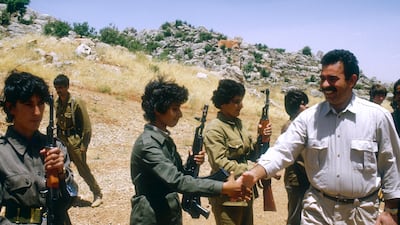
  • Kurdistan Workers' Party (PKK) leader Abdullah Ocalan greets women soldiers at the Mahsun Korkmaz Academy military training camp in Lebanon on June, 18, 1988. Getty Images
    Kurdistan Workers' Party (PKK) leader Abdullah Ocalan greets women soldiers at the Mahsun Korkmaz Academy military training camp in Lebanon on June, 18, 1988. Getty Images
  • Peshmerga and Turkish soldiers prepare to storm a hill on October 23, 1992, near a stronghold held by the PKK in Hakurk Valley. AFP
    Peshmerga and Turkish soldiers prepare to storm a hill on October 23, 1992, near a stronghold held by the PKK in Hakurk Valley. AFP
  • Abdullah Ocalan was abducted in Nairobi in 1999 by the Turkish National Intelligence Agency (MIT), with assistance from the US, and taken to Turkey. Reuters
    Abdullah Ocalan was abducted in Nairobi in 1999 by the Turkish National Intelligence Agency (MIT), with assistance from the US, and taken to Turkey. Reuters
  • Turkish riot police detain a Kurdish protester following a demonstration in central Istanbul on April 2, 2006. Reuters
    Turkish riot police detain a Kurdish protester following a demonstration in central Istanbul on April 2, 2006. Reuters
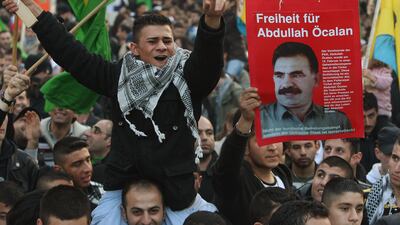
  • A man holds a sign demanding freedom for imprisoned Kurdish leader Abdullah Ocalan at a protest of mostly Kurdish demonstrators on November 4, 2007, in Berlin, Germany. Getty Images
    A man holds a sign demanding freedom for imprisoned Kurdish leader Abdullah Ocalan at a protest of mostly Kurdish demonstrators on November 4, 2007, in Berlin, Germany. Getty Images
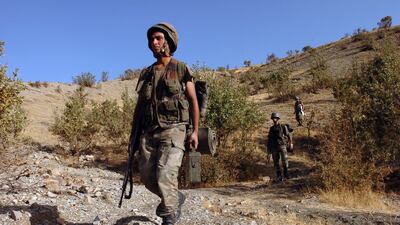
  • Turkish army commandos on patrol near the Iraq border on October 27, 2007, in the Uludere district of Sirnak province, south-eastern Turkey. Getty Images
    Turkish army commandos on patrol near the Iraq border on October 27, 2007, in the Uludere district of Sirnak province, south-eastern Turkey. Getty Images
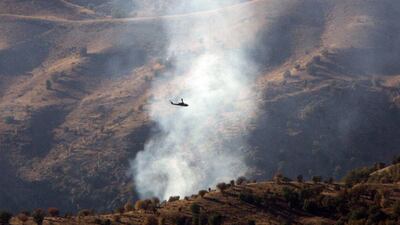
  • A Turkish helicopter flies over the Cudi Mountains during an attack on an outlawed PKK camp October 30, 2007, in Sirnak province, near the Iraq border. AFP
    A Turkish helicopter flies over the Cudi Mountains during an attack on an outlawed PKK camp October 30, 2007, in Sirnak province, near the Iraq border. AFP
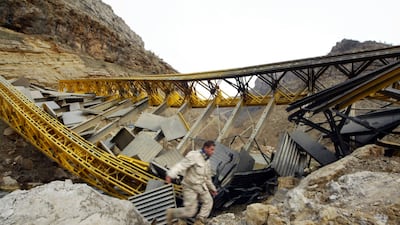
  • A ruined bridge lies in northern Iraq's Kurdistan region during fighting between Turkish forces and PKK fighters on February 24, 2008. AFP
    A ruined bridge lies in northern Iraq's Kurdistan region during fighting between Turkish forces and PKK fighters on February 24, 2008. AFP
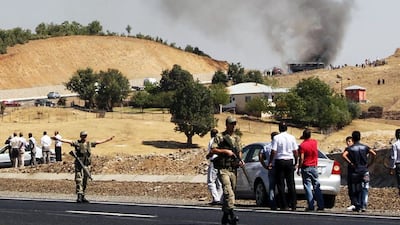
  • Turkish soldiers stand guard as smokes rises from a bus that was attacked by members of the PKK on September 18, 2012, in Bingol. AFP
    Turkish soldiers stand guard as smokes rises from a bus that was attacked by members of the PKK on September 18, 2012, in Bingol. AFP
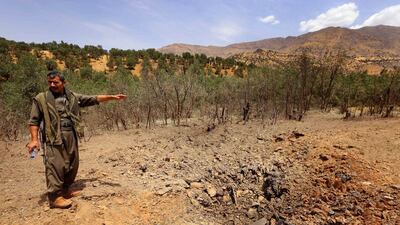
  • A member of the PKK inspects a crater reportedly caused by an air strike by Turkish warplanes on July 29, 2015, in the Qandil Mountains in northern Iraq. AFP
    A member of the PKK inspects a crater reportedly caused by an air strike by Turkish warplanes on July 29, 2015, in the Qandil Mountains in northern Iraq. AFP
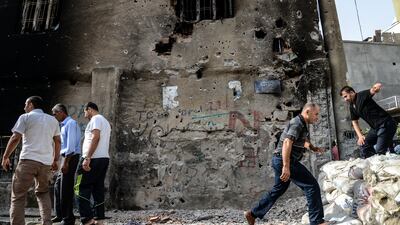
  • Locals assess the damage following clashes between Turkish forces and PKK militants in the Kurdish-majority city of Cizre, in south-eastern Turkey, on September 12, 2015. AFP
    Locals assess the damage following clashes between Turkish forces and PKK militants in the Kurdish-majority city of Cizre, in south-eastern Turkey, on September 12, 2015. AFP
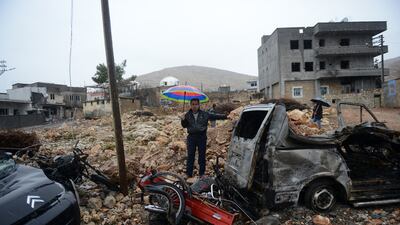
  • People return to their homes in Dargecit after a curfew imposed by the Turkish government was lifted on December 30, 2015, in Mardin province. AFP
    People return to their homes in Dargecit after a curfew imposed by the Turkish government was lifted on December 30, 2015, in Mardin province. AFP
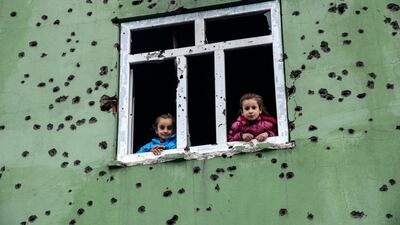
  • Children look out from a window of a bullet-scarred house in the Kurdish town of Silopi in south-eastern Turkey, near the border with Iraq, on January 19, 2016. AFP
    Children look out from a window of a bullet-scarred house in the Kurdish town of Silopi in south-eastern Turkey, near the border with Iraq, on January 19, 2016. AFP
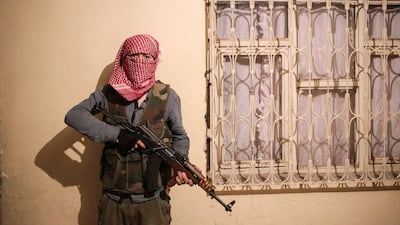
  • A member of the Patriotic Revolutionary Youth Movement (YDG-H), a division of the PKK, stands guard in the south-eastern Turkish city of Nusaybin on February 25, 2016. Getty Images
    A member of the Patriotic Revolutionary Youth Movement (YDG-H), a division of the PKK, stands guard in the south-eastern Turkish city of Nusaybin on February 25, 2016. Getty Images

Ankara has launched several operations against PKK fighters in Iraq and Syria, the latest of which began in northern Iraq last month.

Much of the fighting takes place in remote mountainous areas, but local Iraqi-Kurdish civilians have sometimes been killed or injured by Turkish air strikes. This has angered locals, many of whom do not support the PKK.

The Kurdish Democratic Party, the largest Kurdish party in the semi-autonomous Kurdish Region of Iraq, has increasingly found itself at odds with the PKK.

The KDP has strong energy ties with Ankara and its tolerance of Turkish military action has led to clashes between the KDP's Peshmerga fighters and the PKK. The PKK now finds itself increasingly isolated in northern Iraq.

This month, Iraqi forces, which increasingly co-operate with the Peshmerga, clashed with a small militia allied to the PKK in the contested Iraqi town of Sinjar.

Despite this, several major political parties in Baghdad have expressed strong objections to the Turkish military presence in Iraq.

On Wednesday, Ankara’s ambassador to Baghdad, Ali Riza Guney, countered in a meeting with Iraqi politician Najem Al Jubouri that the operations to root out the PKK would bolster Iraqi sovereignty in the long run.

The Turkish escalation in northern Iraq comes amid a wider push by Ankara against Kurdish militia groups in the region.

Turkish President Recep Tayyip Erdogan said on Monday that Turkey would soon launch a new military operation into northern Syria.

He said this would create a 30-kilometre “security zone” along the border.

Since 2016, Turkey has also launched three offensives into northern Syria against the People’s Protection Units (YPG), a Syrian-Kurdish group it considers to be part of the PKK.

Turkey wants to use these security zones to keep Kurdish militants at a safe distance – and to house some of the 3.7 million Syrian refugees currently sheltering inside its own borders.


Key developments

All times UTC 4

Ten tax points to be aware of in 2026

1. Domestic VAT refund amendments: request your refund within five years

If a business does not apply for the refund on time, they lose their credit.

2. E-invoicing in the UAE

Businesses should continue preparing for the implementation of e-invoicing in the UAE, with 2026 a preparation and transition period ahead of phased mandatory adoption. 

3. More tax audits

Tax authorities are increasingly using data already available across multiple filings to identify audit risks. 

4. More beneficial VAT and excise tax penalty regime

Tax disputes are expected to become more frequent and more structured, with clearer administrative objection and appeal processes. The UAE has adopted a new penalty regime for VAT and excise disputes, which now mirrors the penalty regime for corporate tax.

5. Greater emphasis on statutory audit

There is a greater need for the accuracy of financial statements. The International Financial Reporting Standards standards need to be strictly adhered to and, as a result, the quality of the audits will need to increase.

6. Further transfer pricing enforcement

Transfer pricing enforcement, which refers to the practice of establishing prices for internal transactions between related entities, is expected to broaden in scope. The UAE will shortly open the possibility to negotiate advance pricing agreements, or essentially rulings for transfer pricing purposes. 

7. Limited time periods for audits

Recent amendments also introduce a default five-year limitation period for tax audits and assessments, subject to specific statutory exceptions. While the standard audit and assessment period is five years, this may be extended to up to 15 years in cases involving fraud or tax evasion. 

8. Pillar 2 implementation 

Many multinational groups will begin to feel the practical effect of the Domestic Minimum Top-Up Tax (DMTT), the UAE's implementation of the OECD’s global minimum tax under Pillar 2. While the rules apply for financial years starting on or after January 1, 2025, it is 2026 that marks the transition to an operational phase.

9. Reduced compliance obligations for imported goods and services

Businesses that apply the reverse-charge mechanism for VAT purposes in the UAE may benefit from reduced compliance obligations. 

10. Substance and CbC reporting focus

Tax authorities are expected to continue strengthening the enforcement of economic substance and Country-by-Country (CbC) reporting frameworks. In the UAE, these regimes are increasingly being used as risk-assessment tools, providing tax authorities with a comprehensive view of multinational groups’ global footprints and enabling them to assess whether profits are aligned with real economic activity. 

Contributed by Thomas Vanhee and Hend Rashwan, Aurifer


Updated: May 25, 2022, 3:09 PM