


The failure to elect a new Iraqi president during the weekend’s parliament session has further pitted the country’s political rivals against each other, casting uncertainty over the process of forming the new government.
Divisions among Iraqi political parties have grown rapidly since October 10 national elections, the fifth parliamentary vote for a full-term government since the 2003 US-led invasion that toppled Saddam Hussein.
Since then, two camps have emerged.
One comprises an alliance of parties with the most seats in parliament who want to form a majority government. The other is led by losing parties and is backed by Iran, having the current aim of retaining key political positions in a consensus government.
The legislative body failed for the second time to elect the head of the state. The first vote was scheduled on February 7, but failed to materialise after boycotts by some parties.
-
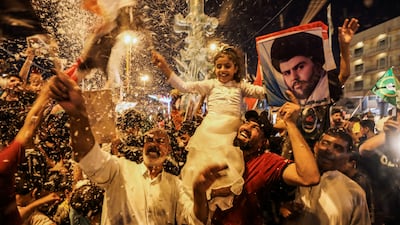
Supporters of the movement of Shiite cleric Moqtada Al Sadr celebrate in Najaf, Iraq, after preliminary results of the country’s parliamentary election were announced. Reuters -

Judge Jalil Adnan Khalaf (C), the chairman of Iraq’s Independent High Electoral Commission, speaks in the capital, Baghdad. AFP -

EU observers of the election hold a press conference in Baghdad. AP -
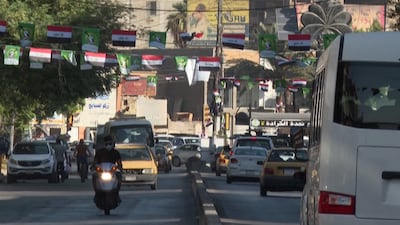
Iraqi flags are strung across a street. -
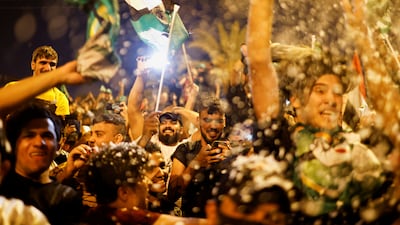
Sadrists celebrate after preliminary results of Iraq’s parliamentary election were announced in Baghdad on October 11. Reuters -
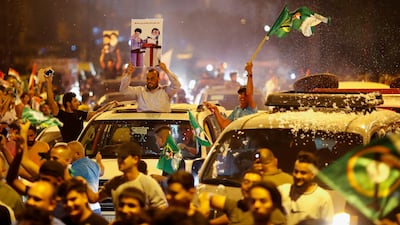
Supporters of Shiite cleric Moqtada Al Sadr celebrate after preliminary results were announced. Reuters -
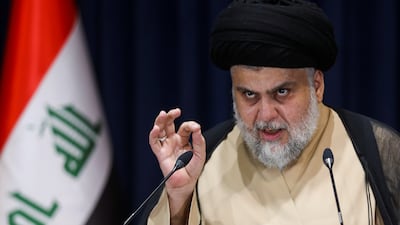
Shiite cleric Moqtada Al Sadr speaks after preliminary results of Iraq’s parliamentary election were announced in Najaf on October 11. Reuters


That prompted the country’s Federal Supreme Court in early March to issue a ruling that gave political parties until April 6 to elect the president.
“If they fail again then it will be hard to fix things as the country will enter into a constitutional vacuum,” legal expert Ali Al Tamimi said.
That may lead to dissolving parliament, after submitting a request by one third of its members which needs the majority vote, or by a ruling from the Federal Supreme Court, Mr Al Tamimi said.
“In both cases, we will face early elections and the current government will continue as a caretaker one,” he added.
During Saturday’s session, the Save The Nation Alliance which is led by the Sadrist Bloc, sponsored by the populist Shiite cleric Moqtada Al Sadr, failed to secure the two thirds quorum of 220 seats in the 329-seat parliament needed to conduct an electoral session to select the president.
Only 202 lawmakers attended the session as the remaining 126, the majority of them from the pro-Tehran Co-ordination Framework, boycotted the session.
Parliament had earlier approved 40 candidates for the post and the contest pits current President Barham Salih of the Patriotic Union of Kurdistan against Rebar Ahmed Khalid of the rival Kurdistan Democratic Party (KDP).
Mr Khalid is supported by Save the Nation Alliance, while President Salih is the nominee of the coordination Framework. Based on a long-standing informal agreement, the post is reserved for Kurdish parties.
Government formation stalls
Without a president, the government formation process has hit an impasse. Once elected, the president is tasked with asking the prime ministerial nominee of the largest bloc to form the government.
The parliament will convene again on Wednesday in another attempt to elect the president.
“There is no indication that Wednesday's session will be different or an imminent solution is on the horizon as both sides are still adamant and exchange accusations,” Baghdad-based political analyst Ihsan Al Shimmari said.
“Things are still complicated and both camps are still trying to win over independent and hesitant lawmakers to join them on Wednesday,” he said.
In a bid to exert more pressure on the coordination Framework and other lawmakers, senior Sadrist politician and Deputy Speaker Hakim Al Zamili warned in a statement to a local TV station that his supporters would be “declaring a state of emergency if we fail again on Wednesday.”
While the coordination Framework is linked to a number of powerful armed groups who've worked closely with Iran, Mr Al Sadr has in the past commanded large paramilitary groups.
Amid the deadlock, Parliament Speaker Mohammed Al Halbousi, Mr Al Sadr's ally, called off a visit to Iran scheduled for Sunday.
“It is regrettable and worrying to see that there is a lack of national understanding among Iraqi political parties and there is a failure to convene the session of the Iraqi Parliament and to meet the constitutional deadlines,” he said in a statement.
“The continuation of the political stalemate in the midst of the challenges faced by our country is unacceptable,” he added.
In a sign of mounting political tension, members of Iran-backed Shiite militias stormed the main KDP office in Baghdad late on Sunday, setting it ablaze. No one was inside the office when the attack happened.
They were apparently angered by a statement made by a KDP member against Shiite spiritual religious leader Grand Ayatollah Sayyed Ali Al Sistani, allegedly saying he was unfit to lead Iraqi Shiites because of his Iranian origin.
The KDP immediately issued a statement to apologise and announced the arrest of the accused MP.
“That development indicates that things are heading to more complexities,” Mr Al Shimmari said.
“It sounds as if using the mistakes of one side has become a strategy among political rivals to drag the public into a conflict after failing to make progress inside parliament in order to win concessions,” he added.
“Each camp is trying to increase pressure on its rival with the cards they hold,” he said.

