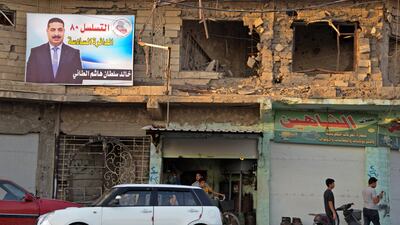
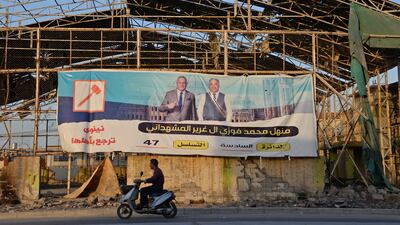
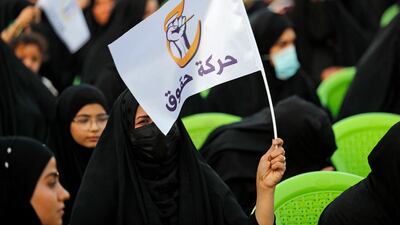
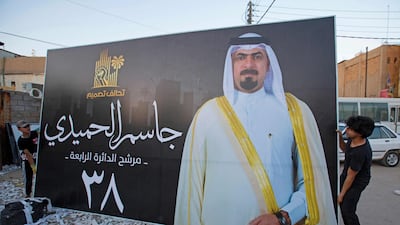
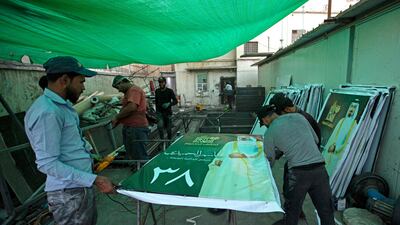
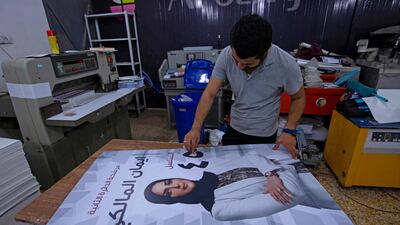
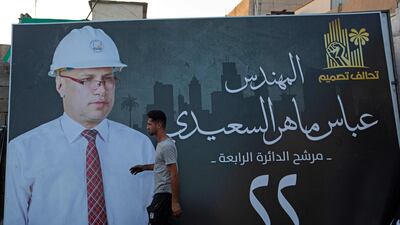
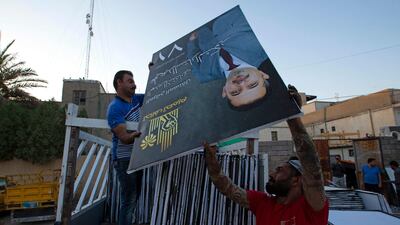
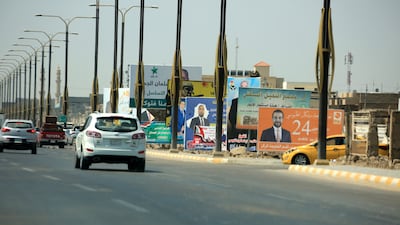
Candidate billboards and placards in Baghdad for the Iraqi parliamentary elections. Almost 25 million Iraqis are on the electoral roll for the October 10 poll to pick 329 MPs. Photo: AFP

Experts say Iraq elections unlikely to change political system


Mina Aldroubi
  • English
  • Arabic

Iraq’s elections are unlikely to bring about real change unless turnout is high and new candidates do not compete for the same seats, experts have said.

Millions of Iraqis are set to head to the polls on October 10 to vote for a new parliament, a poll seen as a vital test of whether the government will uphold its promise of reform and democracy.

“Elections will only bring about real change if voter turnout is high and if the youth-led movement coordinates not to compete for the same parliamentary seats,” Michael Knights, a fellow at the Washington Institute for Near East Policy, told The National.

Some of Iraq’s activists, who took part in the nationwide anti-government protests, have launched political parties to contest national elections. Many observers say they have the potential to enter the country’s political sphere and bring about meaningful change.

“If the independents stuck together, they could make a new bloc, but they would have to quickly agree on a leader and be disciplined, which seems unlikely today. But it might be possible in 2025 Iraqi national elections,” Mr Knights said.

“Unfortunately, the protestors are instead talking about boycotting as they missed their window to organise their efforts.”

Almost 25 million Iraqis are on the electoral roll, and voters will choose 329 members of parliament. But calls for a boycott of the ballot box are growing, especially from disillusioned young adults who accuse parties of intimidation, vote buying and cronyism.

Protesters’ demands

Iraqi protesters stand on concrete blast walls during a protest near the government office building in Basra. Reuters

Early elections were a core demand of the protest movement that erupted from October 2019 to 2020.

The protesters have called for an end to endemic corruption by a political class that is largely seen as having squandered Iraq’s resources through greed and mismanagement over the past few years.

A heavy military crackdown ensued and hundreds of demonstrators were killed.

Last year, the government passed a new electoral law that divides the country into constituencies, giving independent candidates an opportunity to compete for parliamentary seats.

But experts believe that voter apathy and the public’s loss of confidence in the government will mean that major reforms will not be seen.

“I don’t think the upcoming elections will cause much change in parliament, there might be slight rearrangements in terms of the balance of established parties with a few independent candidates making it into parliament,” Lahib Higel, Crisis Group’s senior analyst for Iraq, said.

  • A banner for a candidate is seen in Iraq's second city of Mosul. Iraq's elections will go ahead as planned on October 10, officials say. AFP
    A banner for a candidate is seen in Iraq's second city of Mosul. Iraq's elections will go ahead as planned on October 10, officials say. AFP
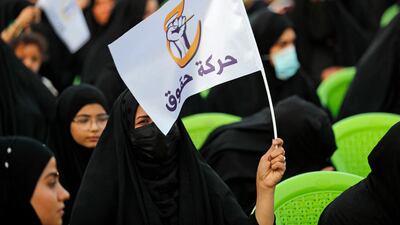
  • A woman holds a flag of the Huquq electoral list during a campaign rally in Baghdad. AFP
    A woman holds a flag of the Huquq electoral list during a campaign rally in Baghdad. AFP
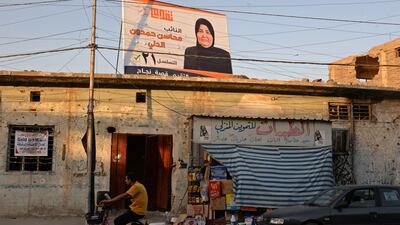
  • A banner for a candidate installed on a rooftop in Mosul. AFP
    A banner for a candidate installed on a rooftop in Mosul. AFP
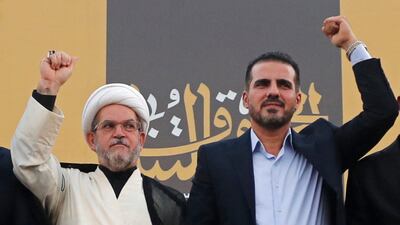
  • Abu Ali Al Askari, right, spokesman of Iraqi Kataeb Hezbollah, during a campaign rally in Baghdad. AFP
    Abu Ali Al Askari, right, spokesman of Iraqi Kataeb Hezbollah, during a campaign rally in Baghdad. AFP
  • Experts are predicting a muted turnout in the October vote because of distrust in the country’s electoral system. AFP
    Experts are predicting a muted turnout in the October vote because of distrust in the country’s electoral system. AFP
  • Candidates of the Huquq electoral list during a campaign rally in Baghdad. AFP
    Candidates of the Huquq electoral list during a campaign rally in Baghdad. AFP
  • A woman holds a flag of the Huquq electoral list during a campaign rally in Baghdad. AFP
    A woman holds a flag of the Huquq electoral list during a campaign rally in Baghdad. AFP
  • Workers prepare to transport campaign banners in Iraq's southern port city of Basra, ahead of the upcoming parliamentary elections. AFP
    Workers prepare to transport campaign banners in Iraq's southern port city of Basra, ahead of the upcoming parliamentary elections. AFP
  • Workers prepare campaign banners in Iraq's southern port city of Basra ahead of the upcoming parliamentary elections. AFP
    Workers prepare campaign banners in Iraq's southern port city of Basra ahead of the upcoming parliamentary elections. AFP
  • A worker prepares a campaign poster in Iraq's southern port city of Basra on September 12, 2021, ahead of the upcoming parliamentary elections. (Photo by Hussein FALEH / AFP)
    A worker prepares a campaign poster in Iraq's southern port city of Basra on September 12, 2021, ahead of the upcoming parliamentary elections. (Photo by Hussein FALEH / AFP)
  • A worker walks by a campaign banner at a workshop in Iraq's southern port city of Basra on, ahead of the upcoming parliamentary elections. AFP
    A worker walks by a campaign banner at a workshop in Iraq's southern port city of Basra on, ahead of the upcoming parliamentary elections. AFP
  • Workers prepare to transport campaign banners in Iraq's southern port city of Basra, ahead of the upcoming parliamentary elections. AFP
    Workers prepare to transport campaign banners in Iraq's southern port city of Basra, ahead of the upcoming parliamentary elections. AFP
  • Iraqis pass by-election campaign posters for Iraqi candidates at a street in Fallujah city, 60 kilometres west of Baghdad, Iraq. The Special Representative for the United Nations Assistance Mission for Iraq, Jeanine Antoinette Hennis-Plasschaert, announced on 07 September 2021, that a group of 130 international experts and around 600 supporting staff will be monitoring Iraq’s upcoming elections. EPA
    Iraqis pass by-election campaign posters for Iraqi candidates at a street in Fallujah city, 60 kilometres west of Baghdad, Iraq. The Special Representative for the United Nations Assistance Mission for Iraq, Jeanine Antoinette Hennis-Plasschaert, announced on 07 September 2021, that a group of 130 international experts and around 600 supporting staff will be monitoring Iraq’s upcoming elections. EPA
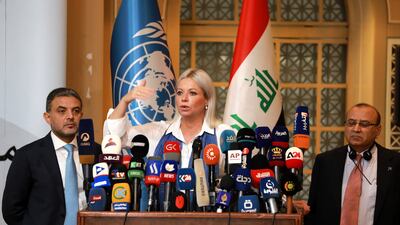
  • The Special Representative for the United Nations Assistance Mission for Iraq, Jeanine Antoinette Hennis-Plasschaert, speaks during a press conference in Baghdad, Iraq. A group of 130 international experts and around 600 supporting staff will be monitoring Iraq’s upcoming elections, Plasschaert said during the press conference. EPA
    The Special Representative for the United Nations Assistance Mission for Iraq, Jeanine Antoinette Hennis-Plasschaert, speaks during a press conference in Baghdad, Iraq. A group of 130 international experts and around 600 supporting staff will be monitoring Iraq’s upcoming elections, Plasschaert said during the press conference. EPA

“Beyond that, we won’t see much significant shifts or changing power balances,” she told The National.

Although new faces enter parliament, they may still be connected to established parties, Ms Higel said.

The Iraqi public are disappointed in the political system and the direction in which the country is heading, Sajad Jiyad, a Baghdad resident and fellow with the Century Foundation, said.

“I don’t think the elections are going to change that perception and that elections won’t lead to significant reforms right away,” he said.

Little trust in the system

Mr Jiyad said the elections are highly unlikely to be a game changer and the public will see that.

“I’m predicting less turnout than last time, looking at 30 per cent this time,” he said, meaning elections will not change Iraq’s current path.

The country’s general population has very little trust in the electoral process to be fair and transparent and, therefore, elections this time around will have low voter participation, Ms Higel said.

“Voting in the elections won’t produce a change and, as a result, some of the parties that were established have announced their boycotting of the elections,” she said.


Abandon
Sangeeta Bandyopadhyay
Translated by Arunava Sinha
Tilted Axis Press 

THE BIO

Born: Mukalla, Yemen, 1979

Education: UAE University, Al Ain

Family: Married with two daughters: Asayel, 7, and Sara, 6

Favourite piece of music: Horse Dance by Naseer Shamma

Favourite book: Science and geology

Favourite place to travel to: Washington DC

Best advice you’ve ever been given: If you have a dream, you have to believe it, then you will see it.

Results

5pm: Maiden (PA) Dh80,000 (Turf) 1,600m; Winner: Rawat Al Reef, Adrie de Vries (jockey), Abdallah Al Hammadi (trainer)

5.30pm: Wathba Stallions Cup Handicap (PA) Dh70,000 (T) 1,400m; Winner: Noof KB, Richard Mullen, Ernst Oertel

6pm: Handicap (PA) Dh80,000 (T) 1,200m; Winner: AF Seven Skies, Bernardo Pinheiro, Qaiss Aboud

6.30pm: Handicap (PA) Dh80,000 (T) 2,200m; Winner: Jabalini, Szczepan Mazur, Ibrahim Al Hadhrami

7pm: UAE Arabian Derby – Prestige (PA) Dh150,000 (T) 2,200m; Winner: Dergham Athbah, Richard Mullen, Mohamed Daggash

7.30pm: Emirates Championship – Group 1 (PA) Dh1,000,000 (T) 2,200m; Winner: Somoud, Richard Mullen, Jean de Roualle

8pm: Abu Dhabi Championship – Group 3 (TB) Dh380,000 (T) 2,200m; Winner: Irish Freedom, Antonio Fresu, Satish Seemar

Defending champions

World Series: South Africa
Women’s World Series: Australia
Gulf Men’s League: Dubai Exiles
Gulf Men’s Social: Mediclinic Barrelhouse Warriors
Gulf Vets: Jebel Ali Dragons Veterans
Gulf Women: Dubai Sports City Eagles
Gulf Under 19: British School Al Khubairat
Gulf Under 19 Girls: Dubai Exiles
UAE National Schools: Al Safa School
International Invitational: Speranza 22
International Vets: Joining Jack

Honeymoonish
%3Cp%3E%3Cstrong%3EDirector%3A%3C%2Fstrong%3E%20Elie%20El%20Samaan%3C%2Fp%3E%0A%3Cp%3E%3Cstrong%3EStarring%3A%20%3C%2Fstrong%3ENour%20Al%20Ghandour%2C%20Mahmoud%20Boushahri%3C%2Fp%3E%0A%3Cp%3E%3Cstrong%3ERating%3A%3C%2Fstrong%3E%203%2F5%3C%2Fp%3E%0A
Desert Warrior

Starring: Anthony Mackie, Aiysha Hart, Ben Kingsley

Director: Rupert Wyatt

Rating: 3/5

Mercer, the investment consulting arm of US services company Marsh & McLennan, expects its wealth division to at least double its assets under management (AUM) in the Middle East as wealth in the region continues to grow despite economic headwinds, a company official said.

Mercer Wealth, which globally has $160 billion in AUM, plans to boost its AUM in the region to $2-$3bn in the next 2-3 years from the present $1bn, said Yasir AbuShaban, a Dubai-based principal with Mercer Wealth.

Within the next two to three years, we are looking at reaching $2 to $3 billion as a conservative estimate and we do see an opportunity to do so,” said Mr AbuShaban.

Mercer does not directly make investments, but allocates clients’ money they have discretion to, to professional asset managers. They also provide advice to clients.

“We have buying power. We can negotiate on their (client’s) behalf with asset managers to provide them lower fees than they otherwise would have to get on their own,” he added.

Mercer Wealth’s clients include sovereign wealth funds, family offices, and insurance companies among others.

From its office in Dubai, Mercer also looks after Africa, India and Turkey, where they also see opportunity for growth.

Wealth creation in Middle East and Africa (MEA) grew 8.5 per cent to $8.1 trillion last year from $7.5tn in 2015, higher than last year’s global average of 6 per cent and the second-highest growth in a region after Asia-Pacific which grew 9.9 per cent, according to consultancy Boston Consulting Group (BCG). In the region, where wealth grew just 1.9 per cent in 2015 compared with 2014, a pickup in oil prices has helped in wealth generation.

BCG is forecasting MEA wealth will rise to $12tn by 2021, growing at an annual average of 8 per cent.

Drivers of wealth generation in the region will be split evenly between new wealth creation and growth of performance of existing assets, according to BCG.

Another general trend in the region is clients’ looking for a comprehensive approach to investing, according to Mr AbuShaban.

“Institutional investors or some of the families are seeing a slowdown in the available capital they have to invest and in that sense they are looking at optimizing the way they manage their portfolios and making sure they are not investing haphazardly and different parts of their investment are working together,” said Mr AbuShaban.

Some clients also have a higher appetite for risk, given the low interest-rate environment that does not provide enough yield for some institutional investors. These clients are keen to invest in illiquid assets, such as private equity and infrastructure.

“What we have seen is a desire for higher returns in what has been a low-return environment specifically in various fixed income or bonds,” he said.

“In this environment, we have seen a de facto increase in the risk that clients are taking in things like illiquid investments, private equity investments, infrastructure and private debt, those kind of investments were higher illiquidity results in incrementally higher returns.”

The Abu Dhabi Investment Authority, one of the largest sovereign wealth funds, said in its 2016 report that has gradually increased its exposure in direct private equity and private credit transactions, mainly in Asian markets and especially in China and India. The authority’s private equity department focused on structured equities owing to “their defensive characteristics.”

Updated: September 20, 2021, 2:01 AM