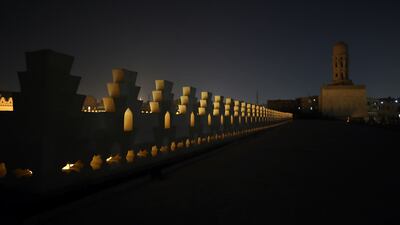
Shiite mosque in Cairo dating back 1,000 years reopens after renovations


Kamal Tabikha
  • English
  • Arabic

A 1000-year-old Shiite mosque in the heart of the Egyptian capital Cairo has reopened following extensive renovations that took six years to complete.

Work on the Al Ḥakim bi Amr Allah mosque began in 2017 and included repairs to water damage and cracks in its walls, according to Brig Gen Hisham Samir, a tourism and antiquities ministry official who spoke at the reopening ceremony on Monday night.

Wooden fixtures, including the mosque's doors, its pulpit and the signature decorative wooden tiles that line the base of its ceilings, were bolstered.

The ornate chandeliers of the mosque, one of Cairo’s most prominent Fatimid sites, were also restored.

Security cameras were installed as well as more efficient electrical wiring to service both the indoor areas and the large courtyard that the mosque is known for.

Intricate restorations were also undertaken on the mosque's facades and marble floors, Brig Gen Samir said.

The work was co-funded by the Bohra community, the western Indian branch of the Musta'li sect, itself a sub-branch of the Ismailite sect of Shiite Islam. The Ismailite sect originated in Egypt and later moved its religious centre to Yemen before gaining a foothold in India through missionaries in the 11th century.

There are only a handful of Shiites left in Sunni-majority Egypt.

The renovations were conducted as part of a large-scale plan by the Ministry of Tourism and Antiquities to boost tourism to Cairo’s Islamic sites.

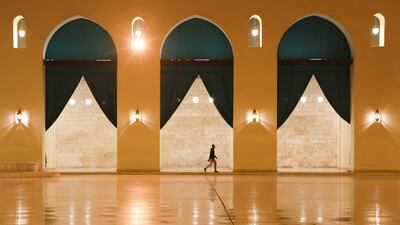
Newly-restored Al Hakim bi Amr Allah mosque in Cairo. AFP

The nearby Al Hussein mosque, Al Ashraf Street and sites visited by Jesus, Mary and Joseph when they escaped to Egypt from Palestine have also been restored under the ministry's plan, Cairo’s governor Khaled Abdel Aal said at the ceremony.

The government wants to make the Islamic sites of Cairo's medieval quarter more accessible to tourists.

Residents in parts of the area have been relocated to make room for infrastructure projects.

Thousands of graves in the area have also been demolished to make way for the roads and flyovers that authorities say are needed to give visitors easier access to the Islamic, Coptic and Jewish sites.

Funds of an undisclosed amount for the renovations were provided in part by Mufaddal Saif Al Din, the Sultan of India’s Bohra sect, who was received in Cairo by President Abdel Fattah El Sisi in April for the inauguration of Al Hussein mosque after it was renovated.

A presidential statement at the time lauded relations between Egypt and the Bohra people and thanked the Sultan for his “sizeable efforts to restore many historical Egyptian mosques”.

The Sultan, whose representative was present at the mosque's reopening on Monday, has also donated undisclosed sums to Mr El Sisi’s Tahya Misr social welfare fund.

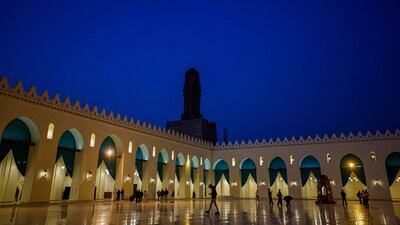
  • Al Hakim bi Amr Allah Mosque, in the Islamic district of Cairo, after its restoration. Reuters
    Al Hakim bi Amr Allah Mosque, in the Islamic district of Cairo, after its restoration. Reuters
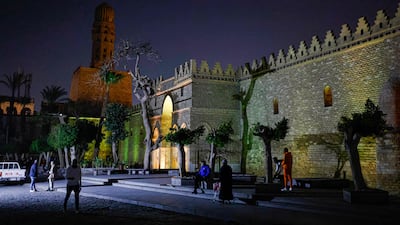
  • The mosque is situated on El Moez Ledin Allah El Fatmy Street in the Egyptian capital. AFP
    The mosque is situated on El Moez Ledin Allah El Fatmy Street in the Egyptian capital. AFP
  • It is the fourth oldest mosque in Egypt. AFP
    It is the fourth oldest mosque in Egypt. AFP
  • The restoration project began in 2017 and cost 85 million Egyptian pounds ($2.7 million). AFP
    The restoration project began in 2017 and cost 85 million Egyptian pounds ($2.7 million). AFP
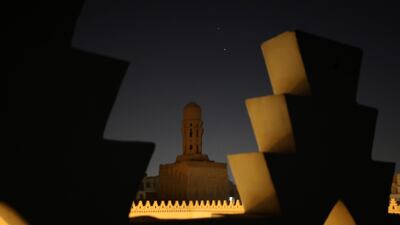
  • It is based in a popular tourist area of Cairo. Reuters
    It is based in a popular tourist area of Cairo. Reuters
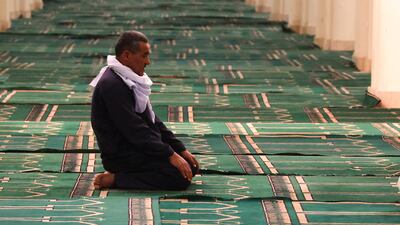
  • A man prays at the mosque. Reuters
    A man prays at the mosque. Reuters
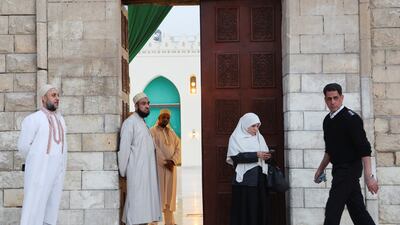
  • Members of the Bohra community outside the mosque. Reuters
    Members of the Bohra community outside the mosque. Reuters
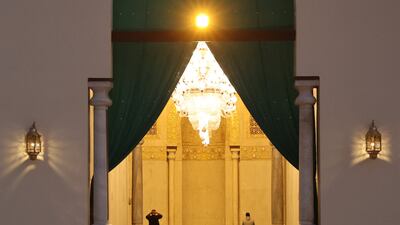
  • A giant chandelier at the restored mosque. Reuters
    A giant chandelier at the restored mosque. Reuters
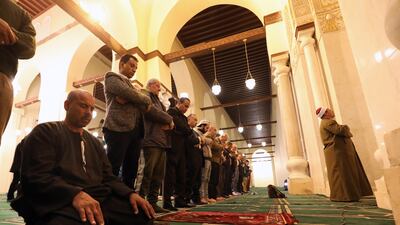
  • Prayers are performed. EPA
    Prayers are performed. EPA
  • The mosque is named after the sixth Fatimid caliph Al Hakim bi Amr Allah. EPA
    The mosque is named after the sixth Fatimid caliph Al Hakim bi Amr Allah. EPA
  • The building of the mosque was started by caliph Al Aziz, the father of Al Hakim, in 990AD. EPA
    The building of the mosque was started by caliph Al Aziz, the father of Al Hakim, in 990AD. EPA
  • It was completed in 1013 by caliph Al Hakim. EPA
    It was completed in 1013 by caliph Al Hakim. EPA

Construction of the Al Ḥakim bi Amr Allah Mosque was started by caliph Al Aziz in 990AD. It was completed by his son Al Hakim, the sixth caliph of the Fatimid era, who named it after himself.

A 14th century earthquake destroyed a portion of the mosque. It was rebuilt over the centuries by several Egyptian Muslim leaders. It was also where Napoleon Bonaparte stationed some of his battalions during the 1798-1801 French campaign in Egypt.

The Fatimid Caliphate represented one of the most prominent Ismailite groups and the only Shiite group to ever rule Egypt. The caliphate was the ruling Islamic dynasty from the ninth to the 12th century.

The Fatimids ruled with Cairo as their capital and dozens of their relics remain.

In numbers: China in Dubai

The number of Chinese people living in Dubai: An estimated 200,000

Number of Chinese people in International City: Almost 50,000

Daily visitors to Dragon Mart in 2018/19: 120,000

Daily visitors to Dragon Mart in 2010: 20,000

Percentage increase in visitors in eight years: 500 per cent

RACE CARD

6.30pm Al Maktoum Challenge Round-1 Group 1 (PA) Dh119,373 (Dirt) 1,600m

7.05pm Handicap (TB) Dh102,500 (D) 1,200m

7.40pm Handicap (TB) Dh105,000 (Turf) 1,800m

8.15pm UAE 1000 Guineas Trial (TB) Dh183,650 (D) 1,400m

9.50pm Handicap (TB) Dh105,000 (D) 1,600m

9.25pm Handicap (TB) Dh95,000 (T) 1,000m

Dr Amal Khalid Alias revealed a recent case of a woman with daughters, who specifically wanted a boy.

A semen analysis of the father showed abnormal sperm so the couple required IVF.

Out of 21 eggs collected, six were unused leaving 15 suitable for IVF.

A specific procedure was used, called intracytoplasmic sperm injection where a single sperm cell is inserted into the egg.

On day three of the process, 14 embryos were biopsied for gender selection.

The next day, a pre-implantation genetic report revealed four normal male embryos, three female and seven abnormal samples.

Day five of the treatment saw two male embryos transferred to the patient.

The woman recorded a positive pregnancy test two weeks later. 

Pox that threatens the Middle East's native species

Camelpox

Caused by a virus related to the one that causes human smallpox, camelpox typically causes fever, swelling of lymph nodes and skin lesions in camels aged over three, but the animal usually recovers after a month or so. Younger animals may develop a more acute form that causes internal lesions and diarrhoea, and is often fatal, especially when secondary infections result. It is found across the Middle East as well as in parts of Asia, Africa, Russia and India.

Falconpox

Falconpox can cause a variety of types of lesions, which can affect, for example, the eyelids, feet and the areas above and below the beak. It is a problem among captive falcons and is one of many types of avian pox or avipox diseases that together affect dozens of bird species across the world. Among the other forms are pigeonpox, turkeypox, starlingpox and canarypox. Avipox viruses are spread by mosquitoes and direct bird-to-bird contact.

Houbarapox

Houbarapox is, like falconpox, one of the many forms of avipox diseases. It exists in various forms, with a type that causes skin lesions being least likely to result in death. Other forms cause more severe lesions, including internal lesions, and are more likely to kill the bird, often because secondary infections develop. This summer the CVRL reported an outbreak of pox in houbaras after rains in spring led to an increase in mosquito numbers.

U19 WORLD CUP, WEST INDIES

UAE group fixtures (all in St Kitts)

  • Saturday 15 January: UAE beat Canada by 49 runs 
  • Thursday 20 January: v England 
  • Saturday 22 January: v Bangladesh 

UAE squad:

Alishan Sharafu (captain), Shival Bawa, Jash Giyanani, Sailles
Jaishankar, Nilansh Keswani, Aayan Khan, Punya Mehra, Ali Naseer, Ronak Panoly,
Dhruv Parashar, Vinayak Raghavan, Soorya Sathish, Aryansh Sharma, Adithya
Shetty, Kai Smith  

Conflict, drought, famine

Estimates of the number of deaths caused by the famine range from 400,000 to 1 million, according to a document prepared for the UK House of Lords in 2024.
It has been claimed that the policies of the Ethiopian government, which took control after deposing Emperor Haile Selassie in a military-led revolution in 1974, contributed to the scale of the famine.
Dr Miriam Bradley, senior lecturer in humanitarian studies at the University of Manchester, has argued that, by the early 1980s, “several government policies combined to cause, rather than prevent, a famine which lasted from 1983 to 1985. Mengistu’s government imposed Stalinist-model agricultural policies involving forced collectivisation and villagisation [relocation of communities into planned villages].
The West became aware of the catastrophe through a series of BBC News reports by journalist Michael Buerk in October 1984 describing a “biblical famine” and containing graphic images of thousands of people, including children, facing starvation.

Band Aid

Bob Geldof, singer with the Irish rock group The Boomtown Rats, formed Band Aid in response to the horrific images shown in the news broadcasts.
With Midge Ure of the band Ultravox, he wrote the hit charity single Do They Know it’s Christmas in December 1984, featuring a string of high-profile musicians.
Following the single’s success, the idea to stage a rock concert evolved.
Live Aid was a series of simultaneous concerts that took place at Wembley Stadium in London, John F Kennedy Stadium in Philadelphia, the US, and at various other venues across the world.
The combined event was broadcast to an estimated worldwide audience of 1.5 billion.

Mercer, the investment consulting arm of US services company Marsh & McLennan, expects its wealth division to at least double its assets under management (AUM) in the Middle East as wealth in the region continues to grow despite economic headwinds, a company official said.

Mercer Wealth, which globally has $160 billion in AUM, plans to boost its AUM in the region to $2-$3bn in the next 2-3 years from the present $1bn, said Yasir AbuShaban, a Dubai-based principal with Mercer Wealth.

Within the next two to three years, we are looking at reaching $2 to $3 billion as a conservative estimate and we do see an opportunity to do so,” said Mr AbuShaban.

Mercer does not directly make investments, but allocates clients’ money they have discretion to, to professional asset managers. They also provide advice to clients.

“We have buying power. We can negotiate on their (client’s) behalf with asset managers to provide them lower fees than they otherwise would have to get on their own,” he added.

Mercer Wealth’s clients include sovereign wealth funds, family offices, and insurance companies among others.

From its office in Dubai, Mercer also looks after Africa, India and Turkey, where they also see opportunity for growth.

Wealth creation in Middle East and Africa (MEA) grew 8.5 per cent to $8.1 trillion last year from $7.5tn in 2015, higher than last year’s global average of 6 per cent and the second-highest growth in a region after Asia-Pacific which grew 9.9 per cent, according to consultancy Boston Consulting Group (BCG). In the region, where wealth grew just 1.9 per cent in 2015 compared with 2014, a pickup in oil prices has helped in wealth generation.

BCG is forecasting MEA wealth will rise to $12tn by 2021, growing at an annual average of 8 per cent.

Drivers of wealth generation in the region will be split evenly between new wealth creation and growth of performance of existing assets, according to BCG.

Another general trend in the region is clients’ looking for a comprehensive approach to investing, according to Mr AbuShaban.

“Institutional investors or some of the families are seeing a slowdown in the available capital they have to invest and in that sense they are looking at optimizing the way they manage their portfolios and making sure they are not investing haphazardly and different parts of their investment are working together,” said Mr AbuShaban.

Some clients also have a higher appetite for risk, given the low interest-rate environment that does not provide enough yield for some institutional investors. These clients are keen to invest in illiquid assets, such as private equity and infrastructure.

“What we have seen is a desire for higher returns in what has been a low-return environment specifically in various fixed income or bonds,” he said.

“In this environment, we have seen a de facto increase in the risk that clients are taking in things like illiquid investments, private equity investments, infrastructure and private debt, those kind of investments were higher illiquidity results in incrementally higher returns.”

The Abu Dhabi Investment Authority, one of the largest sovereign wealth funds, said in its 2016 report that has gradually increased its exposure in direct private equity and private credit transactions, mainly in Asian markets and especially in China and India. The authority’s private equity department focused on structured equities owing to “their defensive characteristics.”

While you're here
Profile Box

Company/date started: 2015

Founder/CEO: Mohammed Toraif

Based: Manama, Bahrain

Sector: Sales, Technology, Conservation

Size: (employees/revenue) 4/ 5,000 downloads

Stage: 1 ($100,000)

Investors: Two first-round investors including, 500 Startups, Fawaz Al Gosaibi Holding (Saudi Arabia)

THE SPECS

2020 Toyota Corolla Hybrid LE

Engine: 1.8 litre combined with 16-volt electric motors

Transmission: Automatic with manual shifting mode

Power: 121hp

Torque: 142Nm

Price: Dh95,900

The burning issue

The internal combustion engine is facing a watershed moment – major manufacturer Volvo is to stop producing petroleum-powered vehicles by 2021 and countries in Europe, including the UK, have vowed to ban their sale before 2040. The National takes a look at the story of one of the most successful technologies of the last 100 years and how it has impacted life in the UAE. 

Read part four: an affection for classic cars lives on

Read part three: the age of the electric vehicle begins

Read part two: how climate change drove the race for an alternative 

The five pillars of Islam
The burning issue

The internal combustion engine is facing a watershed moment – major manufacturer Volvo is to stop producing petroleum-powered vehicles by 2021 and countries in Europe, including the UK, have vowed to ban their sale before 2040. The National takes a look at the story of one of the most successful technologies of the last 100 years and how it has impacted life in the UAE. 

Read part four: an affection for classic cars lives on

Read part three: the age of the electric vehicle begins

Read part one: how cars came to the UAE


WWE TLC results

Asuka won the SmackDown Women's title in a TLC triple threat with Becky Lynch and Charlotte Flair

Dean Ambrose won the Intercontinental title against Seth Rollins

Daniel Bryan retained the WWE World Heavyweight Championship against AJ Styles

Ronda Rousey retained the Raw Women's Championship against Nia Jax

Rey Mysterio beat Randy Orton in a chairs match

Finn Balor defeated Drew McIntyre

Natalya beat Ruby Riott in a tables match

Braun Strowman beat Baron Corbin in a TLC match

Sheamus and Cesaro retained the SmackDown Tag Titles against The Usos and New Day

R-Truth and Carmella won the Mixed Match Challenge by beating Jinder Mahal and Alicia Fox

The specs
  • Engine: 3.9-litre twin-turbo V8
  • Power: 640hp
  • Torque: 760nm
  • On sale: 2026
  • Price: Not announced yet
Profile

Company: Libra Project

Based: Masdar City, ADGM, London and Delaware

Launch year: 2017

Size: A team of 12 with six employed full-time

Sector: Renewable energy

Funding: $500,000 in Series A funding from family and friends in 2018. A Series B round looking to raise $1.5m is now live.

Updated: March 02, 2023, 7:21 AM