Second-longest ancient scroll unveiled at opening of renovated Egyptian Museum wing


Kamal Tabikha
  • English
  • Arabic

The second-longest ancient papyrus — or long piece of inscribed ancient paper — to be discovered in Egypt was unveiled at a ceremony on Monday at Cairo’s Egyptian Museum.

Waziri Papyrus I measures more than 16 metres in length and is inscribed with verses from the Egyptian Book of the Dead. It was excavated in May 2022 by an all-Egyptian mission working at Cairo’s Saqqara necropolis.

The book is a collection of spells believed in ancient Egypt to assist a dead person on their journey through the underworld.

Despite being announced last year, it had not been seen by the public until Monday night when it was unveiled inside a new exhibit at the Egyptian Museum in Tahrir Square by Mostafa Waziri, the Secretary General of Supreme Council of Antiquities, after whom the papyrus was named.

It had been undergoing restoration since May, Mr Waziri told reporters at Monday’s ceremony.

Unearthed within the sarcophagus of a person named Ahmose, the papyrus, which dates back to 50BC, is inscribed in hieratic, a form of ancient Egyptian shorthand used predominantly by priests, and comprises 13 sections from the Book of the Dead.

The 16-metre papyrus roll was unveiled at a ceremony at Cairo's Egyptian Museum on Monday

The verses were inscribed on the papyrus as 150 columns of writing of varying lengths and were accompanied by hieroglyphics and illustrations.

Ahmose’s name was found 260 times on the papyrus, which led the team to believe that it was meant as his personal funerary document.

Furthermore, another papyrus was found at Saqqara more recently and it is now in restoration, and would be unveiled soon, Mr Waziri said.

It will be named Waziri Papyrus II.

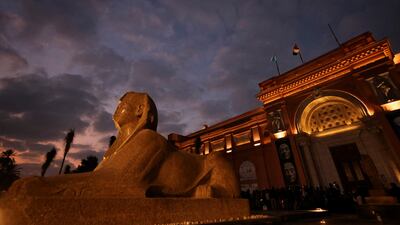
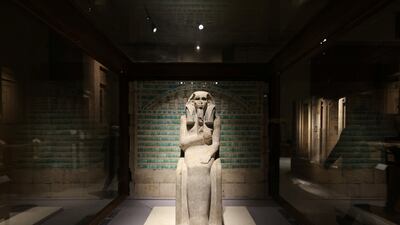
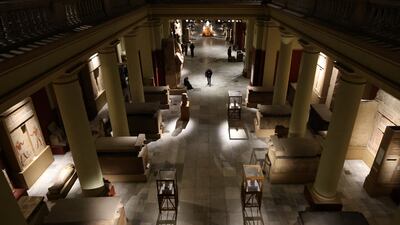
The unveiling took place as part of a larger ceremony held to inaugurate a newly updated wing of the Egyptian Museum which had been undergoing renovation co-funded by the EU.

The renovation plan, the first phase of which has been completed, involves major structural updates to the 120-year-old premises and improvements to its lighting systems and displays. Additionally, its archives and services will be digitised, Mr Waziri said.

Egyptologists from several Egyptian universities attended alongside counterparts from five European museums with large ancient Egyptian collections: the Louvre, the British Museum, the Egyptian Museum in Berlin, the National Antiquities Museum in Leiden, in the Netherlands, and the Egyptian Museum in Turin.

The 16-metre papyrus was found in Saqqara in May last year. EPA

The foreign contingent present at the inauguration of the renovated wing at the museum, praised their “longstanding and fruitful co-operation” with the Egyptian Museum.

The redevelopment was undertaken to ensure the Egyptian Museum, the country’s oldest, is not forgotten now that newer, larger and better-equipped alternatives such as the Grand Egyptian Museum and the National Museum of Egyptian Civilisation have opened to visitors, said Ahmed Eissa, Minister of Tourism and Antiquities.

Mr Eissa announced a plan in January to increase tourism by 30 per cent by updating the quality and speed of services offered to tourists.

“Museums and tourists’ experience inside them is an important part of our plan to boost tourism,” said Mr Eissa during his address on Monday.

The inauguration ceremony was also attended by the European Commission’s ambassador to Egypt, Christian Berger. He outlined the prominence of the Egyptian Museum, which opened in 1902 and has played an important role in the preservation of the country's heritage.

The longest papyrus to be discovered in Egypt, the Harris Papyrus I, was found near Luxor’s Habu Temple in the 1850s.

It was purchased by a British collector in 1855 and has since been displayed at the British Museum.

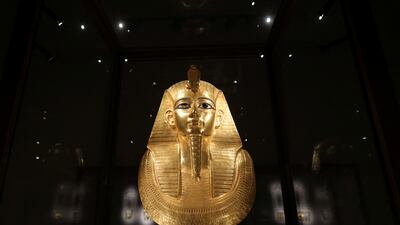
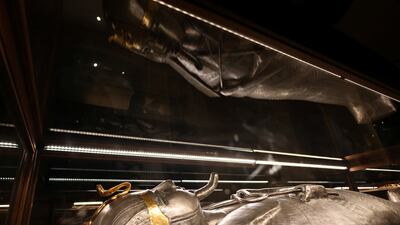
Pharaoh's golden death mask and silver coffin among artefacts on display — in pictures

COMPANY%20PROFILE
%3Cp%3E%3Cstrong%3ECompany%20name%3A%3C%2Fstrong%3E%203S%20Money%3Cbr%3E%3Cstrong%3EStarted%3A%3C%2Fstrong%3E%202018%3Cbr%3E%3Cstrong%3EBased%3A%3C%2Fstrong%3E%20London%3Cbr%3E%3Cstrong%3EFounders%3A%3C%2Fstrong%3E%20Ivan%20Zhiznevsky%2C%20Eugene%20Dugaev%20and%20Andrei%20Dikouchine%3Cbr%3E%3Cstrong%3ESector%3A%3C%2Fstrong%3E%20FinTech%3Cbr%3E%3Cstrong%3EInvestment%20stage%3A%3C%2Fstrong%3E%20%245.6%20million%20raised%20in%20total%3C%2Fp%3E%0A
Tank warfare

Lt Gen Erik Petersen, deputy chief of programs, US Army, has argued it took a “three decade holiday” on modernising tanks. 

“There clearly remains a significant armoured heavy ground manoeuvre threat in this world and maintaining a world class armoured force is absolutely vital,” the general said in London last week.

“We are developing next generation capabilities to compete with and deter adversaries to prevent opportunism or miscalculation, and, if necessary, defeat any foe decisively.”

MATCH INFO

Liverpool 2 (Van Dijk 18', 24')

Brighton 1 (Dunk 79')

Red card: Alisson (Liverpool)

Gifts exchanged
  • King Charles - replica of President Eisenhower Sword
  • Queen Camilla -  Tiffany & Co vintage 18-carat gold, diamond and ruby flower brooch
  • Donald Trump - hand-bound leather book with Declaration of Independence
  • Melania Trump - personalised Anya Hindmarch handbag

Mercer, the investment consulting arm of US services company Marsh & McLennan, expects its wealth division to at least double its assets under management (AUM) in the Middle East as wealth in the region continues to grow despite economic headwinds, a company official said.

Mercer Wealth, which globally has $160 billion in AUM, plans to boost its AUM in the region to $2-$3bn in the next 2-3 years from the present $1bn, said Yasir AbuShaban, a Dubai-based principal with Mercer Wealth.

Within the next two to three years, we are looking at reaching $2 to $3 billion as a conservative estimate and we do see an opportunity to do so,” said Mr AbuShaban.

Mercer does not directly make investments, but allocates clients’ money they have discretion to, to professional asset managers. They also provide advice to clients.

“We have buying power. We can negotiate on their (client’s) behalf with asset managers to provide them lower fees than they otherwise would have to get on their own,” he added.

Mercer Wealth’s clients include sovereign wealth funds, family offices, and insurance companies among others.

From its office in Dubai, Mercer also looks after Africa, India and Turkey, where they also see opportunity for growth.

Wealth creation in Middle East and Africa (MEA) grew 8.5 per cent to $8.1 trillion last year from $7.5tn in 2015, higher than last year’s global average of 6 per cent and the second-highest growth in a region after Asia-Pacific which grew 9.9 per cent, according to consultancy Boston Consulting Group (BCG). In the region, where wealth grew just 1.9 per cent in 2015 compared with 2014, a pickup in oil prices has helped in wealth generation.

BCG is forecasting MEA wealth will rise to $12tn by 2021, growing at an annual average of 8 per cent.

Drivers of wealth generation in the region will be split evenly between new wealth creation and growth of performance of existing assets, according to BCG.

Another general trend in the region is clients’ looking for a comprehensive approach to investing, according to Mr AbuShaban.

“Institutional investors or some of the families are seeing a slowdown in the available capital they have to invest and in that sense they are looking at optimizing the way they manage their portfolios and making sure they are not investing haphazardly and different parts of their investment are working together,” said Mr AbuShaban.

Some clients also have a higher appetite for risk, given the low interest-rate environment that does not provide enough yield for some institutional investors. These clients are keen to invest in illiquid assets, such as private equity and infrastructure.

“What we have seen is a desire for higher returns in what has been a low-return environment specifically in various fixed income or bonds,” he said.

“In this environment, we have seen a de facto increase in the risk that clients are taking in things like illiquid investments, private equity investments, infrastructure and private debt, those kind of investments were higher illiquidity results in incrementally higher returns.”

The Abu Dhabi Investment Authority, one of the largest sovereign wealth funds, said in its 2016 report that has gradually increased its exposure in direct private equity and private credit transactions, mainly in Asian markets and especially in China and India. The authority’s private equity department focused on structured equities owing to “their defensive characteristics.”

Results
%3Cp%3E%3Cstrong%3EStage%203%3A%3C%2Fstrong%3E%3Cbr%3E1.%20Einer%20Rubio%20(COL)%20Movistar%20Team%20-%204h51%E2%80%9924%E2%80%9D%3Cbr%3E2.%20Remco%20Evenepoel%20(BEL)%20Soudal%20Quick-Step%20-%2014%22%3Cbr%3E3.%20Adam%20Yates%20(GBR)%20UAE%20Team%20Emirates%20-%2015%22%3Cbr%3E%3Cstrong%3EGeneral%20classifications%3A%3C%2Fstrong%3E%3Cbr%3E1.%20Remco%20Evenepoel%20(BEL)%20Soudal%20Quick-Step%3Cbr%3E2.%20Lucas%20Plapp%20(AUS)%20Ineos%20Grenaders)%20-%207%22%3Cbr%3E3.%20Pello%20Bilbao%20(ESP)%20Bahrain%20Victorious%20-%2011%22%3C%2Fp%3E%0A
Updated: July 10, 2023, 4:40 AM