

The leaders of Egypt, Jordan and the Palestinians delivered a warning to Israel's far-right government on Tuesday, saying "illegal and unilateral" measures that are undermining the chances of a Palestinian-Israeli settlement must stop.
During a meeting in Cairo, President Abdel Fattah El Sisi, Jordan's King Abdullah and Palestinian leader Mahmoud Abbas called on Israel to maintain the status quo at Jerusalem's holiest site.
They emphasised Amman's historical role as custodian of the city's Al Aqsa Mosque.
They also called on the international community to provide protection for Palestinians and on rival Palestinian factions to unite.
The three leaders periodically meet to co-ordinate policies towards Israel and explore ways to inject life into the long-stalled peace process between the Palestinians and Israel. Their meeting on Tuesday took on added significance after the re-election of Prime Minister Benjamin Netanyahu at the head of a religiously conservative and right-wing government.
"The leaders stressed the necessity for the halt of all of Israel's unilateral and illegal measures that undermine the two-state solution and the chance for a just and comprehensive peace," said a joint statement at the end of the summit in Cairo.
It cited the expansion of Jewish settlements in the West Bank, confiscating Palestinian land, demolishing Palestinian homes and Israeli security raids in Palestinian towns.
Egypt and Jordan signed peace treaties with Israel in 1979 and 1994 respectively. Both Arab nations share borders with Israel.
However, relations between them and Israel often become fraught with tension at times of Israeli-Palestinian violence or when Israel is seen to be using excessive force against Palestinian protesters.
This month, a right-wing member in Mr Netanyahu’s new cabinet — National Security Minister Itmar Ben-Gvir — visited the Al Aqsa compound in East Jerusalem. The visit sparked international condemnation, including from Israel's main backer, the US.
Under a long-standing status quo, non-Muslims can visit the site at specific times, but are not allowed to pray there. In recent years, however, a growing number of Jewish people, most of them Israeli nationalists, have covertly prayed at the Al Aqsa compound, a development decried by Palestinians.
Both Jordan and Egypt strongly condemned the visit, warned Israel against changing the status quo in East Jerusalem and cautioned against provocative actions by the new government.
Al Aqsa is Islam’s third holiest site and East Jerusalem is what the Palestinians want as a capital for a future independent state.
In a move likely to make relations with Israel even more fraught with tension, Jordan's Foreign Ministry said Israeli authorities on Tuesday "intercepted" the Jordanian ambassador to Israel, Ghassan Magali, as he was entering Al Aqsa Mosque.
An Israeli policeman "blocked the way of the Jordanian ambassador as he entered the blessed Al Aqsa Mosque", it said.
The three leaders discussed the prospects for reconciliation between the Fatah faction, led by the Palestinian President, 87, which dominates the Ramallah-based Palestinian Authority, and the Hamas group that has ruled the Gaza Strip alone since 2007.
They said the Palestinians needed to unify their ranks to better defend their cause.
Jordanian analyst Saud Al Sharafat, speaking to The National only hours before Tuesday's meeting, said the leaders had separate reasons for concern.
Their worries have been deepened by the extremist bent of Israel's new government as well as its heavy-handed response to unrest in the West Bank, he said.
-
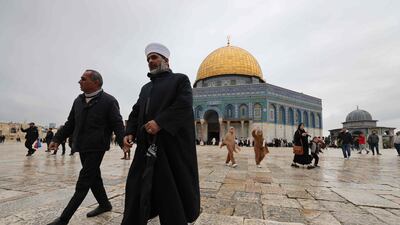
Palestinians in Al Aqsa mosque compound after Friday's noon prayer in Jerusalem, January 6, 2023. AFP -

Israeli minister and Jewish Power party leader Itamar Ben-Gvir on a tour of Al Aqsa mosque compound on January 3, 2023. AFP -

Pope Benedict XVI in front of the Dome of the Rock in Jerusalem's Old City in May 2009. Reuters -
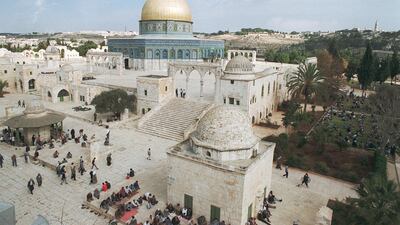
The Dome of the Rock at Al Aqsa mosque compound in 1987. AFP -
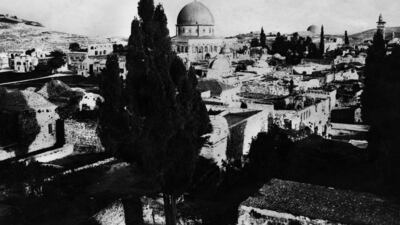
The walled city of old Jerusalem with the Dome of the Rock in the background, circa 1948. AFP -
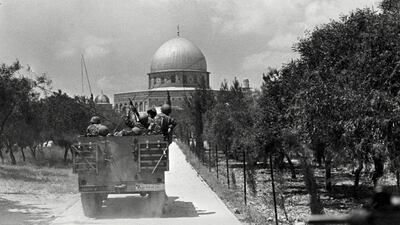
An Israeli military vehicle approaches the Dome of the Rock in June 1967. AFP -

Israeli right-wing opposition leader Ariel Sharon flanked by security guards on a visit to Al Aqsa mosque compound in September 2000. AFP -
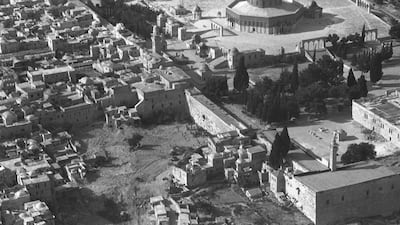
A view of Jerusalem on June 12, 1967 shows the Mughrabi Quarter after the Arab-Israeli war that year. AFP -
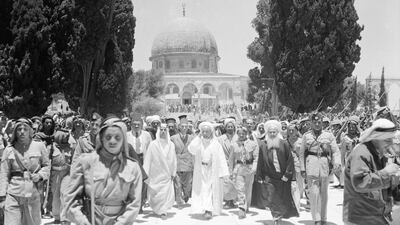
King Abdullah of Jordan on his way to Al Aqsa mosque in June 1948, with the Dome of the Rock in the background. Getty Images -
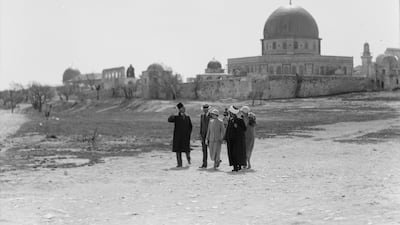
Royal guests Princess Mary and the Earl of Harwood in March 1934 leave the temple area. Photo: Library of Congress -
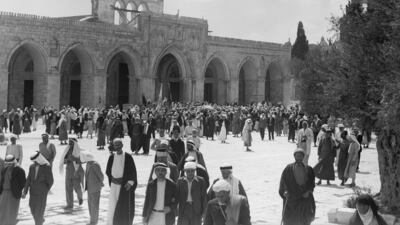
Crowds outside Al Aqsa mosque in the 1930s. Photo: Library of Congress


Mr Abbas is afraid of the Palestinian Authority “becoming internally powerless” and losing external clout in favour of its sworn rival Hamas and other radical Islamist groups in Gaza, Mr Al Sharafat said. Fading hopes for a Palestinian-Israeli settlement is also contributing to concerns.
Egypt, for its part, is worried about the loss to other regional players of its security and intelligence influence in the Gaza Strip, where it has maintained close links with Hamas and Islamist extremists. These links are a key card in Egypt's relations with Israel and are consistently used to broker a truce when Hamas and Israel are at war.
The escalation of Israeli military operations in the West Bank and the rising number of Palestinian casualties there in recent weeks are putting pressure on Jordan and its coveted role as custodian of Jerusalem's holy shrines, said Mr Al Sharafat.
“The actions of the current Netanyahu government are [aimed at] sowing doubt about Jordan’s ability to manage this file,” he said.

