South Sudan President Salva Kiir's transitional government has been slow to write a new constitution and pave the way for elections. AFP

South Sudan postpones elections for two years


  • English
  • Arabic

South Sudan's transitional government will remain in power for another two years, its president said on Thursday.

The move delays elections that were scheduled for December and has raised concerns among western nations supporting the country's peace process.

"We have decided to prepare the country over the next 24 months to plant the seeds of South Sudan's elections, upon which to build a government that can complete the war on poverty, ignorance, and hopelessness," President Salva Kiir said in a live radio broadcast of a meeting that approved the extension.

South Sudan declared independence from Sudan in 2011, becoming the world's newest nation amid celebrations and pledges of support from world powers.

Two years later, violence erupted between troops loyal to Mr Kiir and his longtime rival and vice president Riek Machar.

A peace agreement signed in September 2019, the latest in a series since the conflict began in late 2013, is largely holding.

But the transitional government has been slow to unify the various factions of the military into a single unit, write a new constitution and pave the way for elections.

The 2013-18 war left about 400,000 dead and millions displaced.

The US, Britain and Norway, which have played important roles in mediating South Sudan's peace process, expressed reservations about the transitional government's extension.

"The road map must demonstrate how another extension would differ from previous ones and include steps for clear progress in setting up the institutions and mechanisms necessary to hold elections," the three countries' ambassadors said in a letter to Mr Kiir.

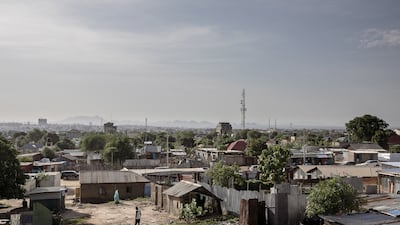
  • A shantytown in Juba, the capital of South Sudan. South Sudan secured a $174 million loan from the International Monetary Fund in April to help finance its budget and stabilise the currency.
    A shantytown in Juba, the capital of South Sudan. South Sudan secured a $174 million loan from the International Monetary Fund in April to help finance its budget and stabilise the currency.
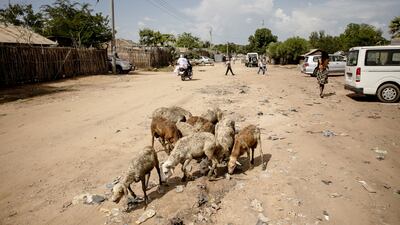
  • Lambs graze in the middle of a dirt road in Juba, the capital of South Sudan.
    Lambs graze in the middle of a dirt road in Juba, the capital of South Sudan.
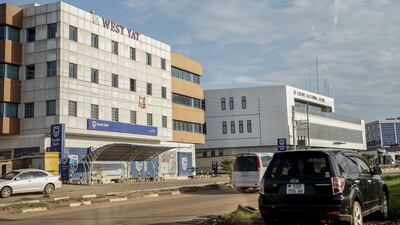
  • Branches of Stanbic Bank, left, and Ebony National Bank, on a street in Juba, South Sudan. South Sudan secured a $174 million loan from the International Monetary Fund in April to help finance its budget and stabilise the currency.
    Branches of Stanbic Bank, left, and Ebony National Bank, on a street in Juba, South Sudan. South Sudan secured a $174 million loan from the International Monetary Fund in April to help finance its budget and stabilise the currency.
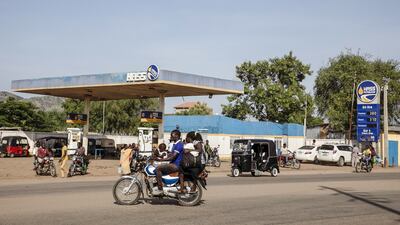
  • Motorcyclists at a petrol station in Juba, the capital of South Sudan.
    Motorcyclists at a petrol station in Juba, the capital of South Sudan.
  • Customers queue at a market stall in Juba, South Sudan.
    Customers queue at a market stall in Juba, South Sudan.
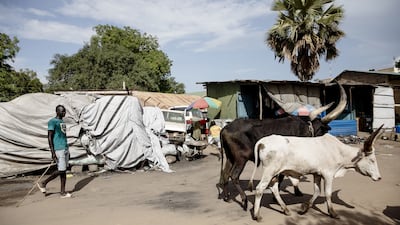
  • A man walks cattle along a dirt road in Juba, South Sudan. South Sudan secured a $174 million loan from the International Monetary Fund in April.
    A man walks cattle along a dirt road in Juba, South Sudan. South Sudan secured a $174 million loan from the International Monetary Fund in April.

The UN gave a warning earlier this year of grave concerns among many politicians and civilians in South Sudan that the country may be heading back into conflict.

It pointed to political disputes between Mr Kiir and Mr Machar.

In May, the UN Security Council renewed an arms embargo against South Sudan, as well as a travel ban and financial sanctions for certain people, amid continuing unrest in the country.

South Sudan is rich in natural resources and one of the most diverse nations in Africa, with more than 60 languages and dozens of ethnic groups.

But 11 years after independence, visitors to the capital Juba will see a country suffering from underdevelopment and extreme poverty — the direct result of five years of civil war that stymied the transformation of the young nation into a viable state.


Infiniti QX80 specs

Engine: twin-turbocharged 3.5-liter V6

Power: 450hp

Torque: 700Nm

Price: From Dh450,000, Autograph model from Dh510,000

Available: Now

About Proto21

Date started: May 2018
Founder: Pir Arkam
Based: Dubai
Sector: Additive manufacturing (aka, 3D printing)
Staff: 18
Funding: Invested, supported and partnered by Joseph Group

Mercer, the investment consulting arm of US services company Marsh & McLennan, expects its wealth division to at least double its assets under management (AUM) in the Middle East as wealth in the region continues to grow despite economic headwinds, a company official said.

Mercer Wealth, which globally has $160 billion in AUM, plans to boost its AUM in the region to $2-$3bn in the next 2-3 years from the present $1bn, said Yasir AbuShaban, a Dubai-based principal with Mercer Wealth.

Within the next two to three years, we are looking at reaching $2 to $3 billion as a conservative estimate and we do see an opportunity to do so,” said Mr AbuShaban.

Mercer does not directly make investments, but allocates clients’ money they have discretion to, to professional asset managers. They also provide advice to clients.

“We have buying power. We can negotiate on their (client’s) behalf with asset managers to provide them lower fees than they otherwise would have to get on their own,” he added.

Mercer Wealth’s clients include sovereign wealth funds, family offices, and insurance companies among others.

From its office in Dubai, Mercer also looks after Africa, India and Turkey, where they also see opportunity for growth.

Wealth creation in Middle East and Africa (MEA) grew 8.5 per cent to $8.1 trillion last year from $7.5tn in 2015, higher than last year’s global average of 6 per cent and the second-highest growth in a region after Asia-Pacific which grew 9.9 per cent, according to consultancy Boston Consulting Group (BCG). In the region, where wealth grew just 1.9 per cent in 2015 compared with 2014, a pickup in oil prices has helped in wealth generation.

BCG is forecasting MEA wealth will rise to $12tn by 2021, growing at an annual average of 8 per cent.

Drivers of wealth generation in the region will be split evenly between new wealth creation and growth of performance of existing assets, according to BCG.

Another general trend in the region is clients’ looking for a comprehensive approach to investing, according to Mr AbuShaban.

“Institutional investors or some of the families are seeing a slowdown in the available capital they have to invest and in that sense they are looking at optimizing the way they manage their portfolios and making sure they are not investing haphazardly and different parts of their investment are working together,” said Mr AbuShaban.

Some clients also have a higher appetite for risk, given the low interest-rate environment that does not provide enough yield for some institutional investors. These clients are keen to invest in illiquid assets, such as private equity and infrastructure.

“What we have seen is a desire for higher returns in what has been a low-return environment specifically in various fixed income or bonds,” he said.

“In this environment, we have seen a de facto increase in the risk that clients are taking in things like illiquid investments, private equity investments, infrastructure and private debt, those kind of investments were higher illiquidity results in incrementally higher returns.”

The Abu Dhabi Investment Authority, one of the largest sovereign wealth funds, said in its 2016 report that has gradually increased its exposure in direct private equity and private credit transactions, mainly in Asian markets and especially in China and India. The authority’s private equity department focused on structured equities owing to “their defensive characteristics.”

UAE currency: the story behind the money in your pockets
The specs

Engine 60kwh FWD

Battery Rimac 120kwh Lithium Nickel Manganese Cobalt Oxide (LiNiMnCoO2) chemistry

Power 204hp Torque 360Nm

Price, base / as tested Dh174,500 

Updated: August 05, 2022, 10:49 AM