


People in western countries should set aside their negative stereotypes of the Middle East and embrace its desire for modernisation, former UK prime minister Tony Blair has said.
Polling by Mr Blair's think tank found evidence of what he called "outdated misconceptions" of the region, with people in Britain, the US, France and Germany likely to see it as unstable, discriminatory and potentially hostile.
Conversely, the survey found most people in countries such as Egypt, Saudi Arabia and Iraq said they regarded western countries positively and believed in equal rights and peaceful co-existence between faiths.
They also expressed optimism about the future of science and technology in the region, contrary to the prevailing western view that the region's economy is rigid and stagnant.
Mr Blair, who ordered British troops into Iraq as part of the US-led invasion in 2003, said there were "surprisingly positive" attitudes in the region towards the UK, US and Europe.
"People across the Middle East and North Africa, especially the youth, want societies which are religiously tolerant, economically enterprising and at peace with their neighbours," he said.
"Unfortunately, western attitudes are lagging [behind]. We still think of the region as backward, intractable and irredeemably hostile to us. And whilst of course there is evidence for those attitudes in parts of the Middle East, the polling shows they do not represent the majority.
"The risk for the West is our outdated misconception of what people in the region really think leads us to disengage at the very moment where there is an opportunity for us to partner the region and its modernising elements for the benefit, not only of the region itself, but for our own security."
'Third way'
A 73-page report by the Tony Blair Institute said there was broad support in the region for Saudi Arabia's reform efforts, intended to drive diversification from oil.
The report cited the Abraham Accords between the UAE, Bahrain and Israel, and the Cop climate summits being hosted by Egypt in 2022 and the UAE in 2023 as examples of international engagement bearing fruit.
It invited US President Joe Biden, visiting the region this week, to support a "third way" between the status quo and radical governments in the region — invoking one of Mr Blair's catchphrases when he was Labour Party leader.
The report said majorities of between 67 per cent and 75 per cent of those polled in Saudi Arabia, Iraq, Lebanon, Egypt and Tunisia believed that women should have the same rights as men at all levels of business and government.
However, only 9 per cent to 15 per cent of people in Britain, the US, France and Germany believed women's rights were making progress in the Middle East.
Joe Biden's Middle East visit - in pictures
-
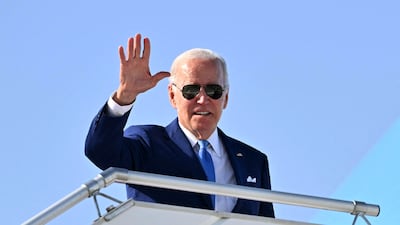
US President Joe Biden waves from a plane at King Abdulaziz International Airport in Jeddah. AFP -

US President Joe Biden boards a plane at King Abdulaziz International Airport in Jeddah. AFP -
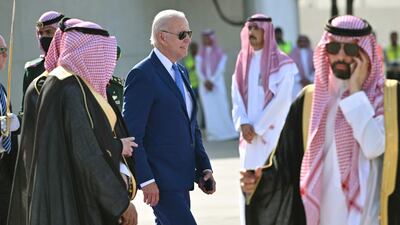
Mr Biden walks to the plane. AFP -
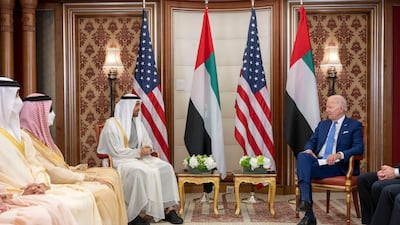
President Sheikh Mohamed in discussion with Mr Biden during the Gulf Co-operation Council GCC+3 Jeddah Security and Development Summit. Photo: Abdulla Al Neyadi for the Presidential Court -
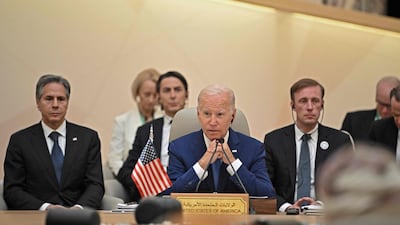
US President Joe Biden attends the Gulf Co-operation Council GCC+3 Jeddah Security and Development Summit at a hotel in the Saudi Arabian Red Sea coastal city. AFP -
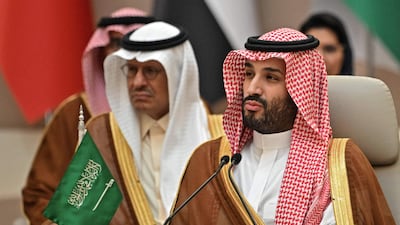
Saudi Arabia's Crown Prince Mohammed bin Salman attends the Gulf Co-operation Council GCC+3 meeting in Jeddah. AFP -
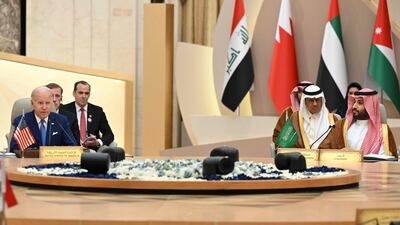
US President Joe Biden and Saudi Arabia's Crown Prince Mohammed bin Salman at the GCC+3 Jeddah Security and Development Summit. AFP -
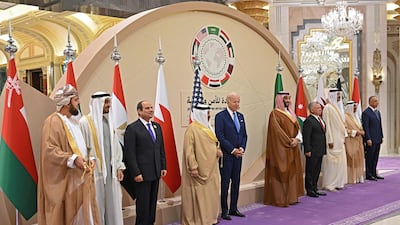
President Sheikh Mohamed attended a traditional summit 'family photo call' in the company of, from left: Asaad bin Tariq Al Said, Omani Deputy Prime Minister for International Relations and Co-operation Affairs and the Special Representative of the Sultan; Sheikh Mohamed; Egypt's President Abdel Fattah El Sisi; Bahrain's King Hamad bin Isa bin Salman Al Khalifa; US President Joe Biden; Saudi Crown Prince Mohammed bin Salman; Jordan's King Abdullah II; Qatar's Emir Sheikh Tamim bin Hamad Al Thani; Kuwait's Crown Prince Mishal Al Ahmad Al Jaber Al Sabah, and Iraq's Prime Minister Mustafa Al Kadhimi. AFP -
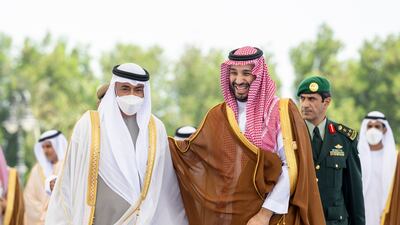
President Sheikh Mohamed is received by Saudi Arabia's Crown Prince Mohammed bin Salman upon his arrival at King Abdulaziz International Airport. Photo: Abdulla Al Neyadi for the Presidential Court -
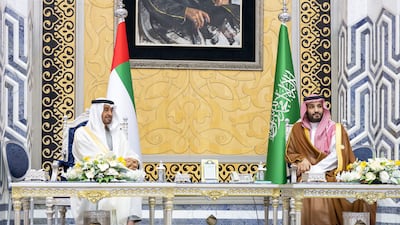
President Sheikh Mohamed is received by Saudi Arabia's Prince Mohamed bin Salman upon his arrival at King Abdulaziz International Airport. Photo: Abdulla Al Neyadi for the Presidential Court -
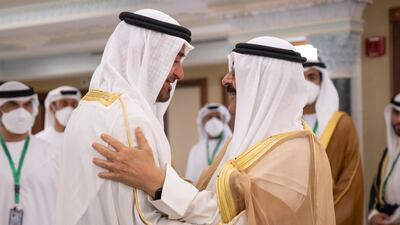
President Sheikh Mohamed greets Sheikh Mishal Al Sabah, Crown Prince of Kuwait, during the GCC+3 Jeddah Security and Development Summit. Photo: Rashed Al Mansoori / Presidential Court -
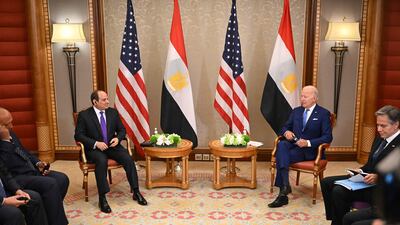
US President Joe Biden and Secretary of State Antony Blinken meet Egyptian President Abdel Fattah El Sisi, Foreign Minister Sameh Shoukry and other officials during a bilateral meeting at a hotel in Saudi Arabia's Red Sea coastal city of Jeddah before the GCC+3 meeting. AFP -
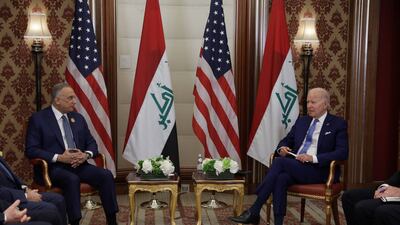
US President Joe Biden meets Iraqi Prime Minister Mustafa Al Kadhimi, in Jeddah before the beginning of the GCC+3 meeting. Reuters -
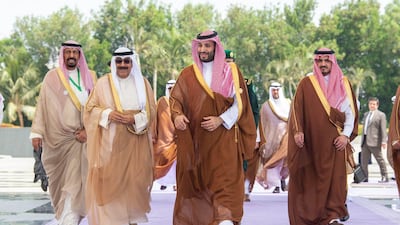
Saudi Arabia's Crown Prince Mohammed bin Salman receives Sheikh Mishal Al Sabah, Crown Prince of Kuwait, before the GCC + 3 Jeddah Security and Development Summit on Saturday. SPA -
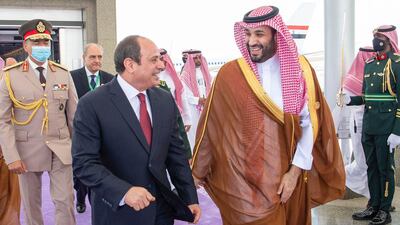
Saudi Arabia's Crown Prince Mohammed bin Salman and Egypt's President Abdel Fattah El Sisi arrive for the Jeddah summit. SPA -
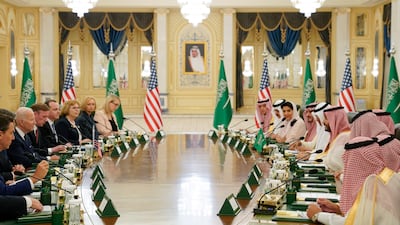
US President Joe Biden participates in a working session with Saudi Crown Prince Mohammed bin Salman at Al Salam Palace in Jeddah. AP -
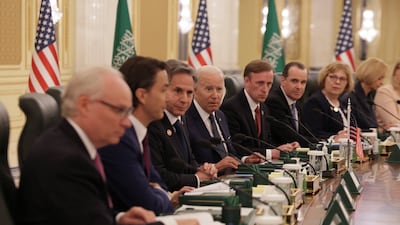
US President Joe Biden and US Secretary of State Antony Blinken in a bilateral meeting with Saudi officials led by Crown Prince Mohammed bin Salman at Al Salam Palace. Reuters -
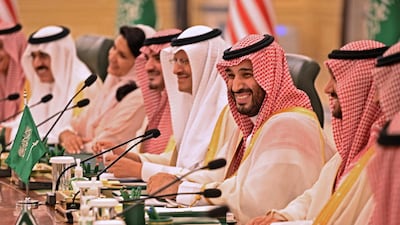
Saudi Arabia's Crown Prince Mohammed bin Salman takes part in a working session with US President Joe Biden and his team. AFP -
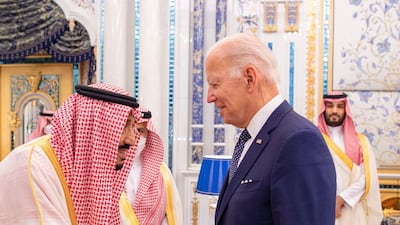
Saudi Arabia's King Salman greets US President Joe Biden at Al Salam Palace in Jeddah. Photo: @spagov -
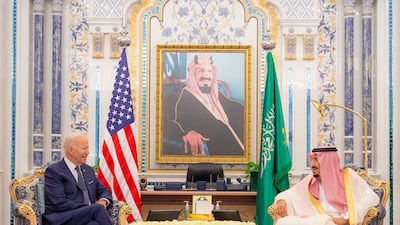
King Salman and US President Joe Biden in discussions at Al Salam Palace in Jeddah. Photo: @spagov -
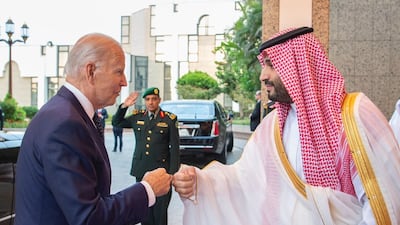
US President Joe Biden meets Saudi Crown Prince Mohammed bin Salman in Jeddah. Photo: @spagov -
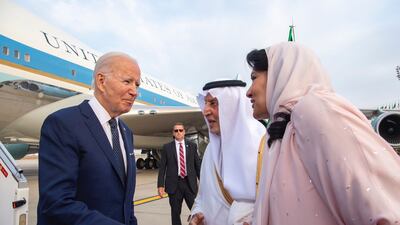
US President Joe Biden arrives at King Abdulaziz International Airport in Jeddah. Photo: @spagov -
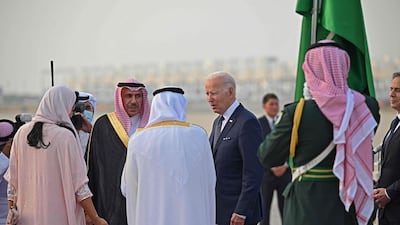
US President Joe Biden is welcomed by Saudi Arabian officials. AFP -
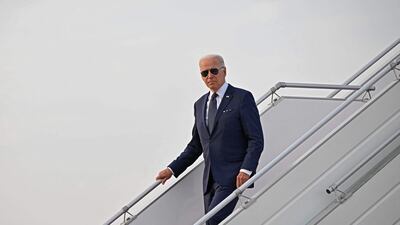
Mr Biden disembarks from Air Force One at King Abdulaziz International Airport, following a flight from Tel Aviv. AFP -
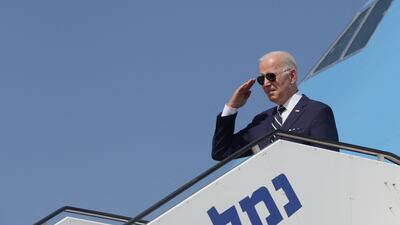
US Presidents Joe Biden salutes as he boards Air Force One at Ben Gurion International Airport in Lod, near Tel Aviv en route to a meeting with the GCC+3 in Jeddah, Saudi Arabia. Reuters -
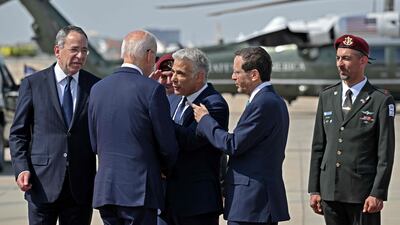
Israel's President Isaac Herzog, second right, and caretaker Prime Minister Yair Lapid, centre, bid farewell to US President Joe Biden at Ben Gurion Airport. AFP -
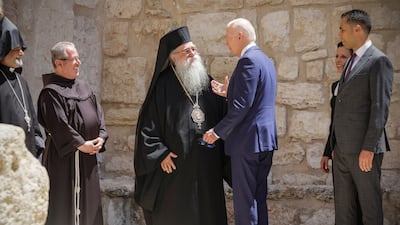
US President Joe Biden meets clergy at the Church of Nativity in Bethlehem, in the occupied West Bank. Reuters -
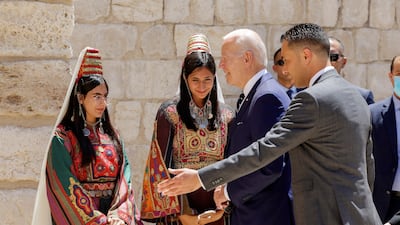
US President Joe Biden is introduced to local people at the Church of Nativity in Bethlehem. Reuters -

US President Joe Biden arrives at the Church of Nativity in Bethlehem, on the second full day of his Middle East visit. AFP -
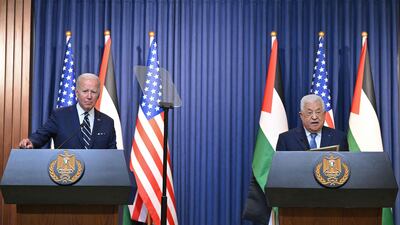
US President Joe Biden and Palestinian President Mahmoud Abbas address the media after their meeting at the Muqataa Presidential Compound in Bethlehem, the occupied West Bank. AFP -
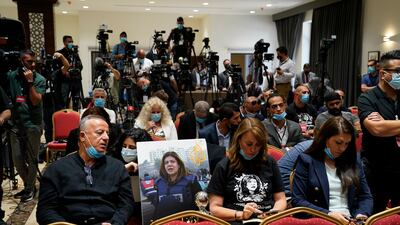
A photo of journalist Shireen Abu Akleh is placed on a chair as reporters wait for US President Joe Biden and Palestinian President Mahmoud Abbas to speak. She was killed in a raid by Israeli forces in May. The caption reads: 'Shireen Abu Akleh, voice of Palestine'. AP -
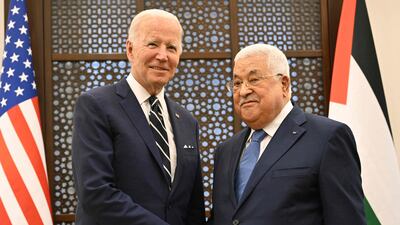
US President Joe Biden with Palestinian President Mahmoud Abbas at a welcome ceremony at the Palestinian Muqataa Presidential Compound in Bethlehem, in the occupied West Bank. AFP -
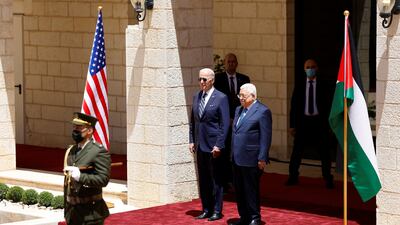
Palestinian President Mahmoud Abbas welcomes US President Joe Biden to the Israeli-occupied West Bank. Reuters -
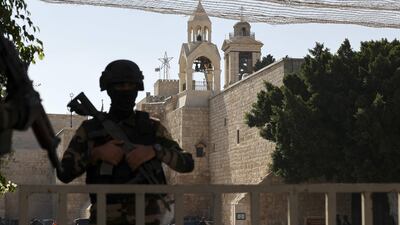
A Palestinian security officer stands guard near the Church of the Nativity in Bethlehem in the occupied West Bank before US President Joe Biden’s official visit. AFP -
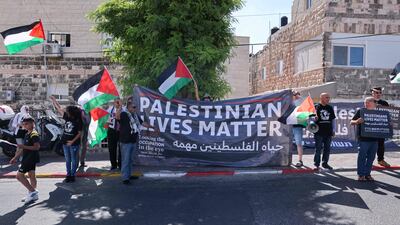
Palestinian and Israeli human rights campaigners lift banners during a rally near Augusta Victoria Hospital in East Jerusalem as US President Joe Binden visits. AFP -
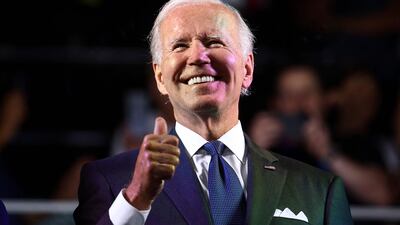
US President Joe Biden greets fans as he attends the opening ceremony of the Maccabiah Games at Teddy Stadium in Jerusalem. AFP -
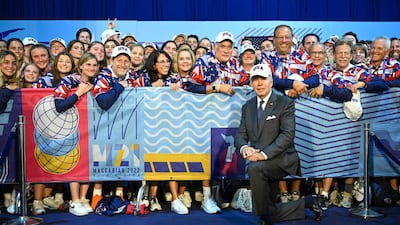
US President Joe Biden poses for a picture with US athletes competing in the Maccabiah Games. AFP -

People use the lights of their phones during the opening ceremony of the Maccabiah Games in Jerusalem, attended by US President Joe Biden. Reuters -
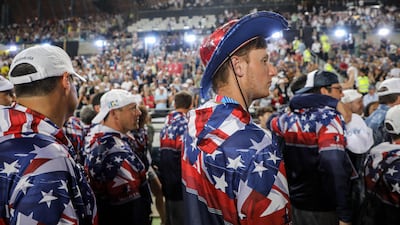
US athletes attend the opening ceremony of the Maccabiah Games in Jerusalem. AFP -
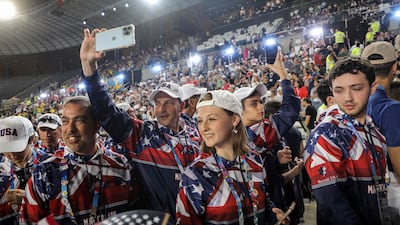
The Maccabiah Games coincided with the US President Joe Biden's visit to the Middle East. AFP -
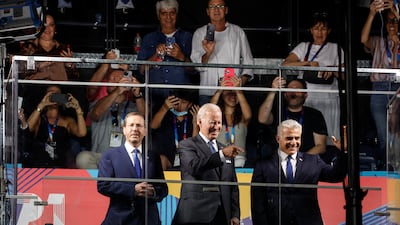
US President Joe Biden, centre, Israel's caretaker Prime Minister Yair Lapid, right, and President Isaac Herzog attend the opening ceremony for the Maccabiah Games in Jerusalem. Reuters -
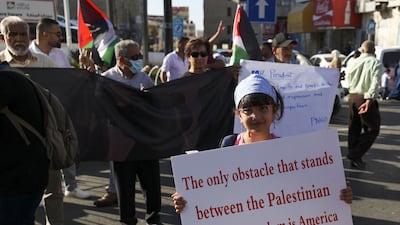
A Palestinian protester carries a placard during a demonstration in the occupied West Bank city of Ramallah as US President Joe Biden visited Israel. AFP -
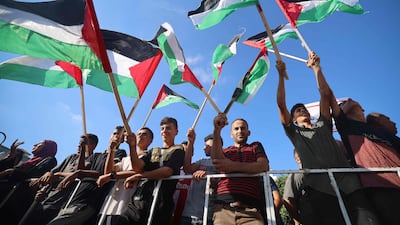
In Gaza City, Palestinian demonstrators wave their national flag as they gather to protest against the visit by US President Joe Biden to Israel. AFP -
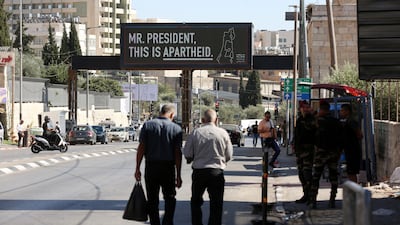
A billboard, part of a campaign organised by the Centre for Human Rights B'Tselem, installed before US President Joe Biden's arrival for an official visit in the West Bank city of Bethlehem. PA -
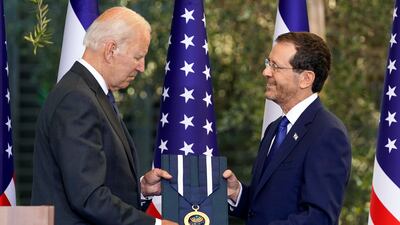
US President Joe Biden receives the Israeli Presidential Medal of Honour from Israeli President Isaac Herzog in Jerusalem. AP Photo -
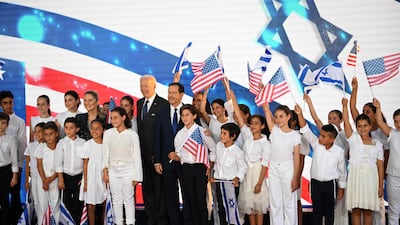
US President Joe Biden, centre left, and President Isaac Herzog with children after Mr Biden's arrival at the presidential residence in Jerusalem. AFP -
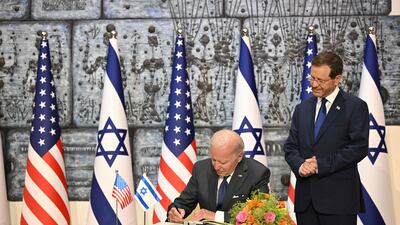
US President Joe Biden signs the guest book in the presence of President Isaac Herzog on arriving at the presidential residence in Jerusalem. AFP -
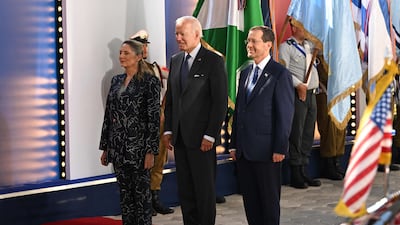
US President Joe Biden with President Isaac Herzog and Mrs Michal Herzog in Jerusalem. AFP -
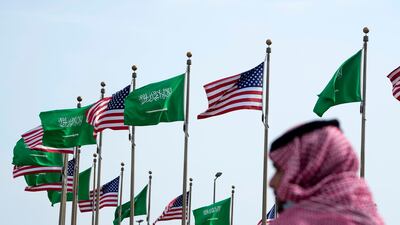
US and Saudi Arabian flags in a square in Jeddah, Saudi Arabia, before US President Joe Biden's visit. AP -
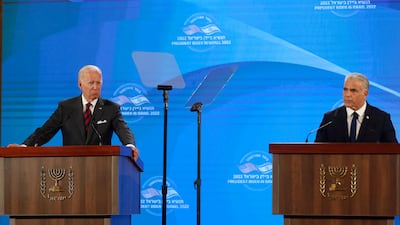
US President Joe Biden and caretaker Israeli Prime Minister Yair Lapid at a press conference at the Waldorf Astoria Hotel in Jerusalem. EPA -

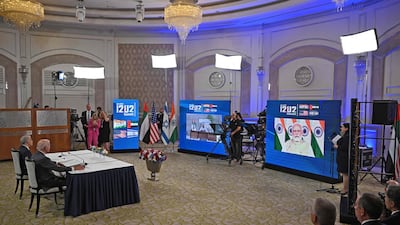
President Sheikh Mohamed delivers the opening speech during the I2U2 summit, a meeting between the leaders of the UAE, India, Israel and the US. Seen with Sheikh Abdullah bin Zayed, UAE Minister of Foreign Affairs and International Co-operation. Photo: Presidential Court -
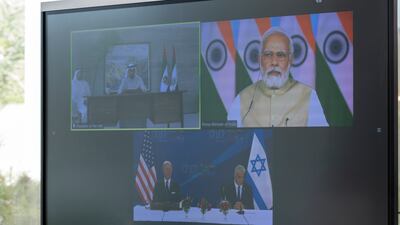
President Sheikh Mohamed speaks with Indian Prime Minister Narendra Modi, US President Joe Biden and Israeli Prime Minister Yair Lapid during the I2U2 summit. Photo: Presidential Court -
US President Joe Biden and caretaker Iraeli Prime Minister Yair Lapid address a joint press conference. AFP -
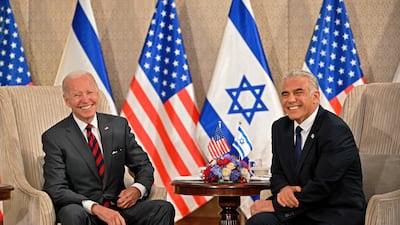
US President Joe Biden and Israeli caretaker Prime Minister Yair Lapid during their meeting at a hotel in Jerusalem. AFP -

US President Joe Biden speaks to Holocaust survivors Dr Gita Cycowicz and Rena Quint in the Hall of Remembrance, at Yad Vashem in Jerusalem. AP -
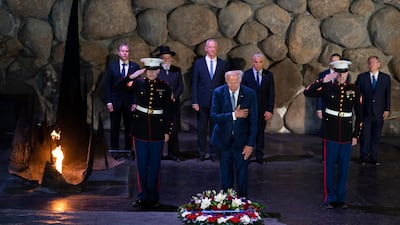
US President Joe Biden participates in a wreath-laying ceremony in the Hall of Remembrance at Yad Vashem Holocaust Remembrance Centre in Jerusalem. AP -
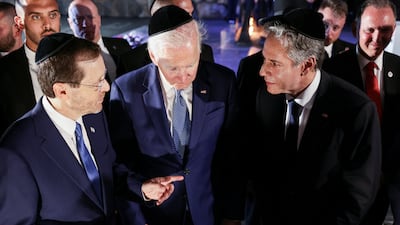
Israel's President Isaac Herzog speaks with US Secretary of State Antony Blinken and US President Joe Biden during their visit to Hall of Remembrance at Yad Vashem Holocaust Remembrance Centre in Jerusalem. Reuters -
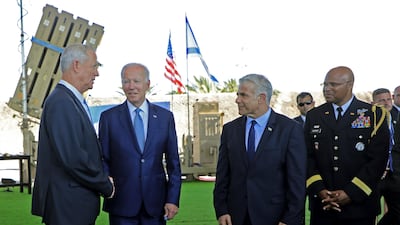
Israeli Defence Minister Benny Gantz, left, US President Joe Biden, second left, caretaker Prime Minister Yair Lapid, right, and Brig Gen Shawn Harris, defence attache to the US embassy, in front of Israel's Iron Dome defence system during a tour at Ben Gurion Airport. AP -
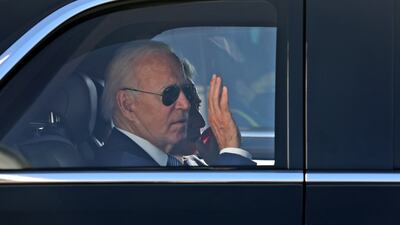
US President Joe Biden waves as he leaves Israel's Ben Gurion Airport on his way to Jerusalem. EPA -
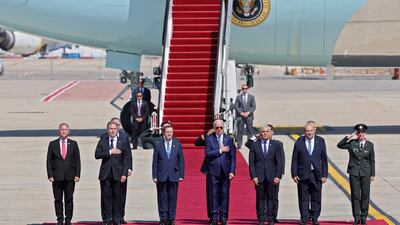
US President Joe Biden, centre, stands for the national anthems alongside Secretary of State Antony Blinken, second left, Israel's President Herzog, third left, caretaker Prime Minister Yair Lapid, third right, and departing prime minister Naftali Bennett, second right, at Ben Gurion Airport. AFP -
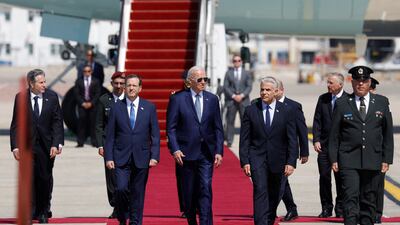
Caretaker Israeli Prime Minister Yair Lapid and President Isaac Herzog welcome US President Joe Biden to Israel as his trip begins. Reuters


Between 41 per cent and 49 per cent of western respondents thought countries in the region were "hostile or generally unfriendly" towards the West, while most thought it likely that there would always be conflict in the Middle East.
By contrast, 72 per cent of those polled in the Middle East expressed a favourable view of the US, with 67 per cent regarding Britain positively and 62 per cent saying the same about France.
The report said that despite continuing conflicts in Syria, Yemen and Palestine, there had been "significant progress towards ending war in the region, as Middle Eastern leaders have taken steps to build a co-operative and peaceful future".
"However, the prevailing view among western publics is that the Middle East is more often a source of problems than solutions," it said. "In spite of this, people in the Middle East and much of its leadership desire regional peace and partnerships with western nations."
The polling in the Middle East was carried out by Zogby Research Services, with 4,856 people interviewed face to face. There were 6,268 respondents to YouGov surveys in Europe and America.

