


Days before the anti-regime protests that sparked Syria’s civil war broke out in the country’s south in March 2011, President Bashar Al Assad drove to the region unannounced.
He visited several towns and villages in what state media described as a gesture of concern about living conditions, which had worsened as a result of soaring prices and bad harvests. But the president toured only Christian and Druze areas.
The demonstrations started in Deraa, the main city in the province of the same name and the region’s urban and farming centre, dominated by Syria’s Sunni majority.
Although the protests spread to parts of neighbouring Suweida, a mostly Druze province, the regime suppressed these in less violent and punitive ways than it had in Deraa.
But new protests in Suweida this week, and signs of discontent in the heartland of Mr Assad’s Alawite sect, indicate that his regime’s policy of co-opting minorities may have reached its limits in the face of a severe economic decline after more than a decade of conflict.
Plans for widespread reconstruction of war-damaged areas remain on paper, although the UN has poured billions of dollars into regime areas in recent years to restore schools, clinics, sanitation and even markets, as well as for technical training for government personnel.
Perks and concessions
Alone among Syria’s minority groups, the Druze of Suweida have a de facto waiver of mandatory military conscription. The regime has not punished young Druze men who failed to sign up, nor does it force boys of conscription age to do so.
It is a significant reprieve for the tiny community, which comprised about 3 per cent of Syria’s 20 million population in 2010, the last year reliable statistics were available.
But thousands of young Druze have joined militias the regime began to create in Suweida in 2012. The regime portrayed these forces as bulwark against Sunnis in Deraa – with whom there are historic and violent disputes over land – but they also serve as a counter to anti-regime Druze clans who have quietly armed themselves.
Other regime incentives for loyalty, such as pay rises, have become less valuable than before because of soaring inflation. And no one is spared the severe shortages of electricity and fuel.

Residents of the province said groups of mostly young people took to the streets for a fifth day on Thursday to complain about poverty and corruption, although their numbers dropped sharply with an increased presence of state security.
Local officials “sent messages reminding Suweida that we already don’t serve in the army and that we practically have self-administration”, said a resident who asked not to be identified.
“The society in Suweida is finely balanced and the regime knows how to play on this,” he said.
Similar demonstrations occurred in the region last year after another sharp drop in the value of the Syrian pound. Security forces arrested about 20 young people, most of whom were released.
Syria's food crisis deepens as bread prices double - in pictures
-
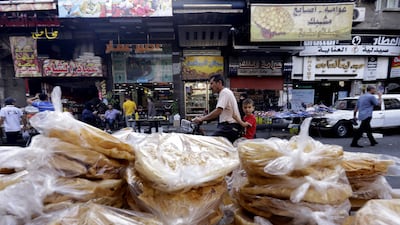
Piles of bread for sale in Midan, a district of Damascus renowned for its sweet delicacies. AFP -
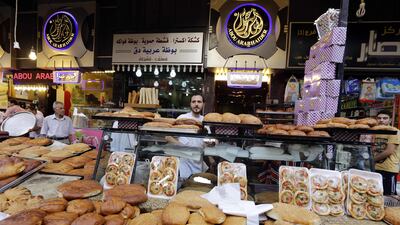
Steep bread and diesel price hikes came into effect in government-held parts of Syria on Sunday, bringing more economic pain to war-weary civilians. AFP -
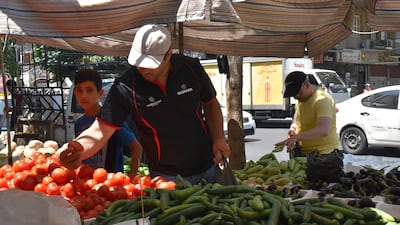
Syrians shop for vegetables at a market in Damascus on Sunday July 11, hours after Syrian President Bashar Al Assad issued a legislative decree granting civil servants and military members a 50 per cent pay rise. The decision comes a day after the government raised the price of fuel by more than 50 per cent for the third time this year. EPA -
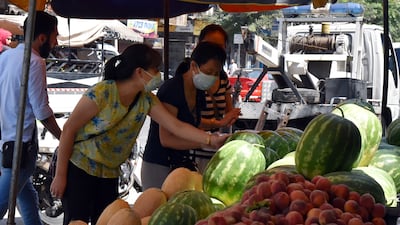
Syrians shop for vegetables at a market in Damascus on Sunday July 11, hours after Syrian President Bashar Al Assad issued a legislative decree granting civil servants and military members a 50 per cent pay rise. The decision comes a day after the government raised the price of fuel by more than 50 per cent for the third time this year. EPA -
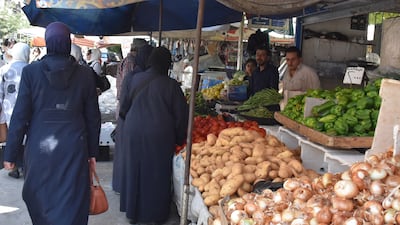
Syrians shop for vegetables at a market in Damascus on Sunday July 11, hours after Syrian President Bashar Al Assad issued a legislative decree granting civil servants and military members a 50 per cent pay rise. The decision comes a day after the government raised the price of fuel by more than 50 per cent for the third time this year. EPA -
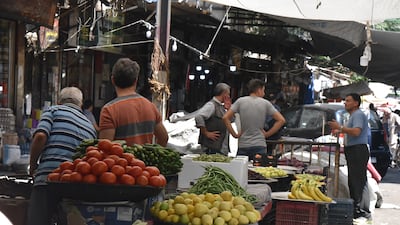
Syrians shop for vegetables at a market in Damascus on Sunday July 11, hours after Syrian President Bashar Al Assad issued a legislative decree granting civil servants and military members a 50 per cent pay rise. The decision comes a day after the government raised the price of fuel by more than 50 per cent for the third time this year. EPA -
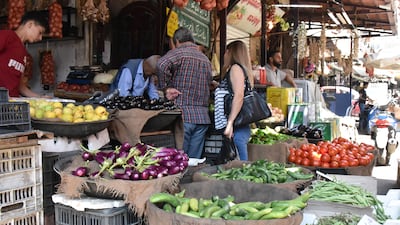
Syrians shop for vegetables at a market in Damascus on Sunday July 11, hours after Syrian President Bashar Al Assad issued a legislative decree granting civil servants and military members a 50 per cent pay rise. The decision comes a day after the government raised the price of fuel by more than 50 per cent for the third time this year. EPA -

Syrian President Bashar Al Assad waves at a polling station during the presidential elections in Douma, Syria, on May 26, 2021. President Assad issued a decree on Sunday, July 11, 2021, awarding a 50 per cent pay rise to hundreds of thousands of civil servants and military members. AP


Core loyalists
In a veiled reference to Suweida, Bouthaina Shaaban, an adviser to the president, wrote in the loyalist Al-Watan newspaper this week that street protests were intended to destabilise Syria and “had nothing to do with improving living conditions”.
In reference to Islamist militancy, she warned of a “fifth column” aiming to undermine the fight against “the mightiest terrorist forces in the world”.
Even before the civil war, the regime portrayed itself as a bulwark against Sunni extremist groups such as Al Qaeda. The rise of ISIS helped it drive home the message, particularly among Syria’s minority communities.
But the regime’s crushing of the armed Sunni opposition in the civil war, with help from Iran and Russia, has undermined its arguments because the supposed enemy has been all but wiped out, said Jihad Yazigi, the editor of Syria Report, an economic and business newsletter based in Beirut.
“The Sunnis are traumatised by the regime and know that the regime can do what it wants with them if they protest again,” he said.
He said the waning of the perceived Sunni threat had turned the focus to the economy, but Mr Assad “continues to show total lack of interest in reviving it”.
Street protests like those in Suweida would be politically significant only if they spread to Alawite regions, Mr Yazigi said.
“The regime still has the money to satisfy its core loyalist fighting units,” he said.
This core continues to be drawn from the Alawite heartland on the Mediterranean coast.
In the past few weeks there has been rare public defiance of Mr Assad among the Alawite community.
In the Ismaili and Alawite town of Masyaf, a mob ransacked a communications centre belonging to an internet company linked to the president’s wife. An Alawite journalist in the coastal province of Tartus, Kenan Wakkaf, mocked Mr Assad on Facebook for ignoring mass discontent over the economy, and has since gone into hiding.
Fragility under the surface
When Mr Assad drove to the south in 2011, with his wife, Asma, in the passenger seat, the Syrian pound was trading at 50 to the dollar.
Syria’s per capita income was $2,500, on par with Egypt. The state made several billion dollars a year from selling oil and there was some foreign investment, mostly in property.
The Syrian pound now trades at about 3,500 to the dollar and most of the country’s oilfields are with Kurdish militia. The latest World Bank data shows per capita income at $1,334 in 2019.
A senior European diplomat said Mr Assad may be ignoring the economy because “hard power repression is still stronger than the popular resentment, grievances, frustrations and protest”.
“He is leaving leeway on Suweida because it is a minority community. But the economy is getting so much worse,” the diplomat said.
“It is a very fragile peace. We cannot exclude that at some point it might implode.”

