A handout picture released by Iraq's Prime Minister's Media Office on January 9, 2022 shows Iraqi lawmakers attending the inaugural session of the parliament in Baghdad, three months after legislative elections. AFP
A handout picture released by Iraq's Prime Minister's Media Office on January 9, 2022 shows Iraqi lawmakers attending the inaugural session of the parliament in Baghdad, three months after legislative

Iraq parliament session to elect president boycotted by parties


  • English
  • Arabic

Iraq's parliamentary session to elect a new president on Monday fell into disarray following a boycott by major political parties.

By late afternoon, quorum had not been reached to hold the vote with less than 60 MPs out of 329 in attendance.

The meeting in the Council of Representatives was then turned into a deliberative session where MPs discussed several issues such as agriculture and forming parliamentary committees.

The position of president will likely remain vacant until quorum can be made — something that appears unlikely to occur soon amid political deadlock.

The Kurdish Democratic Party, the Sadrist Bloc and their rivals — parts of the Shiite majority Co-ordination Framework — said they would boycott the session because of competing demands on presidential candidates.

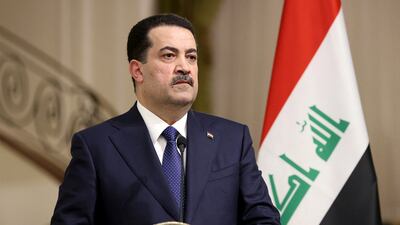
  • Iraq's Prime Minister Mohamed Shia al-Sudani. AFP
    Iraq's Prime Minister Mohamed Shia al-Sudani. AFP
  • Hadi al-Amiri leader of the Badr Organisation attends an election rally, along with his Fatih bloc supporters, ahead of the parliamentary election in Baghdad, Iraq October 5, 2021. REUTERS/Ahmed Saad
    Hadi al-Amiri leader of the Badr Organisation attends an election rally, along with his Fatih bloc supporters, ahead of the parliamentary election in Baghdad, Iraq October 5, 2021. REUTERS/Ahmed Saad
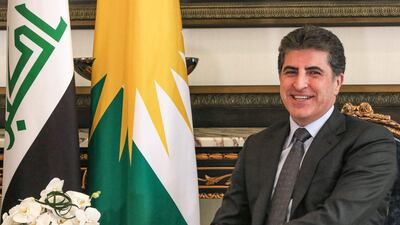
  • Nechirvan Barzani, President of Iraq's autonomous Kurdistan Region, meets with the Iraqi prime minister in Erbil, the capital of the northern Iraqi Kurdish autonomous region, on March 14, 2022. AFP
    Nechirvan Barzani, President of Iraq's autonomous Kurdistan Region, meets with the Iraqi prime minister in Erbil, the capital of the northern Iraqi Kurdish autonomous region, on March 14, 2022. AFP
  • Shiite Muslim cleric Moqtada Sadr gives a speech in Iraq's central holy shrine city of Najaf. AFP
    Shiite Muslim cleric Moqtada Sadr gives a speech in Iraq's central holy shrine city of Najaf. AFP
  • A member of the Iraqi Sadrist bloc (of Shiite leader Moqtada Sadr) announces the party's electoral programme for the upcoming elections, in the central city of Najaf, on September 30, 2021. - Iraq will hold parliamentary elections on October 10, a year early to appease an anti-government protest movement, at a time of simmering anger over graft and economic crisis. (Photo by Ali NAJAFI / AFP)
    A member of the Iraqi Sadrist bloc (of Shiite leader Moqtada Sadr) announces the party's electoral programme for the upcoming elections, in the central city of Najaf, on September 30, 2021. - Iraq will hold parliamentary elections on October 10, a year early to appease an anti-government protest movement, at a time of simmering anger over graft and economic crisis. (Photo by Ali NAJAFI / AFP)
  • Ammar al-Hakim, Leader of the Hikma movement and accompanied by his children, shows his inked finger at a polling station in Baghdad, as Iraqis go to the polls to vote in the parliamentary election, in Iraq, October 10, 2021. REUTERS/Thaier al-Sudani
    Ammar al-Hakim, Leader of the Hikma movement and accompanied by his children, shows his inked finger at a polling station in Baghdad, as Iraqis go to the polls to vote in the parliamentary election, in Iraq, October 10, 2021. REUTERS/Thaier al-Sudani
  • Former Iraqi Prime Minister Nouri al-Maliki shows his inked finger at a polling station in Baghdad, as Iraqis go to the poll to vote in the parliamentary election, in Iraq, October 10, 2021. REUTERS/Thaier al-Sudani
    Former Iraqi Prime Minister Nouri al-Maliki shows his inked finger at a polling station in Baghdad, as Iraqis go to the poll to vote in the parliamentary election, in Iraq, October 10, 2021. REUTERS/Thaier al-Sudani

Sunni parties Taqadum and the Azm Coalition also said they would boycott the vote.

Iraq's constitution requires that at least two thirds of MPs are in Parliament to pass legislation and elect members to high office.

An independent lawmaker said the fate of the vote on the President is unknown, chastising the parliament’s major blocs for not showing up.

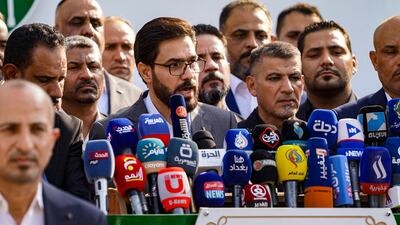
“We are keen to adhere to the time-frames set by the constitution,” Mohammed Enooz told a press conference at the Parliament.

“But unfortunately there are political traditions and norms controlled by the big blocs as in previous parliament terms,” he added.

The assembly vote had been set for noon for the head of state — a post with a four-year mandate held by convention by a member of Iraq's Kurdish minority, and currently occupied by Barham Saleh.

The process toward a presidential vote had been further thrown into disarray when Iraq's Supreme Court on Sunday suspended the candidacy of Mr Saleh's key challenger, Hoshyar Zebari, 68.

The court cited corruption charges against Mr Zebari, a former foreign minister from the KDP — allegations he denies.

"I have not been convicted in any court," Mr Zebari had said in a television interview on Friday as the charges resurfaced alongside forecasts he would unseat Mr Saleh.

Incumbent Saleh, the other frontrunner out of some 25 candidates, represents the KDP's main rival in Iraqi Kurdistan, the Patriotic Union of Kurdistan (PUK).

The Supreme Court said it was suspending Mr Zebari after receiving a complaint from lawmakers that his candidacy was "unconstitutional" because of the graft claims.

The complainants cited his 2016 dismissal from the post of finance minister by parliament "over charges linked to financial and administrative corruption".

The complaint also cited at least two other judicial cases linked to him, including when he was Iraq's long-time foreign minister after the fall of dictator Saddam Hussein in the 2003 US-led invasion.

Therefore, Mr Enooz said, the “session will be open until a decision is made on the case filed against the nomination of Mr Zebari at the court”.

Drawn-out government formation

The mass boycott represents another setback for political momentum in Iraq following the contested outcome of an election in October.

Government positions, including the cabinet, cannot be formed without the president's nomination of the largest bloc in parliament.

That must occur within 15 days of the new president being elected. The largest post-election bloc can then choose the prime minister, who must form the next government within 30 days.

Legal expert Ali Al Tamimi told The National that the Supreme Federal Court decision to temporarily suspend the nomination of Mr Zebari has already pushed back the deadlines.

"Since there is an ongoing case against the nomination of Hoshyar Zebari and a decision to temporarily suspend his nomination that means today's session has been suspended too," Mr Al Tamimi said.

Current President Barham Salih will continue in his post, Mr Al Tamimi added.

In Iraq's fractured political landscape, any delay in this chain of events can drag out the process for months. Negotiations, including which party will be granted control of key ministries often go on behind closed doors during the duration of government formation.

Iraq at one point held the world record for government formation following elections in 2010, which failed to produce a government for 289 days.

That record was beaten by Belgium which saw negotiations drag on for 549 days between 2010 and 2011, after 11 parties were elected to the Chamber of Representatives.

In Iraq, the passing of the budget will now face even more economically damaging delays and political tensions are set to worsen.


Martin Sabbagh profile

Job: CEO JCDecaux Middle East

In the role: Since January 2015

Lives: In the UAE

Background: M&A, investment banking

Studied: Corporate finance

ENGLAND%20SQUAD
%3Cp%3E%3Cstrong%3EGoalkeepers%3C%2Fstrong%3E%20Pickford%20(Everton)%2C%20Pope%20(Newcastle)%2C%20Ramsdale%20(Arsenal)%3C%2Fp%3E%0A%3Cp%3E%3Cstrong%3EDefenders%3C%2Fstrong%3E%20Chilwell%20(Chelsea)%2C%20Dier%20(Tottenham)%2C%20Guehi%20(Crystal%20Palace)%2C%20James%20(Chelsea)%2C%20Maguire%20(Man%20United)%2C%20Shaw%20(Man%20United)%2C%20Stones%20(Man%20City)%2C%20Trippier%20(Newcastle)%2C%20Walker%20(Man%20City)%3Cbr%3E%3Cbr%3E%3Cstrong%3EMidfielders%20%3C%2Fstrong%3EBellingham%20(Dortmund)%2C%20Gallagher%20(Chelsea)%2C%20Henderson%20(Liverpool)%2C%20Maddison%20(Leicester)%2C%20Mount%20(Chelsea)%2C%20Phillips%20(Man%20City)%2C%20Declan%20Rice%20(West%20Ham)%3Cbr%3E%3Cbr%3E%3Cstrong%3EForwards%20%3C%2Fstrong%3EFoden%20(Man%20City)%2C%20Grealish%20(Man%20City)%2C%20Kane%20(Tottenham)%2C%20Rashford%20(Man%20United)%2C%20Saka%20(Arsenal)%2C%20Toney%20(Brentford)%3C%2Fp%3E%0A
Ferrari 12Cilindri specs

Engine: naturally aspirated 6.5-liter V12

Power: 819hp

Torque: 678Nm at 7,250rpm

Price: From Dh1,700,000

Available: Now

Common%20symptoms%20of%20MS
%3Cul%3E%0A%3Cli%3EFatigue%3C%2Fli%3E%0A%3Cli%3Enumbness%20and%20tingling%3C%2Fli%3E%0A%3Cli%3ELoss%20of%20balance%20and%20dizziness%3C%2Fli%3E%0A%3Cli%3EStiffness%20or%20spasms%3C%2Fli%3E%0A%3Cli%3ETremor%3C%2Fli%3E%0A%3Cli%3EPain%3C%2Fli%3E%0A%3Cli%3EBladder%20problems%3C%2Fli%3E%0A%3Cli%3EBowel%20trouble%3C%2Fli%3E%0A%3Cli%3EVision%20problems%3C%2Fli%3E%0A%3Cli%3EProblems%20with%20memory%20and%20thinking%3C%2Fli%3E%0A%3C%2Ful%3E%0A
Ten tax points to be aware of in 2026

1. Domestic VAT refund amendments: request your refund within five years

If a business does not apply for the refund on time, they lose their credit.

2. E-invoicing in the UAE

Businesses should continue preparing for the implementation of e-invoicing in the UAE, with 2026 a preparation and transition period ahead of phased mandatory adoption. 

3. More tax audits

Tax authorities are increasingly using data already available across multiple filings to identify audit risks. 

4. More beneficial VAT and excise tax penalty regime

Tax disputes are expected to become more frequent and more structured, with clearer administrative objection and appeal processes. The UAE has adopted a new penalty regime for VAT and excise disputes, which now mirrors the penalty regime for corporate tax.

5. Greater emphasis on statutory audit

There is a greater need for the accuracy of financial statements. The International Financial Reporting Standards standards need to be strictly adhered to and, as a result, the quality of the audits will need to increase.

6. Further transfer pricing enforcement

Transfer pricing enforcement, which refers to the practice of establishing prices for internal transactions between related entities, is expected to broaden in scope. The UAE will shortly open the possibility to negotiate advance pricing agreements, or essentially rulings for transfer pricing purposes. 

7. Limited time periods for audits

Recent amendments also introduce a default five-year limitation period for tax audits and assessments, subject to specific statutory exceptions. While the standard audit and assessment period is five years, this may be extended to up to 15 years in cases involving fraud or tax evasion. 

8. Pillar 2 implementation 

Many multinational groups will begin to feel the practical effect of the Domestic Minimum Top-Up Tax (DMTT), the UAE's implementation of the OECD’s global minimum tax under Pillar 2. While the rules apply for financial years starting on or after January 1, 2025, it is 2026 that marks the transition to an operational phase.

9. Reduced compliance obligations for imported goods and services

Businesses that apply the reverse-charge mechanism for VAT purposes in the UAE may benefit from reduced compliance obligations. 

10. Substance and CbC reporting focus

Tax authorities are expected to continue strengthening the enforcement of economic substance and Country-by-Country (CbC) reporting frameworks. In the UAE, these regimes are increasingly being used as risk-assessment tools, providing tax authorities with a comprehensive view of multinational groups’ global footprints and enabling them to assess whether profits are aligned with real economic activity. 

Contributed by Thomas Vanhee and Hend Rashwan, Aurifer

The%20Hunger%20Games%3A%20The%20Ballad%20of%20Songbirds%20%26%20Snakes
%3Cp%3E%3Cstrong%3EDirector%3A%3C%2Fstrong%3E%C2%A0Francis%20Lawrence%3C%2Fp%3E%0A%3Cp%3E%3Cstrong%3EStars%3A%C2%A0%3C%2Fstrong%3ERachel%20Zegler%2C%20Peter%20Dinklage%2C%20Viola%20Davis%2C%20Tom%20Blyth%3C%2Fp%3E%0A%3Cp%3E%3Cstrong%3ERating%3A%20%3C%2Fstrong%3E3%2F5%3C%2Fp%3E%0A
What went into the film

25 visual effects (VFX) studios

2,150 VFX shots in a film with 2,500 shots

1,000 VFX artists

3,000 technicians

10 Concept artists, 25 3D designers

New sound technology, named 4D SRL


Results

5pm: Al Maha Stables – Maiden (PA) Dh80,000 (Turf) 1,600m; Winner: Reem Baynounah, Fernando Jara (jockey), Mohamed Daggash (trainer)

5.30pm: Wathba Stallions Cup – Maiden (PA) Dh70,000 (T) 1,600m; Winner: AF Afham, Tadhg O’Shea, Ernst Oertel

6pm: Emirates Fillies Classic – Prestige (PA) Dh100,000 (T) 1,600m; Winner: Ghallieah, Sebastien Martino, Jean-Claude Pecout

6.30pm: Emirates Colts Classic – Prestige (PA) Dh100,000 (T) 1,600m; Winner: Yas Xmnsor, Saif Al Balushi, Khalifa Al Neyadi

7pm: The President’s Cup – Group 1 (PA) Dh2,500,000 (T) 2,200m; Winner: Somoud, Adrie de Vries, Jean de Roualle

7.30pm: The President’s Cup – Listed (TB) Dh380,000 (T) 1,400m; Winner: Haqeeqy, Dane O’Neill, John Hyde.

HOW TO WATCH

Facebook: TheNationalNews  

Twitter: @thenationalnews  

Instagram: @thenationalnews.com  

TikTok: @thenationalnews 

Real estate tokenisation project

Dubai launched the pilot phase of its real estate tokenisation project last month.

The initiative focuses on converting real estate assets into digital tokens recorded on blockchain technology and helps in streamlining the process of buying, selling and investing, the Dubai Land Department said.

Dubai’s real estate tokenisation market is projected to reach Dh60 billion ($16.33 billion) by 2033, representing 7 per cent of the emirate’s total property transactions, according to the DLD.

Updated: February 07, 2022, 2:44 PM