


Planned UN talks to end Sudan’s political crisis are unlikely to succeed, with rival groups increasingly at loggerheads and the country's economy in free fall, analysts say.
Pro-democracy groups that toppled Omar Al Bashir’s regime in 2019, who are now spearheading opposition to military rule, have been vehemently rejecting any dealings with the generals.
But analysts say a proposed UN-sponsored dialogue may be the only available route to break the deadlock, and end bloodshed.
Such an effort likely depends on whether army chief and coup leader Gen Abdel Fattah Al Burhan and his second-in-command Gen Mohamed Hamdan Dagalo step down.
-
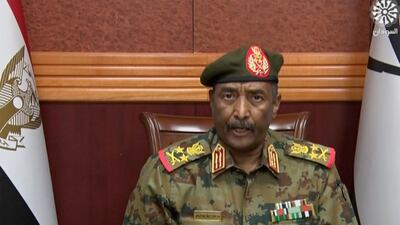
Sudan's Gen Abdel Fattah Al Burhan announced in a televised address that he was dissolving the country's ruling Sovereign Council and the government led by Prime Minister Abdalla Hamdok. Gen Al Burhan said the military would run the country until elections in 2023. Photo: Sudan TV / AP -
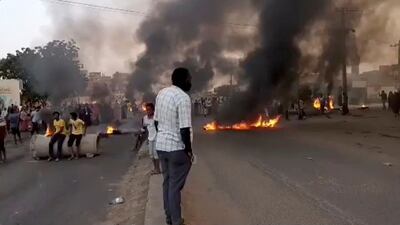
People gather on the streets of Khartoum as smoke rises after reports of a coup on Monday. Photo: Rasd Sudan Network / Reuters -

People gather on the streets of Khartoum as smoke rises after reports of a coup on October 25, 2021. Rasd Sudan Network via Reuters -
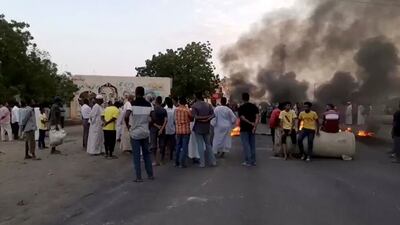
The scene on Khartoum's streets. Photo: Rasd Sudan Network / Reuters -

Sudanese Prime Minister Abdalla Hamdok has been arrested by the military and taken to an undisclosed location, the Information Ministry reported. AFP -
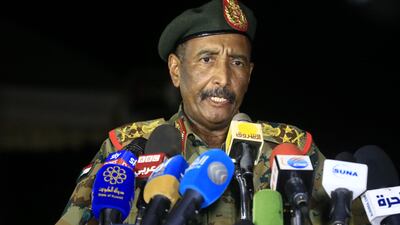
Political parties and pro-civilian rule groups have accused army general and head of the sovereign council Gen Abdel Fattah Al Burhan of ordering the military takeover. AFP -
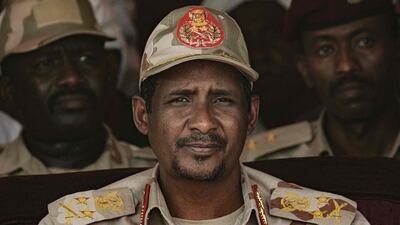
Mohamed Hamdan Dagalo, known as Himediti, is the deputy head of Sudan's ruling Transitional Military Council (TMC) and commander of the Rapid Support Forces (RSF) paramilitaries, making him one of the country’s most powerful generals. AFP -
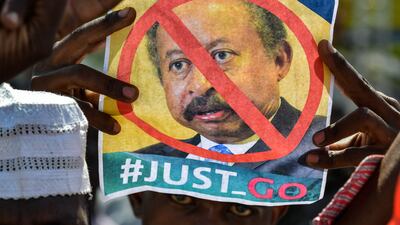
The military’s move comes after protests in favour of the military and against Mr Hamdok as well as those backing civilian rule. AFP -
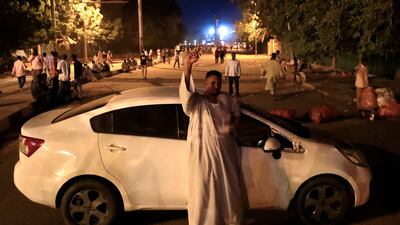
A protester blocks a street with his car during a demonstration to demand the dissolution of Sudan's transitional government. AFP -
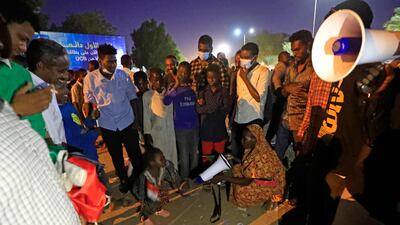
There have been numerous protests in recent days, including outside the presidential palace in Sudan's capital, Khartoum. AFP -
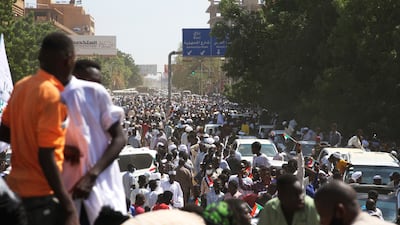
Protesters camping outside the presidential palace demand the dismissal of the government of Prime Minister Abdalla Hamdok. AP -
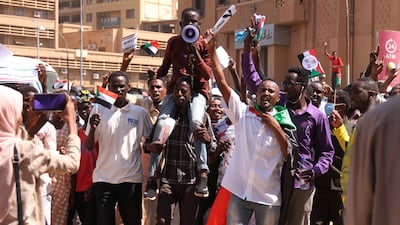
Protesters chant 'one army, one people' and 'the army will bring us bread' slogans during their demonstration outside the presidential palace in Khartoum. AP -

Pro-military protesters hold a rally demanding the dissolution of Sudan’s government, outside the presidential palace. AP -
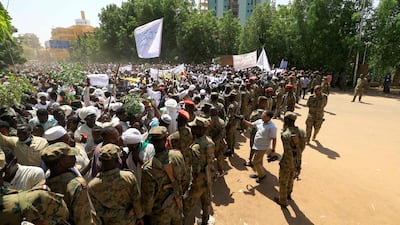
Mr Hamdok has issued a warning that the transition is facing its 'worst and most dangerous' crisis. AFP -
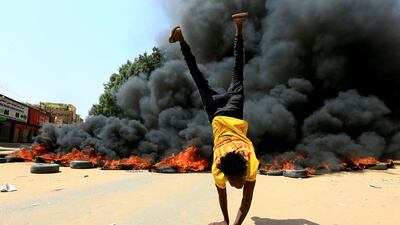
A person does a handstand in front of a burning pile of tyres during a pro-civilian rule protest against any military takeover in Khartoum on October 21. Reuters -
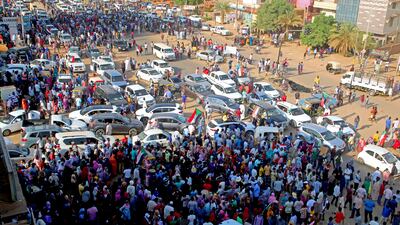
Thousands rallied to back Mr Hamdok’s government after protests by pro-military supporters. EPA -
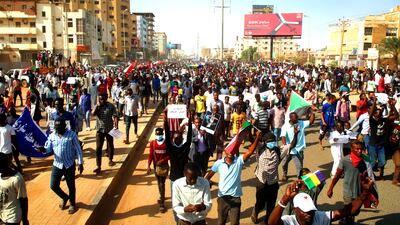
Thousands of people marched during a demonstration called by the Alliance of Forces for Freedom and Change, the Central Council Group to support the government of Abdullah Hamdok, while the army and police forces closed the roads leading to government headquarters and main markets. EPA -
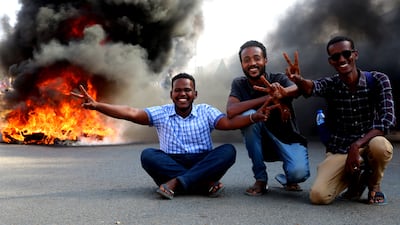
People attend demonstrations in support of the civilian government on October 21. EPA -
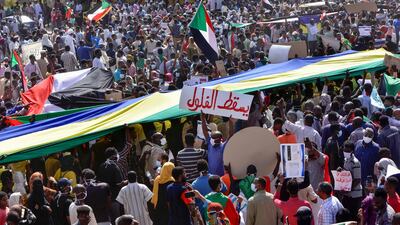
Sudanese demonstrators take part in a protest in the city of Khartoum Bahri, the northern twin city of the capital, to demand the government's transition to civilian rule. AFP


Two of the three major pro-democracy groups — the Sudanese Professional Association and the Resistance Committees — have rejected the UN proposals outright. The third one, the Forces for Freedom and Change, said on Sunday it was ready to engage with the process but insisted that the total withdrawal of the military from politics must be part of any deal.
Rutgers University
Gen Al Burhan’s October 25 coup has caused mass street protests in which at least 64 people were killed and about 2,100 injured. He sought to placate the protesters when he reinstated the civilian prime minister, Abdalla Hamdok, a month after he dismissed him in October. Mr Hamdok resigned on January 2, deepening the crisis and leaving the military alone in control.
The military, meanwhile, is entrenching power and showing no sign that its leaders intend to step down or cede some control to civilians.
It has, however, agreed to co-operate with the UN initiative, which requires consulting all stakeholders before the start of round-table negotiations.
Economic disaster looms
The crisis is playing out against a rapidly darkening picture in Sudan. Economic problems have been worsening and the value of the local currency fell by more than 3 per cent on Sunday on the black market. Vast parts of he western Darfur region are falling into lawlessness, while discontent is simmering in the north and east of the country.
“They [protesters] are taken advantage of by parties unknown to them to work against the country, democracy and the stability of the transitional period,” military spokesman Brig Gen Al Taher Abu Hagah said on Thursday. “Their objective is to fuel sedition and falsely portray the armed forces and the security agencies as the enemies of the people.”
Brig Gen Abu Hagah's words point to more deadlock. The protest movement's insistence that the military must leave politics altogether is resonating with millions of Sudanese who have taken to the streets during about 15 major street rallies to protest against the coup.

Rather than participating in a UN process, protest leaders believe the army chief and his associates should instead be tried over the deaths of protesters since the coup, including at least 100 killed in June 2019 when security forces broke up a sit-in protest outside the army headquarters in Khartoum.
“The streets are boiling and people can no longer trust the military,” said Sulaima Ishaq, a prominent pro-democracy activist and a veteran of the uprising that toppled Al Bashir’s regime.
“I am torn between the zero-sum position of the revolutionary groups and the need to make concessions to the military so we can proceed to elections next year."
“But we did make concessions in the past to the military and look what happened!” she said, alluding to the 2019 power-sharing deal between the military and the pro-democracy movement that Gen Al Burhan rescinded on October 25, just weeks before he was due to hand over the head of state position to a civilian.

Going forward, available evidence doesn’t bode well for the UN initiative.
With the UN-sponsored consultations in progress, the pro-democracy movement has announced plans for four nationwide rallies before the end of January. Similar protests have paralysed the country, deepened its economic woes but also kept the country’s predicament alive on the international stage.
“I don’t think the UN has a chance in Sudan,” said Alex DeWaal, a prominent Sudan expert from Rutgers University in the US. “What has yielded results in the last two-plus years has been Sudanese initiatives backed by the US, UK and the Gulf states,” he said.
US hints at backing protesters
The US is sending Assistant Secretary of State Molly Phee and new special envoy for the Horn of Africa David Satterfield to Sudan this week as part of a tour that would also take them to Saudi Arabia and Ethiopia.
While in Sudan, the pair will meet all stakeholders.
“Their message will be clear: The United States is committed to freedom, peace and justice for the Sudanese people," said the US State Department.
The US placed pro-democracy activists at the top of the list of stakeholders that the two officials would meet, with the military and political leaders the last two.
The phrase “freedom, peace and justice” used in the statement was also the rallying cry of the anti-Al Bashir uprising and has been resurrected by protesters now.
Whether this apparent US sentiment can push the military towards concessions remains to be seen.
“Al Burhan and Hemedti [the more commonly used name for Gen Dagalo] should not even be in the picture as the search for a solution is under way,” said Sudanese analyst Ahmed Hassanein. “Without them, there’s a chance the UN initiative can succeed.”
While Gen Al Burhan is known to have been close to Al Bashir and is sympathetic with the Islamist supporters of the ousted dictator, Gen Dagalo leads a paramilitary force suspected of committing atrocities against civilians during a revolt in Darfur in the 2000s. His men are also accused by activists of killing protesters in June 2019.
Another analyst, Jihaan Al Naeem, finds the UN approach to be something of a mixed bag.
“It’s positive in the sense that it’s leaving to the Sudanese stakeholders the freedom to negotiate and eventually agree on a solution. But it’s also negative in that it did not offer anything clear or specific for the parties to take to the negotiating table."
“Failure could only mean two things; Sudan sliding into civil war, or a full-fledged coup,” said Ms Al Naeem, a political science lecturer at Khartoum’s Al Zayeem Al Azhari University.

