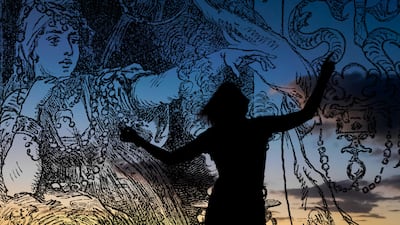

In the fourth instalment of Sara Al Sayegh's The Thousand and First Night, news of Sinbad’s return is interrupted by the arrival of a mysterious woman. As Scheherazade tends to her unexpected patient, a story emerges that threatens to unsettle everything she knows about her own family. Read chapter 3 here
The Wasting Lady-in-Waiting
The sisters arrive home and settle into their sunset rituals. Scheherazade tends the pots on her stove like a woman waking small children from sleep – blowing gently on one fire, coaxing another back to life, stirring the first pot softly, the second with more vigour. Their aromas bloom and fill the air.
Dunyazade sits at the counter, a chopping board heaped with dandelion roots to separate and grind. She has barely begun before it bursts out of her. "So what did the Lady Ghaf say about Sinbad?"
Scheherazade hums into her pots. "What did she not say would be the quicker question."
Dunya groans. "You promised! At sunset!"
"I said at sunset. With the milk. The milk is not ready."
Dunya moans again. "Please. I'll finish my work while you tell it ..."
Scheherazade sighs. "Fine. Fine." She taps the spoon against the rim of the pot. "She said he is back. And in trouble. As he always is."
Dunya is giddy. "Back from where? Where did he go? What did he find? Who is he in trouble with?" Not a single root gets chopped. Scheherazade gives the board a pointed look, and Dunya, chastened, bends to her work – still beseeching her sister with her eyes to go on.
"He is in trouble with everyone. As he always is. Starting with the men who lent him the gold for his voyage – the one where he swore he would return with triple the treasure. And, as always, he has come back with barely the clothes on his back, and a woman ..."
A flurry of anxious knocks at the door.
Scheherazade is across the room before the knocking stops. She opens the door to find Mrs. Fatima half-buckling under the weight of a woman she can barely hold upright. Purple and yellow bruises spread across the stranger's skin like rot blooming through fruit. A red rash climbs steadily up her neck.
Scheherazade pulls them both inside, and together they lay the woman on the sofa. She is delirious, her eyes rolling loose in her head. But when they settle on Scheherazade, she goes very still, and whispers – "Mariyah?"
Scheherazade's hands do not pause in their work, though something behind her ribs does. Fever-talk, she tells herself. The sick reach for the dead all the time.
"Dunya. Bed."
For once her sister knows better than to argue. She slips from her stool and vanishes behind the curtain – though Scheherazade does not doubt for a moment that she is listening.
Mrs. Fatima, still breathless, begins. "She came with ..."
"With Sinbad. I know."
Scheherazade sets a pot to boil and throws in watercress and mallow by the fistful, until the water turns dark and green and slick. She soaks strips of clean cloth and lays them over the worst of it – the spreading bruises, the climbing rash, the cracked and bleeding gums. The stranger sighs as the heat draws the fire out of her skin.
"This will calm what you can see," Scheherazade murmurs, more to herself than to anyone. "But it is not what ails you."
She turns to Mrs. Fatima, who hovers by the door, wringing her hands. "You did right to bring her. But there is nothing more for you here tonight, and your own house is waiting. Go. I will send word in the morning."
Mrs. Fatima hesitates, then presses a coin into Scheherazade's palm – they both know it is not enough, and they both know Scheherazade will never say so – and she goes.
The house settles into the deep quiet of a night turned late. Scheherazade works by lamplight. She knows this sickness – though she has only ever watched it from a distance, in the grey mouths and mottled skin of men hauled off the ships and carried past her door to some other healer's hands. She treats women; that is her rule, and she keeps it. She has never once laid hands on this rot herself. She lays them on it now.
She crushes loomi – dried limes, black and hard as stones – and steeps them with rosehip and a fistful of parsley from her windowsill, until the whole kitchen smells sharp and sour and alive. She lifts the woman's head and presses the cup to her lips.
"Drink. All of it, though it bites."
The woman drinks, and grimaces, and drinks again.
"The sea starves men of the one thing the land gives away for nothing," Scheherazade says softly. "Green things. Fruit. A handful of herbs any child could pull from a wall. Men cross the whole world for treasure – and die for the want of a lime."
She tends her through the small hours. Fresh cloths. More of the sour syrup. Water when she can take it. And slowly, slowly, the delirium loosens its grip.
When the woman's eyes open again, they are clearer. They find Scheherazade's face and stay there – and this time there is no fever in the looking. Only a kind of wonder, and something close to grief.
"Forgive me," she rasps. "When I first saw you, I thought – but no. You are far too young." She searches Scheherazade's face as though reading an old letter. "Still. You have her face."
Scheherazade's hands go quiet. "Whose face?"
"A woman I served with, long ago – when I was young, and new to the palace, and frightened of everything in it." A weak smile. "Mariyah. The healer. She had hands like yours. That same way of moving, as though the sick were her own blood."
Scheherazade does not say that was my mother. She does not entirely know why she doesn't. Perhaps because this is a Mariyah she never met – a young one, palace-new, frightening no one – and for a moment she wants only to hear her mother spoken of as someone had known her, before she was anyone's mother at all.
"Tell me about her," she says instead. Quietly. "If it will not tire you."
And Zumurrud – for that is the name she gives, when Scheherazade asks – tells her.
She tells of a young healer who came to the palace and was gentle with a frightened girl when no one else troubled to be. Of how she and the Queen grew close – closer than a lady and her servant had any business growing. Of a strange, blessed season when the two women were with child at the very same time, their bellies rounding together, and how the whole palace held its breath.
"And then," Zumurrud says, and her voice dips low, "Mariyah lost hers. Poor lamb. Carried it nearly to the end, and then it was simply gone." She shakes her head at the old grief. "The Queen was delivered of a daughter that same season. The little princess. Budoor." A pause. "Mariyah raised her almost as her own, after. As though loving that child could fill the place the other one left behind."
Something moves through Scheherazade that she cannot name – the word Budoor brushing against some nerve she did not know she had. A garden. A woman who would not take her hand. It is gone before she can close her fingers on it.
What stays is smaller, and far heavier. My mother lost a child. A brother, or a sister – before Scheherazade was ever born, carried almost to term and then gone. And in all their years, in all their thousand evenings over the milk, Mariyah never once spoke of it.
She thinks she should ask more. When. How. What she did after ... whether she wept, whether Amin knew to hold her ...
But she looks at Zumurrud, spent and grey against the cushions, her eyes already sinking closed, and Scheherazade – who spends her whole life drawing other people's stories out of them, who defers and defers and always, always finishes the tale – finds that, for once, she does not want the rest of it. Not tonight.
She draws the blanket up over the sleeping woman. She banks the fires. And she crosses to the curtain to look in on Dunyazade – fast asleep at last, one hand flung open across the pillow. The same long bones. The same curve to the knuckles their mother gave to them both.
There was another, she thinks. Before us. And she never told us.
She does not go to bed. She sits down at the table where she tells her stories, in the dark, and she keeps this one – the way she keeps all the others. It does not sit the same.


FOLLOW TN MAGAZINE