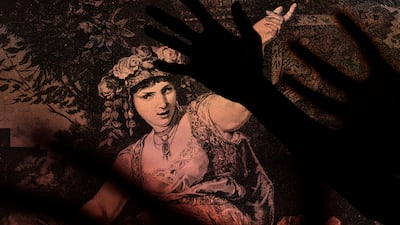

The Thousand and First Night continues with The Sweetness Sickness, as Scheherazade returns to the palace where her family’s past still haunts her. But when she discovers that Princess Budoor may be in danger from someone close to her, the healer finds that telling the truth can be as dangerous as keeping secrets.
The Sweetness Sickness
Princess Budoor is five months gone and dying on her feet, in a garden that Scheherazade’s father planted before this palace took him. The princess laughs without humour. “Where doesn’t it hurt? That might be the better question.”
Scheherazade can see as much. She begins her examination – all business, willing her hands not to betray her nerves. The princess is gaunt everywhere but her belly. Dark hollows sit beneath her eyes, and even here, in the cool shade of Amin’s trees, perspiration beads at her temples and gathers along her neck.
“How is your appetite?”
The princess scoffs. “Ravenous. And I cannot keep a thing down. Except sweets, apparently.”
Scheherazade gives a low hum. The princess bristles, trying to take the measure of this woman who hums where others would bow.
Scheherazade takes her wrist and counts. The pulse gallops beneath her fingers – too fast; she knows it before the count is done. To cover her frown, she says: “You are five months and 22 days along.”
The princess gasps. “Yes. How could you possibly ...”
“I just do.”
The words leave Scheherazade before she can weigh them. She does not know how she knows. The number simply arrived, whole and certain, the way the end of a story sometimes arrives before you have reached it.
Something cool slides down her spine, and she keeps her eyes off the shadow she can feel lying wrong across the grass.
She draws a small dark bottle from her satchel. “Drink this. A spoonful now. It will steady the blood before you faint into your roses.”
The princess pulls back. “I drink nothing my taster has not tried first.”
“Suit yourself.”
Scheherazade rests the bottle on her knee. “But you carry a sickness of the blood – the sweetness sickness. It comes to some women only while they are with child. Just now your body has dropped too low; that is the sweat, the racing heart, the shaking you hide in your sleeves. It will climb too high next, then crash again, each swing worse than the last, until it takes you, or the child, or both.”
The princess’s mouth opens to protest – but Scheherazade is no longer being careful, because she has understood the sweets. She sets the bottle down in the grass and, for the first time, looks at the princess wholly.
“Someone is feeding you the one thing that is killing you, and dressing it as care.”
She knows the shape of it far too well. She has watched a palace kill this way before – a death got up as an accident, a gift that was really a grave. Roses, once. Sugar, now. The same cold hand, only more patient.
The princess has gone very still. When she speaks, her voice is low and final. “Take your bottle and leave me.”
Scheherazade sees, then, that she has lost her. And she sees the darkness pooling at her own feet, where no shadow should fall. “Jinni,” she says quietly. “Take me home. The princess has no use for my treatment.”
The jinni unfolds into the air between them like a held breath let go. “Ladies ...”
The princess turns her whole body away, one hand curving over her belly as though to shield the child from the words themselves. “You heard her. Take her home.”
“But princess.”
The jinni spreads his hands. “Aladdin trusts her. Every woman in the town trusts her ...”
“She has yet to earn mine.”
And then – so quickly that Scheherazade nearly misses it – the princess’s eyes flick back. Just once. Towards the very healer she is casting out. Something in the look does not match the voice at all; something in it reaches, even as the rest of her refuses. Then it is gone, folded away.
“Take her home,” the princess says again. Softer, this time.
In the blink of an eye, he does.
Scheherazade stands in her own kitchen as though she never left it, the jinni settling into the exact spot where they first met – a morning that already feels like another woman’s life.
“You might have spoken for me better,” she tells him.
“I might have,” he allows. “But you were right. And being right, healer, is rarely welcome behind palace walls.”
He tilts his head. “Still. She looked back.”
“She did not.”
“She did.” And with that small cruelty, or kindness, he thins into nothing.
Scheherazade does not have time to sit with any of it. There is a sister to collect, a supper to coax from a near-empty larder, and no wish whatsoever to explain a floating man to the neighbours.
By afternoon the whole palace might be a fever-dream, if her hands did not still carry the green smell of Budoor’s garden. She goes to fetch Dunyazade from school – and it is there, beneath the wide grey arms of the old ghaf tree at the school gate, that her sister discovers her mid-conversation.
Dunyazade flushes hot red. She darts forward and yanks Scheherazade’s hand down from the bark. “Please. Please stop talking to trees outside my school.”
Scheherazade shrugs. “She spoke to me first. And she had a great many complaints. It would have been rude not to listen.”
Dunyazade groans from somewhere deep in her soul and storms off ahead.
Scheherazade sighs and hurries after, reaching for her hand – but Dunyazade snatches it away, furious.
“Do you know what they call you at school? A witch. A tree-whisperer.”
“Well.” Scheherazade considers this. “I am one of those two things.”
They walk on. “But anyone can speak to trees, my Dunya. The trouble is that no one stops to listen. They might find the trees have very interesting stories to tell – if only they did.”
“What story,” Dunyazade scoffs, “could a tree possibly have?”
“This one is extremely cross with Sinbad the Sailor.”
Dunyazade’s feet slow.
“He trod on her roots,” Scheherazade goes on, all innocence, “and hid up in her branches from a passing armed guard, without so much as asking leave. Most impolite. One does not simply climb a great lady ghaf’s arm as though she were a common date palm ...”
“Sinbad the Sailor!” Dunyazade whirls around, her fury forgotten entirely, her whole face alight. “The tree – she knew him? You have to tell me. Tell me everything, right now ...”
Scheherazade laughs, and for the first time since the garden something in her chest comes loose. “First,” she says, “we get home. Some stories are only for after sunset. With milk. You know the rule.”
Dunyazade seizes her hand – the very hand she would not take a moment ago – and pulls her down the road towards home, towards the kitchen, towards the story waiting to be told.


FOLLOW TN MAGAZINE