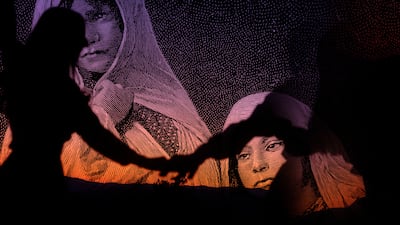

For centuries, One Thousand and One Nights has captivated readers with tales of magic, adventure and survival. But what happens when the women at the heart of these stories are given the chance to tell their own?
This month, TN Magazine introduces The Thousand and First Night, an original work of serialised fiction by author and screenwriter Sara Al Sayegh. Drawing on Arab and Gulf folklore, the series reimagines familiar characters and legends through the lives of women, exploring the stories they inherit, the secrets they keep and the power of storytelling itself.
In the opening chapter, The Healer’s Daughter, we meet Scheherazade not as the storyteller of legend, but as a healer caring for the women of her community and raising her younger sister, Dunyazade. As questions about their parents’ mysterious past begin to surface, an unexpected visitor arrives carrying a message that threatens to change everything.
The Healer's Daughter
The woman moves through her kitchen like a conductor leading an orchestra. Copper pots catch the afternoon light. Glass jars line the shelves – each labelled in careful script. Dried herbs. Crushed petals. Seeds that hold their potency in darkness.
This is Scheherazade’s kitchen. You’d know it by the smell alone.
She grinds cardamom in a brass mortar, the pestle moving in steady circles. The scent rises – warm, ancient, necessary. A woman will come tomorrow with hands that ache. This will help.
On the stove, three separate pots simmer. One holds a deep red liquid – hibiscus and rose hips for a merchant’s wife who can no longer bear children but wants to try. One steams with nettle and ginger for old Mrs Nadira’s joints. The third – the milk, pale gold with saffron and cinnamon – is different. This one is for her sister.
Scheherazade moves between them with the rhythm of prayer, tasting nothing, knowing everything.
A knock at the kitchen door. She doesn’t look up.
“Come in, Amira.”
The girl enters – thin-boned, worried, her veil slipping. She’s been crying. Her eyes are swollen pink, like she’s spent the night awake.
“The pregnancy?” Scheherazade asks.
Amira nods miserably. “Third one. He says if I can’t give him sons …”
“Sit.”
Scheherazade pours the red liquid into a clay cup. The steam carries the scent of possibility. Of hope, measured and careful.
“Drink this every morning,” Scheherazade says. “Before sunrise. For 40 days.”
“Will it work?”
“It will give your body what it needs to carry strength.”
Scheherazade doesn’t promise miracles. She promises honesty. “The rest is in God’s hands. And yours.”
Amira takes the cup like it’s made of glass. “How much do I owe you?”
“Bring me honey next month. The good kind from the mountains.”
When Amira leaves, Scheherazade returns to her pots. She strains the nettle brew through muslin, watching the green liquid darken. Bottles it. Labels it in her precise script. For Nadira – three times daily with food.
She is a healer. This is what healers do.
Dunyazade appears in the kitchen doorway just as the sun begins its descent. She’s 12, maybe 13 – an age of sharp elbows and sharper questions. Her dark hair is tangled and matted. There’s dirt under her fingernails. Her eyes are red, knees scuffed. Scheherazade notices it all. The signs of distress. Chooses to wait.
“You’re late,” Scheherazade says, not unkindly.
“Meera wanted to play house in the courtyard.”
Dunyazade climbs on to the stool by the counter. “I told her you’d set the kitchen on fire if I didn’t come help.”
Scheherazade smiles. She knows her sister is lying. But she continues to wait. She hands the girl a wooden spoon and a small bowl of dried rose petals. “Crush these. Gently. We need them broken, not destroyed.”
Dunyazade concentrates, working the petals between her fingers. “What’s this for?”
“Sleep,” Scheherazade says. “For a woman who can’t find rest.”
“Why can’t she sleep?”
“Her son is at sea. She won’t know if he’s alive until the ships return.”
Dunyazade crushes more carefully now, understanding the weight of what she’s holding. “Will your medicine make her not worry?”
“No.” Scheherazade measures honey into a jar – the good kind, from the mountains, left by Amira last month. “But it will let her sleep while she worries. That’s almost the same thing.”
They work in companionable silence. This is their time. Every evening before sunset, Dunyazade comes to the kitchen and becomes her sister’s apprentice. She learns which herbs heal and which harm. Which plants require moonlight, and which need sun. How to listen to what a woman’s body is trying to tell you.
The spiced milk simmers at the back of the stove. Scheherazade stirs it now – saffron threads unfurling in the cream like golden stories. Cardamom. Cinnamon. A single star anise, whole.
“Is that for me?” Dunyazade asks.
“It is.”
“Why do I get something special?”
Scheherazade doesn’t answer immediately. She finishes the sleep mixture – rose petals, honey and the faintest hint of chamomile – and sets it aside. Only then does she turn to look at her sister fully.
“Because you need something special,” she says finally.
The milk is nearly ready. The spices have bloomed to their full depth. Scheherazade pours it into two clay cups – one for Dunyazade, one for herself – and carries them to the small table in the corner where they sometimes sit.
Dunyazade settles across from her, cradling the cup between her palms. And the story she’s been holding in spills out of her in one breath.
“It happened again. They bullied me. They called our parents traitors … they called me a dirty orphan … they said you were a witch … that you speak to …”
“Drink,” Scheherazade says gently.
“They said our parents worked for …”
“Drink, sister.”
Dunyazade obeys. The milk is warm, fierce with spice, sweeter than anything she’s ever tasted. It settles in her belly like truth.
“Why won’t you tell me?” she asks, her voice small. “Why do I have to hear it from everyone else but you?”
Scheherazade reaches across and takes her sister’s hand. Their fingers are similar – same long bones, same curve to the knuckles.
“Because some stories need to be told at sunset. When the day is closing. When the world grows quiet enough to listen.”
“I’m listening now.”
“Tomorrow,” Scheherazade promises. “Tomorrow at this time, in this kitchen, with this milk. I’ll tell you about our parents. About an orphan street rat named Aladdin and his monkey Abou. About how they became part of something larger than themselves.”
“Why not tonight?”
“Because you deserve the whole story, not just the pieces.” Scheherazade squeezes her hand. “And because tonight, we need to finish Mrs Nadira’s remedy. Because there are women waiting for us to do what only we can do.”
They drink their milk in silence. Outside the kitchen window, the city settles into evening. Lamps are being lit in distant houses. The call to prayer rises from the mosque, beautiful and familiar. Scheherazade’s hands move through their evening work – bottling, labelling, arranging – while her sister watches and learns.
The door creaks open. A small brown shape swings from the rafters and lands on Scheherazade’s shoulder. Abou the monkey chatters, reaching for her ear.
Dunyazade yelps. “What is that?”
“An old friend.” Scheherazade scratches Abou’s chin. “He was there too.”
Abou pulls a folded note from under his fez and presses it into her hand. Scheherazade looks at the seal on it and does not open it. She folds it into her sleeve. Dunyazade notices. “What does it say?”
Dunyazade tries again, but Scheherazade cuts her off. “Tomorrow night, Dunya. I will explain.”


FOLLOW TN MAGAZINE