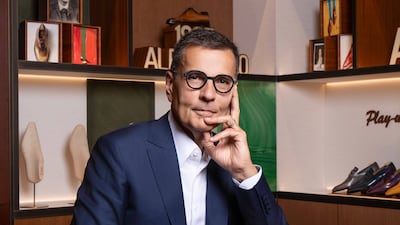

High-end French shoemaker Berluti’s next chapter is being written through subtraction rather than addition, according to chief executive Jean-Marc Mansvelt.
Since taking over in January 2024, he has been sharpening the brand’s focus on fewer, more deliberate products. The ambition, he says, is “focused luxury” – doing less, but doing it better.
“More than ever, people need to understand why you are here, what you do and what you want to do,” he says. “It is about being sincere with what we have been over the decades.”
Despite almost two decades at LVMH and a 40-year career in luxury, Mansvelt admits he knew surprisingly little about Berluti when he arrived.
He spent his first three months travelling, listening and questioning everyone – from workshop employees and store staff to managers, clients and journalists – about their understanding of the brand.

What emerged was a desire not for reinvention, but for clarity. “Nothing was about reinvention,” says Mansvelt. “Nothing was about transformation. It was more about cleaning up the table, making things more articulate and fine-tuning choices.”
His task has been to bring Berluti’s heritage back into focus, something he insists would be impossible without the knowledge and trust of its employees. “Everything is possible on paper, but at the end, nothing is possible without them,” he says.
The approach reflects a broader recalibration across the luxury industry, where consumers increasingly question relentless price increases without corresponding improvements in quality. For Mansvelt, it is an opportunity to rebuild trust.
He recalls a lesson from Yves Carcelle, the former Louis Vuitton chief executive, about the importance of the “moral contract” between a luxury house and its clients. The question is not simply whether something is expensive, but whether its price and value make sense together.
That value, Mansvelt believes, comes from design, craftsmanship and functionality, but also from demonstrating how an object fits into contemporary life.

“When I joined the Berluti family, people were saying formal shoes are over, and a pair of shoes like Alessandro are nice, but a high price and typically for the day of your wedding,” he says.
“We are changing that perspective by showing it can be worn not only with a suit and a tie, but also with a pair of jeans. It’s a different attitude, and there is versatility. That brings value.”
Increasingly, he believes, customers want to understand how something is made, why it exists and whether it will remain relevant beyond a single season.
The Alessandro, one of Berluti’s most recognisable shoes, embodies this philosophy. Created in 1895, the Alessandro's deceptively simple design uses a single piece of leather, with no visible stitching on the upper section and just three rows of eyelets. Behind that simplicity lies considerable technical expertise. “In terms of savoir-faire, when it’s this simple, it’s very hard,” Mansvelt explains.
While its appearance has remained largely unchanged, the shoe’s construction has evolved considerably, incorporating lessons from trainers to improve comfort, lightness and flexibility. “Aesthetically it looks the same,” he says. “But internally it has completely changed.”

One recent version is so supple that it can be folded in half.
The same thinking informs Berluti’s Jour leather goods family. Crafted in the house’s signature Venezia calf leather, newer designs such as the Luti 38 tote and Fly 24h and 72hr travel bags preserve the original DNA while adapting to modern life. Continuity, in other words, need not mean standing still.
That philosophy extends to the lifespan of Berluti’s products. Thanks to a dedicated workshop outside Paris, 97 per cent can be repaired – a figure Mansvelt considers central to the maison’s identity. “This has been anchored in Berluti for years, and not just today because it’s trendy,” he says. The figure, he adds, “shows this is not something new for us”.
On one of his first visits to the workshop, Mansvelt encountered a particularly battered pair of shoes. Inside the box was a handwritten letter from their owner, pleading with the craftspeople to “save my friends”.
During a recent fashion week presentation, Berluti displayed similar letters, offering a glimpse into the emotional relationships clients develop with their possessions.
For Mansvelt, these stories illustrate how an object can accumulate memories, become part of someone’s personal history and ultimately be given another life. “That is the true mark of luxury,” he says.

The emphasis on craft over spectacle also helps explain Berluti’s decision to step away from the traditional fashion calendar.
The move predates Mansvelt. In 2021, after appointing three artistic directors in a decade – Alessandro Sartori from 2011 to 2016, Haider Ackermann from 2016 to 2018 and Kris Van Assche from 2018 to 2021 – the maison abandoned the model. With results falling short of expectations, successive creative changes risked confusing clients about the brand’s direction.
Today, Berluti operates through three studios, each dedicated to a specific metier: shoemaking (souliers), tailoring (tailleur) and leathercraft (maroquinerie).
Mansvelt does not rule out appointing another artistic director to unite these disciplines, but finding the right person will be crucial. Whoever takes the role must put the maison “over everything, even his ego”, he says.
Another part of Berluti’s identity that Mansvelt wants to restore is its dual heritage. Founded in France by an Italian, the house draws on the traditions and savoir-faire of both countries.
Yet it is a story that Mansvelt believes the brand has not always communicated effectively. “It was lost a little bit,” he says.

As we speak, he gestures towards a mannequin wearing a bomber jacket made from exceptionally soft crocodile leather. The piece is not for sale. Its purpose is simply to demonstrate what Berluti’s craftspeople can achieve. “Berluti is not transactional; it’s conversational,” he explains.
He describes stores where clients spend an hour or two drinking coffee, reading the newspaper or chatting with staff, with shopping almost an afterthought.
In a luxury market increasingly preoccupied with visibility and status, Mansvelt sees an opportunity to offer something different: a house where craftsmanship inspires curiosity, products are designed to last, and relationships matter as much as transactions.
For Berluti, the future may depend less on becoming something new than on reminding people what made it special in the first place.


FOLLOW TN MAGAZINE