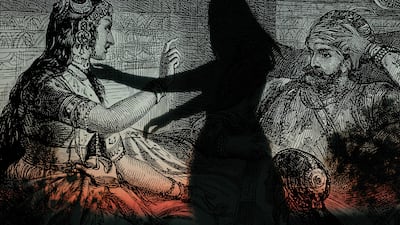

The story continues in The Thousand and First Night, Sara Al Sayegh’s reimagining of Arab folklore through the eyes of its women. In Aladdin and Princess Budoor, a desperate plea from the palace forces Scheherazade to confront old secrets, a mysterious jinni and a tragedy that changed her life.
Aladdin and Princess Budoor
Dunyazade crosses her arms firmly. “No. Tonight! You will tell me the story tonight.
Why do you always have to hide everything from me!”
Scheherazade sighs, exasperated and exhausted from the day’s work. But she can see she won’t get Dunyazade to concede completely tonight. She decides.
“Get into bed and I will tell you a story. Not the whole one you want to hear, but the beginning. Or maybe the middle, now that I think about it.”
Dunyazade beams with excitement. She races through her bedtime routine – washes her face, changes her clothes. Forgets to brush her teeth. Scheherazade knows without looking.
“Teeth, young lady! I have no remedies to grow back teeth that fall out!”
Dunyazade sheepishly returns to their makeshift bathroom and brushes her teeth, then races to their shared bed. She makes herself comfortable, and Scheherazade joins her, snuggling down next to her little sister.
“Once upon a time, in a place neither here nor there, there was an orphan street rat named Aladdin, a monkey named Abou and a princess called Budoor – whose destinies were bound to one another …”
Dunyazade listens, enraptured.
By the tail end of the story, her eyes are heavy, her breathing slowing. Scheherazade finishes: “Princess Budoor and Aladdin – now Prince Ali – were married, with all the blessings and joy of the kingdom. And for his final wish, Prince Ali freed the jinni from the lamp. They all lived happily, ever after …”
Dunyazade mutters, almost asleep, “Even the Wazir? He tried to hurt the princess and Aladdin. Why didn’t the Sultan arrest him? Why does he get to live happily ever after …”
Scheherazade smiles at her sister’s astute observation. “Because, my Dunya, some people choose to believe a lie. Because if they don’t, it means admitting they were wrong.”
Dunyazade frowns but loses her battle to sleep. Scheherazade plants a soft kiss on her forehead, then untangles herself and returns to her kitchen.
She sits at the table and takes out the note from Abou. Worry lines crease her forehead as she reads:
“Princess Budoor’s pregnancy is at risk. We need you in the palace. Please.”
Signed, Aladdin.
The next morning, Scheherazade is up and working before Dunyazade has risen. Dunyazade wakes to soft murmurs from the kitchen. She peers in, watching and listening.
Scheherazade holds Mrs Fatima’s hands, listening sympathetically. Mrs Fatima’s eyes are bloodshot, her veil and dress crumpled as if she rolled straight out of bed and into Scheherazade’s kitchen. Her hair is greyer from worry than from age.
She whimpers: “He just can’t sit still. Can’t stay in one place for any time. It’s like he’s bound to the sea. And I must suffer – waiting, always waiting, wondering if he’ll come back alive. He’s my only son. My only child. I wish I could make him stop leaving.”
Scheherazade stands to retrieve her prescription and hands it over. “It is our fate as women,” she says, “to worry and wait for the men we love. While they pursue the things they love.”
She says it to the shelves, not to Mrs Fatima’s face, and something in her jaw tightens around the words. “The sea is Sinbad’s kayan. He cannot be separated from it. This will help you sleep. Until he returns, God willing.”
Dunyazade’s eyes widen at the mention of Sinbad. Mrs Fatima looks dejected. But then her head snaps up. Hopeful. “But couldn’t you make something for me – to give to him – to sever his tie?”
Scheherazade chuckles. “I could make Sinbad seasick for all eternity. And he would still get on that ship.”
Mrs Fatima sighs, retrieves a few gold coins from her purse, thanks Scheherazade, and leaves with her prescription.
Without turning, Scheherazade calls out, “If you’re going to keep eavesdropping on me, you’re going to be very late for school!”
Dunyazade scuttles away before she can be chastised further.
The house empties. The morning folds back into its ordinary rhythm – the scrape of the pestle, the low mutter of the pots. For a moment, Scheherazade lets herself not think about the note folded into her sleeve.
A knock at the kitchen door.
“Come in,” she says, not looking up.
A woman enters. Veiled, stooped, one hand pressed to her side as though holding something in. “Forgive me,” she says. “I’ve come a long way. They told me the healer here turns no one away.”
“They told you right. Sit.”
Scheherazade reaches for a clean cup – and stops. The saffron milk she’d left warming has gone still. Not cooling.
Still.
No steam rises from it, though the flame beneath it burns. She glances at the woman’s shadow on the floor and finds it falling towards the window, towards the light, where it has no business falling.
“What ails you?” Scheherazade asks, carefully now.
“An old debt,” the woman says. “A promise made to a man I once served. He asked me to find someone. A healer, with clever hands and a mother’s teaching in them.”
The scent should have arrived by now. Every visitor brings one – sweat, dust, the market on their clothes. This woman smells of nothing.
Scheherazade sets down the cup. She looks, at last, at where the woman’s feet should meet the floor.
They do not. A hand’s width of morning air hangs between the hem of her robe and the ground.
Scheherazade does not scream. She has told this story too many times to scream at it. “Last night,” she says slowly, “I promised my sister I’d finish a tale. It ended with a freed jinni.”
The woman smiles – and the smile is wrong. Too wide. Too old. “Endings are doors, healer. You opened one.”
The voice has shed its borrowed softness. “He kept his final wish. He set me loose in the world. And a loosed thing goes where it is called. Your name is being called.”
“By whom?”
“By the one who signed your note. The princess is dying and the palace that cast you out will not open its gates to you.”
The jinni extends a hand that casts no shadow. “But I am not bound by their gates. I can put you where you need to be. Whether you go is yours to choose. It always was.”
Scheherazade thinks of a newborn who did not breathe. Of the last royal child she was ever summoned to save. Then she thinks of Dunyazade asleep in the next room, of the lie the whole city believes, of a man who trimmed roses for a living and died for one.
She unties her apron.
The garden is not as she remembers it. And it is exactly as she remembers it.
Roses gone wild along a wall her father built with his own hands. Jasmine climbing where he once trained it – a decade untended and thriving anyway. The air is thick with a green she has not let herself breathe in 13 years.
A woman waits among the overgrowth. Young, richly dressed, one hand resting on the swell of her belly. Her face turns, and Scheherazade knows her. She is certain of it, for the space of a breath – the way you know a face in a dream, and wake, and lose it.
“You’re the healer,” Princess Budoor says.
“I am.”
They stand a moment. Two strangers in a dead man’s garden. “Thank you for coming,” the princess says. “I was afraid no one would.”
Scheherazade steps closer, into the shade of her father’s trees, and does the only thing she has ever truly known how to do.
“Tell me where it hurts,” she says.


FOLLOW TN MAGAZINE