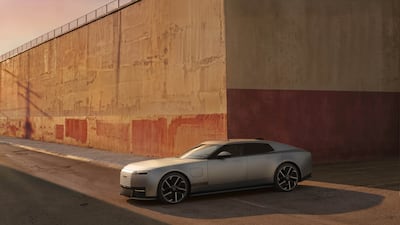

Rawdon Glover is unequivocal. “Jaguar is back,” proclaims the managing director of the British car maker, speaking about its new all-electric Type 01. “It feels surreal to finally be in here [at this point] and we’re very keen to get the car out and see what the reaction is. I’m often reminded of the magnitude of feeling for the brand.”
It’s a magnitude that generates some strong opinions. When Jaguar unveiled its Type 00 concept car two years ago, the reaction was divided, to say the least. Critics said it showed Jaguar had abandoned its heritage and classic styling cues in favour of something more akin to a minimalist spaceship. And the critics were dismissed as out-of-touch traditionalists.
There was even more confusion around Jaguar’s rebranding: the car was pink; the promotional material populated by a very cosmopolitan bunch with bold haircuts and a sci-fi style of dress. It was, in short, not very “middle-aged, middle-class white guy in a country pub”, Jaguar’s long-time homeland.

That was the point: Jag Man is dying out. “Our new customer is more likely to be younger, more urban, wealthier, interested in design, but have a unifying mindset of wanting the kind of brands that not everyone else has,” says Glover. “They are after individuality.”
And, to drive that point home, what people cannot fail to notice is that Jaguar has pushed on with its new look regardless of the heat it received. If production cars tend to differ, often quite dramatically – and disappointingly – from the concept cars that inspire them, the similarity between the Type 01 and the Type 00 is clear, even if the 01 was all but finished before the 00 was unveiled as an extreme take on it.
Indeed, according to Carlee Hardacre, Jaguar’s global head of marketing, the Type 01 shows the company is effectively preparing to shed part of its historic customer base with the aim of winning a new one – by, counter-intuitively perhaps, doubling down on divisiveness with a GT car design it knows many people will hate, but that enough will love. That pushes Jaguar into more of a low-volume, high-price strategy – the Type 01 will start at about £130,000 ($174,250) – a turnaround on its prior high-volume positioning that, arguably, aimed to please too many people with vehicles that also felt too much like the competition’s.

But perhaps more importantly, the Type 01, which has been six years in the making, also returns Jaguar to the design ethos of its more golden years, Hardacre says. “When the E-Type was launched [65 years ago this year], some said it was the worst car they had ever seen. And Enzo Ferrari said it was the most beautiful,” she says. “It’s important to us that some people don’t like the Type 01. We decided that the worst thing would be to make a car that everyone thinks is all right but nobody really wants to buy.”
Focus group testing only underscored the divide. Before production began, Jaguar asked about 5,000 potential customers around the world – its most extensive run of clinics, as the car industry calls them – to give their reaction to the Type 01, scoring it from one (cannot stand it) to 10 (must have it). Hardacre sounds pleased with the fact that the car scored the greatest number of ones in Jaguar’s history of such surveys, but also the greatest number of 10s.
“Once you move beyond commodity pricing then anything you buy becomes about want, and not about need. That realisation came to the design team [behind the Type 01] very early,” says Glover. “Deciding to make it an electric vehicle was secondary. First of all, it had to be a Jaguar [of the old school].”

There is, he adds, a lot of “homogeneous design” in the automotive industry right now, with electric cars especially following a “very cookie-cutter shape. I think we’re starting to see an approach with luxury brands that cuts through that”.
Shape is an example of the many engineering feats that have gone into the Type 01, leading to about 360 new patent applications. They are feats that, sadly, are all too easy to overlook, even when you know the Type 01, with more than 1,000 hp, is Jaguar’s fastest and most aerodynamic car to date. Indeed, the company says that, early in the development of the Type 01, it had a profile in mind and was determined that engineering would have to find workarounds to make that profile possible.
So, for example, many electric vehicles tend to follow a boxy form — because the battery cells are centred under the cabin, in part to keep them away from crash zones — but the Type 01 puts a sixth of them at the front of the car. This helps to give it much better balance – 50/50 front/rear, the company claims – and extends its range. But it also allows for a sleek, low roofline and more legroom in the back. Yet achieving this required the development of an industry-first structural design Jaguar calls the Tri-Apex Node, capable of absorbing and stopping 26 tonnes of force in a head-on collision.
“From an engineering point of view, putting battery cells towards the front of a car is a bit crazy,” says Thomas Muller, Jaguar’s chief technology officer. “Of course, it’s never the case that your first attempt [at a solution] works. There’s a lot of time spent standing in front of a whiteboard.”

There is also the pressure of getting a new model to market as planned. “Delivering a car to the schedule is important, but if you’re spending a week longer on some aspect when you’re deciding on the future of the brand, it’s worth it,” he adds.
It’s Muller’s team that has also developed a suspension system that allows the Type 01’s giant 23-inch wheels sufficient travel up and down, while still fitting snugly within the wheel arches. The team is also behind what the company is calling the “impossible panel”, a one-piece rear quarter panel that brings together four planes and which Jaguar’s design simulation software told them couldn’t be done. After 1,500 hours of tooling, the resulting seamless piece helps create the Type 01’s sense of the monolithic, as though the car was carved out of a single block of aluminium with brutalist intent.
This, of course, is where the rubber really hits the road when it comes to divided opinion: in the look of the Type 01. From the super-slim wraparound headlights setting off a short overhang at the front, to the windowless rear where instead there’s a bold, grille-like “strike through” graphic arrangement into which a wraparound, Tron-like taillight is embedded, there’s little doubt that the car is unmistakable from either end.
There are shades of the Rolls-Royce Phantom, of Tesla’s equally divisive Cybertruck, of the industrial form-follows-function of a Rimowa suitcase, but with much bigger wheels. Inside there’s a complete lack of leather and mahogany – it’s all organic forms covered seamlessly in a super-light, super-tough laminate textile called Ultra Fabric, and the seats are individually sculpted like pieces of space-age furniture. There is, at least, some carpet – covering not just the floor but continuing up into the lower quarter of each door. The Type 01 is, in a sense, a design object before it’s a car. Perhaps this is even a car for people who aren’t even that into cars – but are into their chairs, lamps, phones and trainers.

“Reimagining Jaguar from a blank sheet of paper was part of the process with the Type 01. We wanted the result to feel very fresh and modern,” says Alexey Andreev, lead exterior designer for Jaguar. “It follows quite a reductive design philosophy, with every line following a certain visual logic that sets it in a certain place that will still make sense 30 years from now. The thing is that a lot of this kind of thing is easy to do on a concept car, and not so easy on a production car.”
Andreev reckons that even if the initial reaction is uncertainty – and so soon after the Type 01’s launch, the jury is still out – more people will warm to the model when they see it on the road. But he adds that, from his perspective, it is no bad thing for people to feel “a little bit uncomfortable” when they see something for the first time. “It suggests that’s because it’s something they haven’t seen before,” he says. “And, ask yourself, have you ever seen a car like this before?”
The answer is no – and, by breaking the monotony of so much car design, it will either push Jaguar back into the sunlit uplands or, as some industry commentators have feared, mark its final farewell. Glover says that he can’t do anything “about tariffs or the Chinese [car makers]. I can only focus on the stuff I can control and do what I can to help Jaguar”. Then he adds that tagline again: “Jaguar is back.”


FOLLOW TN MAGAZINE